Centre for Immune Regulation, Institute of Immunology, University of Oslo and Oslo University Hospital Oslo, Norway.
Front Oncol. 2012 Oct 30;2:154. doi: 10.3389/fonc.2012.00154. eCollection 2012.
Idiotypes (Id) are antigenic determinants localized in variable (V) regions of Ig. Id-specific T and B cells (antibodies) play a role in immunotherapy of Id(+) tumors. However, vaccine strategies that enhance Id-specific responses are needed.
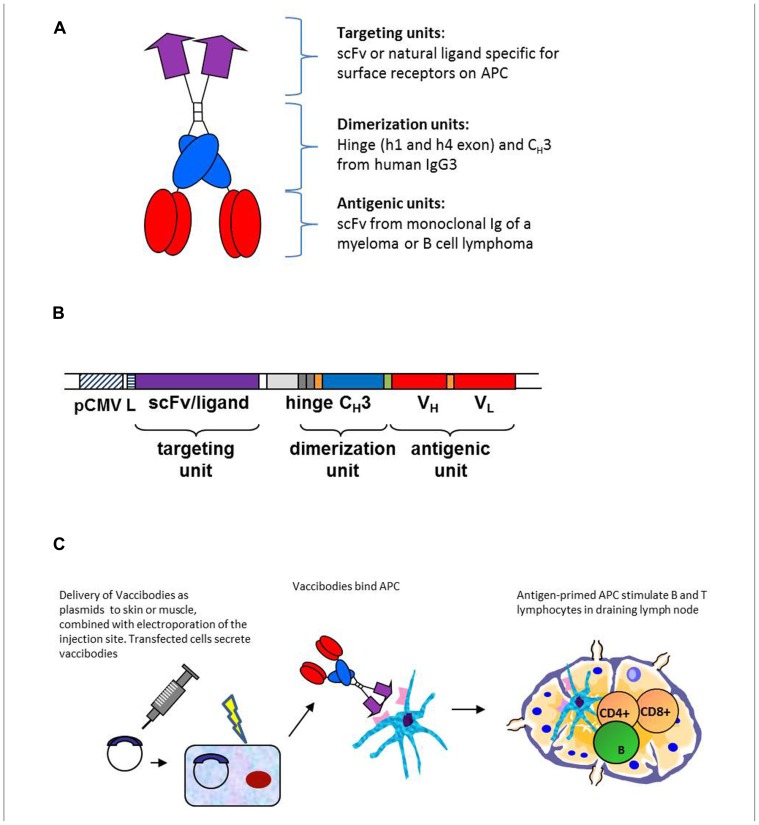
Id(+) single-chain fragment variable (scFv) from multiple myelomas and B cell lymphomas were prepared in a fusion format that bivalently target surface molecules on antigen-presenting cells (APC). APC-specific targeting units were either scFv from APC-specific mAb (anti-MHC II, anti-CD40) or chemokines (MIP-1α, RANTES). Homodimeric Id-vaccines were injected intramuscularly or intradermally as plasmids in mice, combined with electroporation.
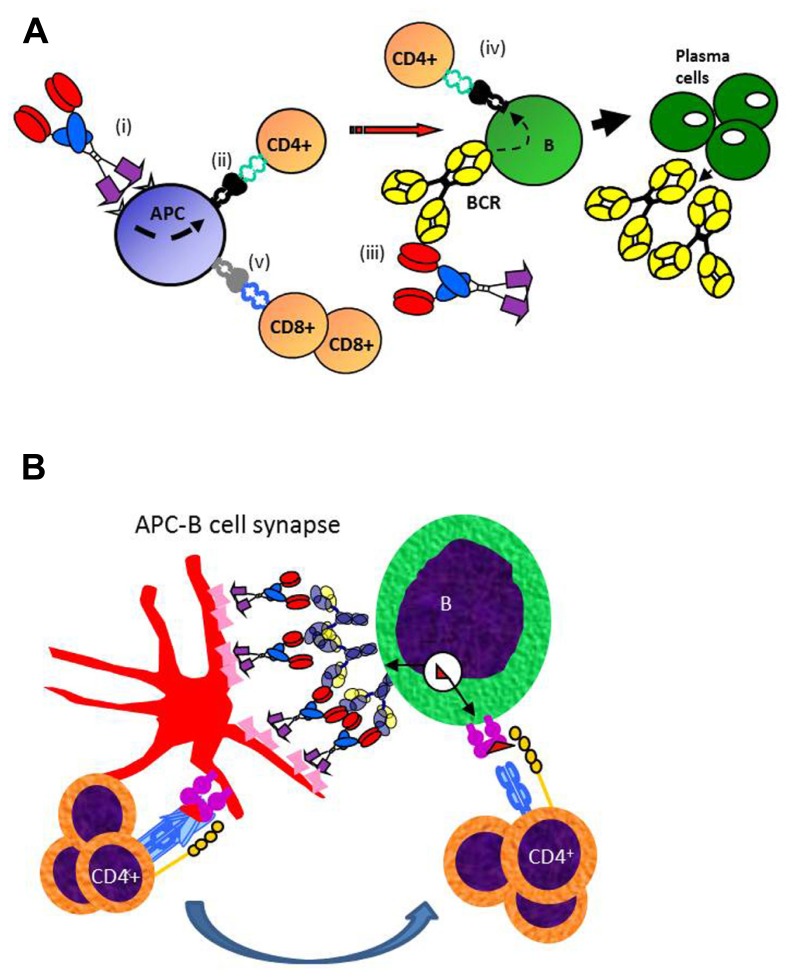
(i) Transfected cells secreted plasmid-encoded Id(+) fusion proteins to extracellular fluid followed by binding of vaccine molecules to APC. (ii) Targeted vaccine molecules increased Id-specific B and T cell responses. (iii) Bivalency and xenogeneic sequences both contributed to enhanced responses. (iv) Targeted Id DNA vaccines induced tumor resistance against challenges with Id(+) tumors. (v) Human MIP-1α targeting units enhanced Id-specific responses in mice, due to a cross reaction with murine chemokine receptors. Thus, targeted vaccines designed for humans can be quality tested in mice. (vi) Human Id(+) scFv from four multiple myeloma patients were inserted into the vaccine format and were successfully tested in mice. (vii) Human MIP-1α vaccine proteins enhanced human T cell responses in vitro. (viii) A hypothetical model for how the APC-targeted vaccine molecules enhance Id-specific T and B cells is presented.
Targeted DNA Id-vaccines show promising results in preclinical studies, paving the way for testing in patients.
独特型(Id)是位于免疫球蛋白可变(V)区的抗原决定簇。Id 特异性 T 和 B 细胞(抗体)在 Id(+)肿瘤的免疫治疗中发挥作用。然而,需要增强 Id 特异性反应的疫苗策略。
从多发性骨髓瘤和 B 细胞淋巴瘤中制备了 Id(+)单链片段可变(scFv),以融合形式靶向抗原呈递细胞(APC)表面分子。APC 特异性靶向单位是 APC 特异性 mAb(抗 MHC II、抗 CD40)或趋化因子(MIP-1α、RANTES)的 scFv。同种二聚体 Id 疫苗作为质粒肌内或皮内注射到小鼠中,结合电穿孔。
(i)转染细胞将质粒编码的 Id(+)融合蛋白分泌到细胞外液中,然后疫苗分子与 APC 结合。(ii)靶向疫苗分子增加了 Id 特异性 B 和 T 细胞反应。(iii)二价和异种序列都有助于增强反应。(iv)靶向 Id DNA 疫苗诱导肿瘤抵抗 Id(+)肿瘤的挑战。(v)靶向人类 MIP-1α 的疫苗单位增强了小鼠的 Id 特异性反应,这是由于与小鼠趋化因子受体的交叉反应。因此,设计用于人类的靶向疫苗可以在小鼠中进行质量测试。(vi)将来自四名多发性骨髓瘤患者的人类 Id(+) scFv 插入疫苗格式并在小鼠中成功测试。(vii)人类 MIP-1α 疫苗蛋白增强了体外人类 T 细胞反应。(viii)提出了一种关于 APC 靶向疫苗分子如何增强 Id 特异性 T 和 B 细胞的假设模型。
靶向 DNA Id 疫苗在临床前研究中显示出有希望的结果,为患者测试铺平了道路。