Doyle Matthew S, Collins Emily S, FitzGerald Oliver M, Pennington Stephen R
Arthritis Res Ther. 2012 Oct 31;14(5):226. doi: 10.1186/ar4071.
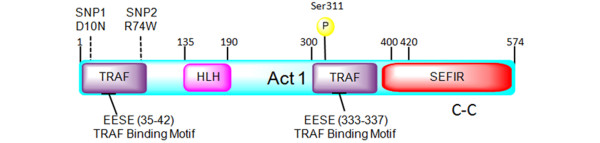
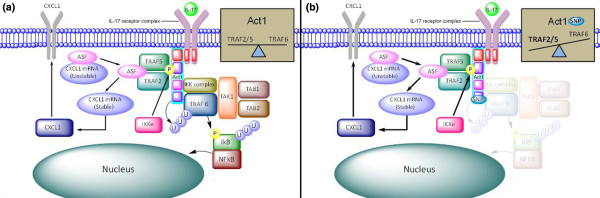
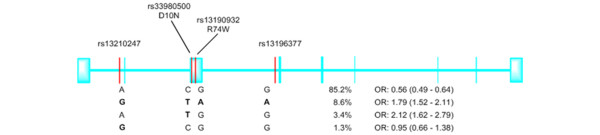
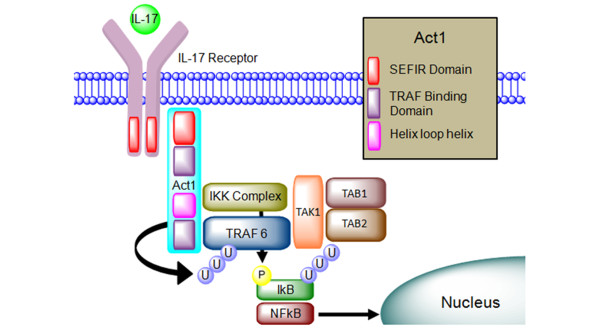
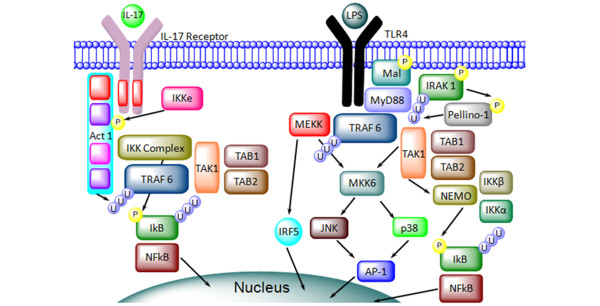
Recent genome-wide association studies have implicated the tumor necrosis factor receptor-associated factor 3-interacting protein 2 (TRAF3IP2) gene and its product, nuclear factor-kappa-B activator 1 (Act1), in the development of psoriatic arthritis (PsA). The high level of sequence homology of the TRAF3IP2 (Act1) gene across the animal kingdom and the presence of the Act1 protein in multiple cell types strongly suggest that the protein is of importance in normal cellular function. Act1 is an adaptor protein for the interleukin-17 (IL-17) receptor, and recent observations have highlighted the significance of IL-17 signaling and localized inflammation in autoimmune diseases. This review summarizes data from recent genome-wide association studies as well as immunological and molecular investigations of Act1. Together, these studies provide new insight into the role of IL-17 signaling in PsA. It is well established that IL-17 activation of tumor necrosis factor receptor-associated factor 6 (TRAF6) signaling pathways normally leads to nuclear factor-kappa-B-mediated inflammation. However, the dominant PsA-associated TRAF3IP2 (Act1) gene single-nucleotide polymorphism (rs33980500) results in decreased binding of Act1 to TRAF6. This key mutation in Act1 could lead to a greater association of the IL-17 receptor with TRAF2/TRAF5 and this in turn suggests an alternative function for IL-17 in PsA. The recent observations described and discussed in this review raise the clinically significant possibility of redefining the immunological role of IL-17 in PsA and provide a basis for defining future studies to elucidate the molecular and cellular functions of Act1.
近期全基因组关联研究表明,肿瘤坏死因子受体相关因子3相互作用蛋白2(TRAF3IP2)基因及其产物核因子-κB激活因子1(Act1)与银屑病关节炎(PsA)的发病机制有关。TRAF3IP2(Act1)基因在动物界具有高度的序列同源性,且Act1蛋白存在于多种细胞类型中,这强烈表明该蛋白在正常细胞功能中具有重要作用。Act1是白细胞介素17(IL-17)受体的衔接蛋白,最近的研究发现突出了IL-17信号传导和局部炎症在自身免疫性疾病中的重要性。本综述总结了近期全基因组关联研究以及Act1的免疫学和分子研究数据。这些研究共同为IL-17信号传导在PsA中的作用提供了新的见解。众所周知,肿瘤坏死因子受体相关因子6(TRAF6)信号通路的IL-17激活通常会导致核因子-κB介导的炎症。然而,与PsA相关的主要TRAF3IP2(Act1)基因单核苷酸多态性(rs33980500)导致Act1与TRAF6的结合减少。Act1中的这一关键突变可能导致IL-17受体与TRAF2/TRAF5的关联增加,这反过来提示了IL-17在PsA中的另一种功能。本综述中描述和讨论的最新研究发现提出了重新定义IL-17在PsA中的免疫作用这一具有临床意义的可能性,并为确定未来研究以阐明Act1的分子和细胞功能提供了基础。