Department of Urology, Yokohama City University Graduate School of Medicine, Yokohama, Kanagawa, Japan.
PLoS One. 2012;7(10):e48186. doi: 10.1371/journal.pone.0048186. Epub 2012 Oct 30.
For patients with metastatic castration-resistant prostatic cancer (mCRPC), docetaxel plus prednisone leads to superior survival and a higher response rate compared with mitoxantrone plus prednisone. We analyzed the efficacy of long-term treatment with ≥10 cycles of docetaxel, and validated the risk group classification in predicting overall survival (OS) in Japanese patients with mCRPC.
Fifty-two patients with mCRPC were administered 55 mg/m(2) docetaxel and 8 mg dexamethasone, every 3 or 4 weeks, simultaneously with hormonal therapy and daily oral dexamethasone. They were divided into two groups, short-term (9 or fewer cycles) and long-term (10 or more cycles). Four risk factors including the presence of anemia, bone metastases, significant pain and visceral metastases were utilized for the risk group classification.
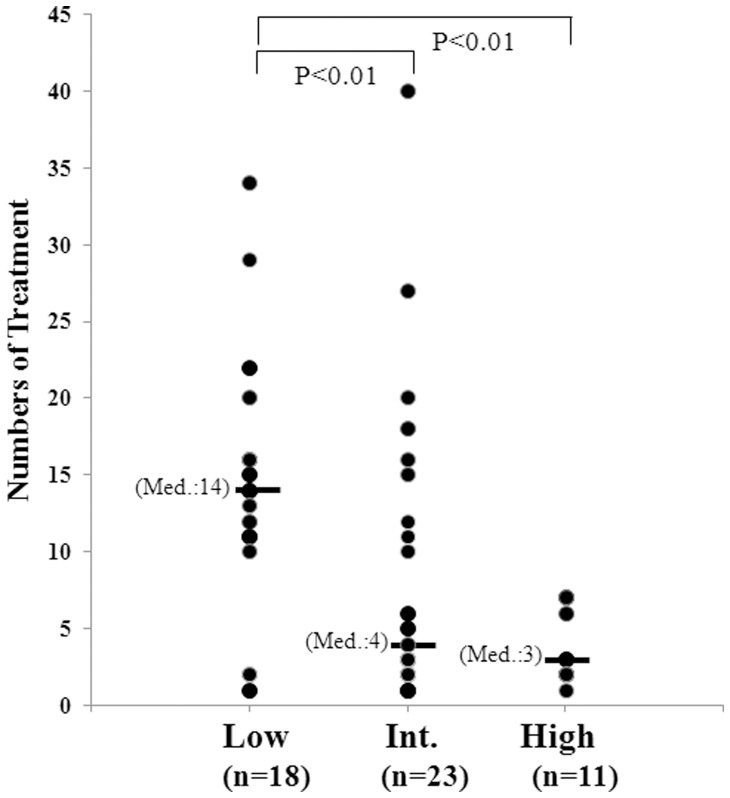
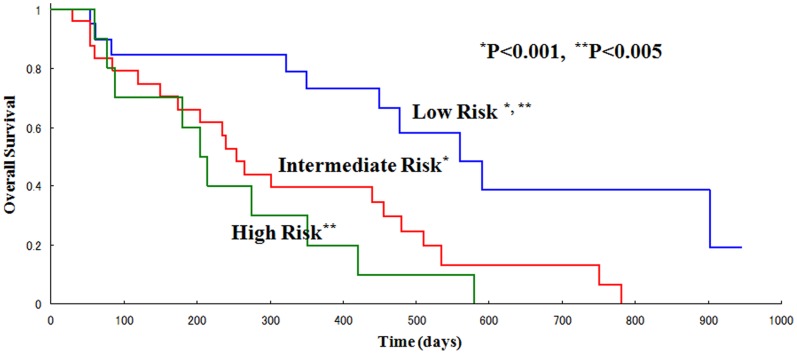
Fourteen patients (27%) had an elevation of PSA in spite of docetaxel treatment, while 23 patients (44%) had a decline in PSA level, including 9 patients (17%) whose PSA level declined by ≥50%. The median duration of OS after the initiation of this therapy was 11.2 months in the short-term group and 28.5 months in the long-term group. The good risk group showed a significant difference in OS compared with the intermediate and poor risk groups (P<0.001). The median number of cycles of treatment was 14, 4 and 3 for each risk group, respectively (p<0.01).
The present study indicated that ≥10 cycles of this docetaxel therapy can significantly prolong survival in Japanese men with CRPC. This risk group classification for men with mCRPC at the initiation of this chemotherapy is useful.
对于转移性去势抵抗性前列腺癌(mCRPC)患者,与米托蒽醌联合泼尼松相比,多西他赛联合泼尼松可显著提高患者的总生存期(OS)和缓解率。我们分析了接受≥10 个周期多西他赛治疗的患者的疗效,并验证了风险组分类在预测日本 mCRPC 患者 OS 中的作用。
52 例 mCRPC 患者接受多西他赛 55mg/m²和 8mg 地塞米松,每 3 或 4 周一次,同时给予激素治疗和每日口服地塞米松。患者分为短期(<9 个周期)和长期(≥10 个周期)两组。利用贫血、骨转移、明显疼痛和内脏转移 4 个危险因素进行风险组分类。
14 例(27%)患者在多西他赛治疗期间 PSA 升高,23 例(44%)患者 PSA 水平下降,其中 9 例(17%)患者 PSA 水平下降≥50%。短期组和长期组的中位 OS 分别为 11.2 个月和 28.5 个月。良好风险组与中危和高危组的 OS 差异有统计学意义(P<0.001)。每组的中位治疗周期数分别为 14、4 和 3 个周期(p<0.01)。
本研究表明,对于 CRPC 男性患者,≥10 个周期的多西他赛治疗可显著延长其生存时间。该化疗起始时用于 mCRPC 患者的风险组分类具有一定的临床价值。