Influenza Division, Centers for Disease Control and Prevention, Atlanta, Georgia, USA.
PLoS One. 2012;7(10):e48187. doi: 10.1371/journal.pone.0048187. Epub 2012 Oct 31.
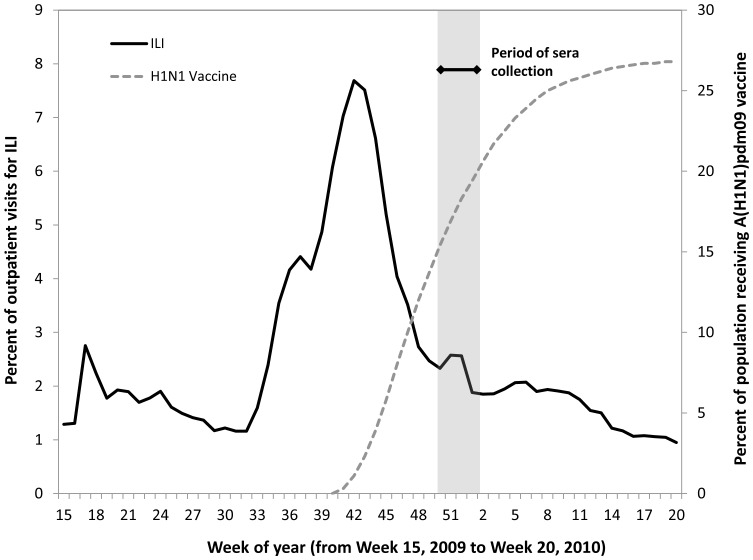
2009 pandemic influenza A/H1N1 (A(H1N1)pdm09) was first detected in the United States in April 2009 and resulted in a global pandemic. We conducted a serologic survey to estimate the cumulative incidence of A(H1N1)pdm09 through the end of 2009 when pandemic activity had waned in the United States.
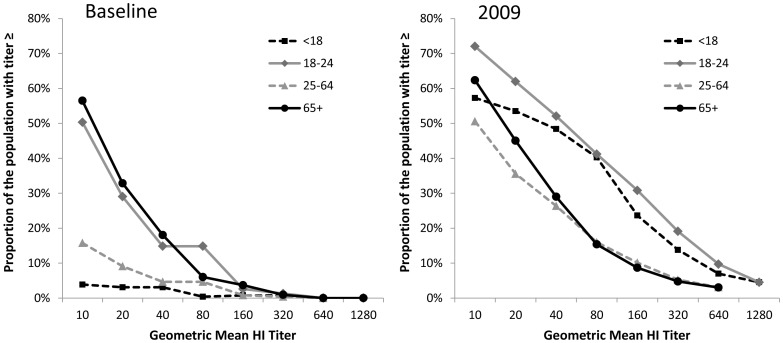
We conducted a pair of cross sectional serologic surveys before and after the spring/fall waves of the pandemic for evidence of seropositivity (titer ≥40) using the hemagglutination inhibition (HI) assay. We tested a baseline sample of 1,142 serum specimens from the 2007-2008 National Health and Nutrition Examination Survey (NHANES), and 2,759 serum specimens submitted for routine screening to clinical diagnostic laboratories from ten representative sites.
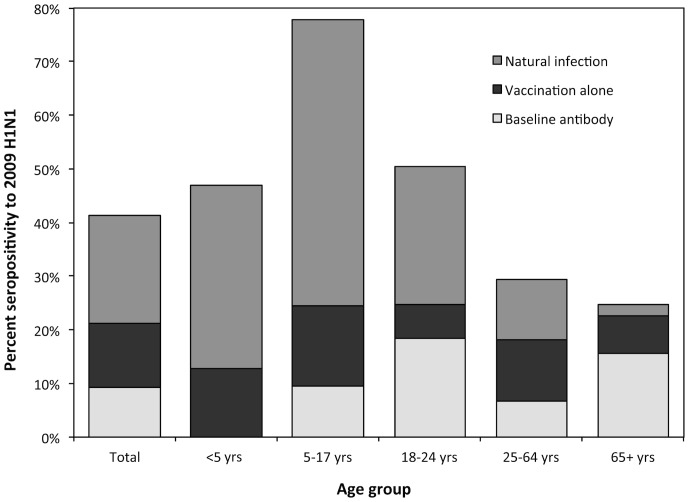
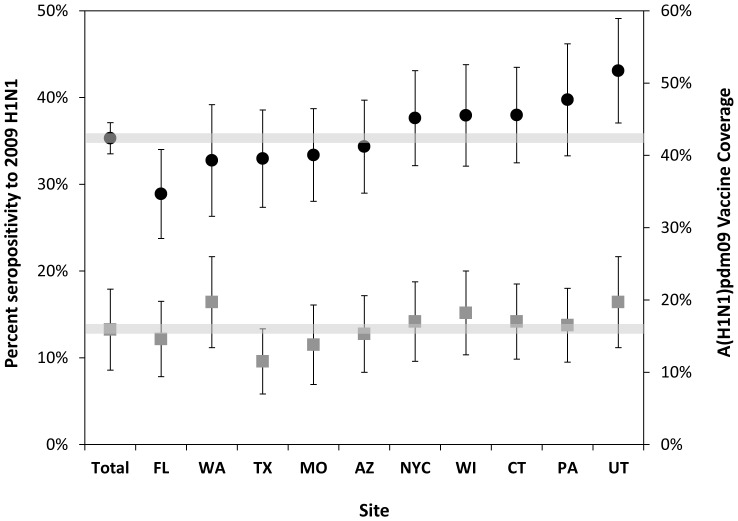
The age-adjusted prevalence of seropositivity to A(H1N1)pdm09 by year-end 2009 was 36.9% (95%CI: 31.7-42.2%). After adjusting for baseline cross-reactive antibody, pandemic vaccination coverage and the sensitivity/specificity of the HI assay, we estimate that 20.2% (95%CI: 10.1-28.3%) of the population was infected with A(H1N1)pdm09 by December 2009, including 53.3% (95%CI: 39.0-67.1%) of children aged 5-17 years.
By December 2009, approximately one-fifth of the US population, or 61.9 million persons, may have been infected with A(H1N1)pdm09, including around half of school-aged children.
2009 年甲型 H1N1 流感(A(H1N1)pdm09)于 2009 年 4 月首次在美国被发现,导致了一场全球大流行。我们进行了一项血清学调查,以估计到 2009 年底大流行活动在美国减弱时 A(H1N1)pdm09 的累积发病率。
我们在大流行的春季/秋季浪潮前后进行了两项横断面血清学调查,使用血凝抑制(HI)测定法检测血清阳性(滴度≥40)的证据。我们测试了 2007-2008 年全国健康和营养检查调查(NHANES)的 1142 份血清标本的基线样本,以及来自 10 个代表性地点的常规筛选提交给临床诊断实验室的 2759 份血清标本。
到 2009 年底,按年龄调整的 A(H1N1)pdm09 血清阳性率为 36.9%(95%CI:31.7-42.2%)。在调整了基线交叉反应性抗体、大流行疫苗接种覆盖率以及 HI 测定法的灵敏度/特异性后,我们估计到 2009 年 12 月,A(H1N1)pdm09 感染人口占总人口的 20.2%(95%CI:10.1-28.3%),其中包括 5-17 岁儿童的 53.3%(95%CI:39.0-67.1%)。
到 2009 年 12 月,约五分之一的美国人口,即 6190 万人,可能感染了 A(H1N1)pdm09,其中包括大约一半的学龄儿童。