Immunisation, Hepatitis and Blood Safety Department, Health Protection Agency, London, United Kingdom.
PLoS One. 2011 Feb 23;6(2):e17074. doi: 10.1371/journal.pone.0017074.
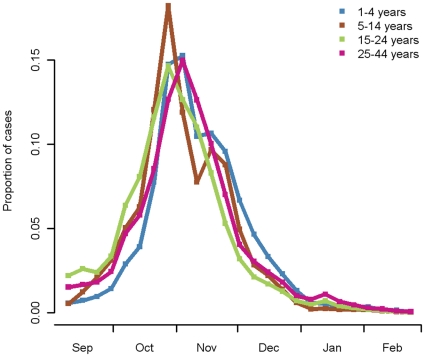
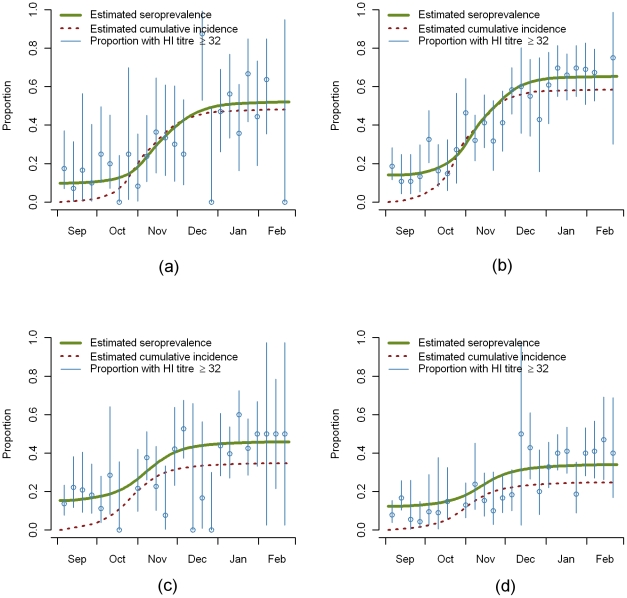
Estimating the age-specific incidence of an emerging pathogen is essential for understanding its severity and transmission dynamics. This paper describes a statistical method that uses likelihoods to estimate incidence from sequential serological data. The method requires information on seroconversion intervals and allows integration of information on the temporal distribution of cases from clinical surveillance. Among a family of candidate incidences, a likelihood function is derived by reconstructing the change in seroprevalence from seroconversion following infection and comparing it with the observed sequence of positivity among the samples. This method is applied to derive the cumulative and weekly incidence of A/H1N1 pandemic influenza in England during the second wave using sera taken between September 2009 and February 2010 in four age groups (1-4, 5-14, 15-24, 25-44 years). The highest cumulative incidence was in 5-14 year olds (59%, 95% credible interval (CI): 52%, 68%) followed by 1-4 year olds (49%, 95% CI: 38%, 61%), rates 20 and 40 times higher respectively than estimated from clinical surveillance. The method provides a more accurate and continuous measure of incidence than achieved by comparing prevalence in samples grouped by time period.
估算新出现病原体的特定年龄发病率对于了解其严重程度和传播动力学至关重要。本文描述了一种使用似然来从连续血清学数据估算发病率的统计方法。该方法需要有关血清转化率间隔的信息,并允许整合来自临床监测的病例时间分布信息。在候选发病率的一系列中,通过从感染后的血清转化中重建血清阳性率的变化,并将其与样本中观察到的阳性序列进行比较,得出似然函数。该方法应用于使用 2009 年 9 月至 2010 年 2 月之间在四个年龄组(1-4、5-14、15-24 和 25-44 岁)中采集的血清,推导出英格兰在第二波期间 A/H1N1 大流行性流感的累积和每周发病率。5-14 岁儿童的累积发病率最高(59%,95%可信区间[CI]:52%,68%),其次是 1-4 岁儿童(49%,95%CI:38%,61%),分别比临床监测估计的发病率高 20 倍和 40 倍。与按时间段分组的样本中比较流行率相比,该方法提供了更准确和连续的发病率衡量标准。