• 文献检索
  • 文档翻译
  • 深度研究
  • 学术资讯
  • Suppr Zotero 插件Zotero 插件
  • 邀请有礼
  • 套餐&价格
  • 历史记录
应用&插件
Suppr Zotero 插件Zotero 插件浏览器插件Mac 客户端Windows 客户端微信小程序
定价
高级版会员购买积分包购买API积分包
服务
文献检索文档翻译深度研究API 文档MCP 服务
关于我们
关于 Suppr公司介绍联系我们用户协议隐私条款
关注我们

Suppr 超能文献

核心技术专利:CN118964589B侵权必究
粤ICP备2023148730 号-1Suppr @ 2026

文献检索

告别复杂PubMed语法,用中文像聊天一样搜索,搜遍4000万医学文献。AI智能推荐,让科研检索更轻松。

立即免费搜索

文件翻译

保留排版,准确专业,支持PDF/Word/PPT等文件格式,支持 12+语言互译。

免费翻译文档

深度研究

AI帮你快速写综述,25分钟生成高质量综述,智能提取关键信息,辅助科研写作。

立即免费体验

加纳女生教育用卫生巾干预措施:一项试点研究。

Sanitary pad interventions for girls' education in Ghana: a pilot study.

机构信息

Centre for Evidence Based Intervention, University of Oxford, Oxford, Oxfordshire, United Kingdom.

出版信息

PLoS One. 2012;7(10):e48274. doi: 10.1371/journal.pone.0048274. Epub 2012 Oct 31.

DOI:10.1371/journal.pone.0048274
PMID:23118968
原文链接:https://pmc.ncbi.nlm.nih.gov/articles/PMC3485220/
Abstract

BACKGROUND

Increased education of girls in developing contexts is associated with a number of important positive health, social, and economic outcomes for a community. The event of menarche tends to coincide with girls' transitions from primary to secondary education and may constitute a barrier for continued school attendance and performance. Following the MRC Framework for Complex Interventions, a pilot controlled study was conducted in Ghana to assess the role of sanitary pads in girls' education.

METHODS

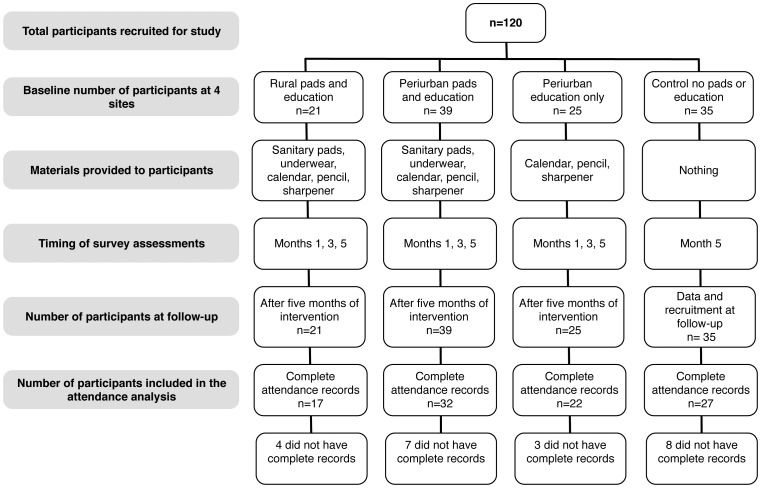
A sample of 120 schoolgirls between the ages of 12 and 18 from four villages in Ghana participated in a non-randomized trial of sanitary pad provision with education. The trial had three levels of treatment: provision of pads with puberty education; puberty education alone; or control (no pads or education). The primary outcome was school attendance.

RESULTS

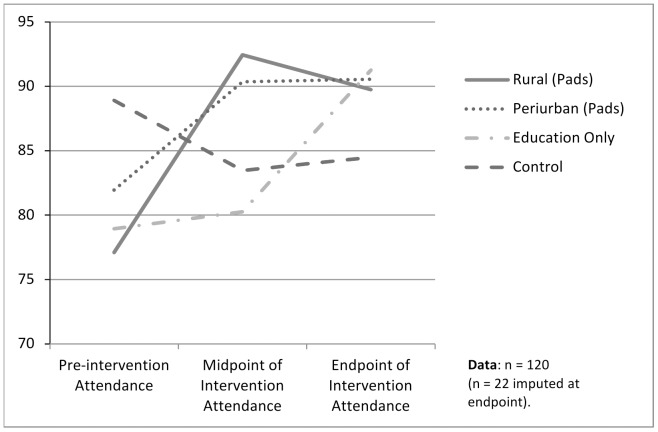
After 3 months, providing pads with education significantly improved attendance among participants, (lambda 0.824, F = 3.760, p<.001). After 5 months, puberty education alone improved attendance to a similar level (M = 91.26, SD = 7.82) as sites where pads were provided with puberty education (Rural M = 89.74, SD = 9.34; Periurban M = 90.54, SD = 17.37), all of which were higher than control (M = 84.48, SD = 12.39). The total improvement through pads with education intervention after 5 months was a 9% increase in attendance. After 3 months, providing pads with education significantly improved attendance among participants. The changes in attendance at the end of the trial, after 5 months, were found to be significant by site over time. With puberty education alone resulting in a similar attendance level.

CONCLUSION

This pilot study demonstrated promising results of a low-cost, rapid-return intervention for girls' education in a developing context. Given the considerable development needs of poorer countries and the potential of young women there, these results suggest that a large-scale cluster randomized trial is warranted.

TRIAL REGISTRATION

Pan African Clinical Trials Registry PACTR201202000361337.

摘要

背景

在发展中地区增加女孩的受教育程度与社区内许多重要的积极健康、社会和经济成果有关。初潮的发生往往与女孩从小学到中学的过渡时期相吻合,可能成为继续上学和表现的障碍。根据 MRC 复杂干预框架,加纳进行了一项试点对照研究,以评估卫生巾在女孩教育中的作用。

方法

来自加纳四个村庄的 120 名 12 至 18 岁的女学生参加了一项非随机试验,试验内容为提供卫生巾和教育。该试验有三个治疗水平:提供带青春期教育的卫生巾;仅进行青春期教育;或对照(不提供卫生巾或教育)。主要结果是出勤率。

结果

3 个月后,提供带教育的卫生巾显著提高了参与者的出勤率(lambda 0.824,F=3.760,p<.001)。5 个月后,仅进行青春期教育也将出勤率提高到了类似水平(M=91.26,SD=7.82),与提供带青春期教育的卫生巾的地点(农村 M=89.74,SD=9.34;城市 M=90.54,SD=17.37)相似,均高于对照组(M=84.48,SD=12.39)。5 个月后,通过带教育的卫生巾干预总改善率为出勤率提高 9%。3 个月后,提供带教育的卫生巾显著提高了参与者的出勤率。5 个月后,试验结束时的出勤率变化在不同地点均有显著差异。仅进行青春期教育就可以达到类似的出勤率水平。

结论

这项试点研究展示了在发展中背景下,一种低成本、快速回报的女孩教育干预措施的有希望的结果。鉴于较贫穷国家的巨大发展需求和那里年轻女性的潜力,这些结果表明,有必要进行大规模的集群随机试验。

试验注册

泛非临床试验注册处 PACTR201202000361337。

https://cdn.ncbi.nlm.nih.gov/pmc/blobs/3b38/3485220/9ea05ac66d1a/pone.0048274.g003.jpg
https://cdn.ncbi.nlm.nih.gov/pmc/blobs/3b38/3485220/db7d756d249a/pone.0048274.g001.jpg
https://cdn.ncbi.nlm.nih.gov/pmc/blobs/3b38/3485220/a7070d2f79f8/pone.0048274.g002.jpg
https://cdn.ncbi.nlm.nih.gov/pmc/blobs/3b38/3485220/9ea05ac66d1a/pone.0048274.g003.jpg
https://cdn.ncbi.nlm.nih.gov/pmc/blobs/3b38/3485220/db7d756d249a/pone.0048274.g001.jpg
https://cdn.ncbi.nlm.nih.gov/pmc/blobs/3b38/3485220/a7070d2f79f8/pone.0048274.g002.jpg
https://cdn.ncbi.nlm.nih.gov/pmc/blobs/3b38/3485220/9ea05ac66d1a/pone.0048274.g003.jpg

相似文献

1
Sanitary pad interventions for girls' education in Ghana: a pilot study.加纳女生教育用卫生巾干预措施:一项试点研究。
PLoS One. 2012;7(10):e48274. doi: 10.1371/journal.pone.0048274. Epub 2012 Oct 31.
2
Menstruation and the Cycle of Poverty: A Cluster Quasi-Randomised Control Trial of Sanitary Pad and Puberty Education Provision in Uganda.月经与贫困循环:乌干达卫生巾及青春期教育供应的整群准随机对照试验
PLoS One. 2016 Dec 21;11(12):e0166122. doi: 10.1371/journal.pone.0166122. eCollection 2016.
3
Effects of sanitary pad distribution and reproductive health education on upper primary school attendance and reproductive health knowledge and attitudes in Kenya: a cluster randomized controlled trial.肯尼亚开展卫生护垫发放和生殖健康教育对小学生入学率及生殖健康知识和态度的影响:一项整群随机对照试验
Reprod Health. 2021 Aug 31;18(1):179. doi: 10.1186/s12978-021-01223-7.
4
A qualitative understanding of the effects of reusable sanitary pads and puberty education: implications for future research and practice.对可重复使用卫生巾和青春期教育效果的质性理解:对未来研究和实践的启示
Reprod Health. 2017 Jun 27;14(1):78. doi: 10.1186/s12978-017-0339-9.
5
Cluster randomized evaluation of the Nia Project: study protocol.集群随机对照评估 Nia 项目:研究方案。
Reprod Health. 2018 Dec 29;15(1):218. doi: 10.1186/s12978-018-0586-4.
6
Schoolgirls' experience and appraisal of menstrual absorbents in rural Uganda: a cross-sectional evaluation of reusable sanitary pads.乌干达农村女学生使用和评价月经吸收用品的经历:对可重复使用卫生巾的横断面评估
Reprod Health. 2016 Dec 7;13(1):143. doi: 10.1186/s12978-016-0260-7.
7
Evaluation of a menstrual hygiene intervention in urban and rural schools in Bangladesh: a pilot study.孟加拉国城乡学校经期卫生干预措施评估:一项试点研究。
BMC Public Health. 2022 Jun 2;22(1):1100. doi: 10.1186/s12889-022-13478-1.
8
Do Menstrual Hygiene Management Interventions Improve Education and Psychosocial Outcomes for Women and Girls in Low and Middle Income Countries? A Systematic Review.月经卫生管理干预措施能否改善低收入和中等收入国家妇女和女童的教育及社会心理状况?一项系统评价。
PLoS One. 2016 Feb 10;11(2):e0146985. doi: 10.1371/journal.pone.0146985. eCollection 2016.
9
Menstrual cups and sanitary pads to reduce school attrition, and sexually transmitted and reproductive tract infections: a cluster randomised controlled feasibility study in rural Western Kenya.月经杯和卫生巾对减少学校辍学率以及性传播感染和生殖道感染的影响:肯尼亚西部农村地区的一项整群随机对照可行性研究
BMJ Open. 2016 Nov 23;6(11):e013229. doi: 10.1136/bmjopen-2016-013229.
10
Menstrual hygiene management in rural schools of Zambia: a descriptive study of knowledge, experiences and challenges faced by schoolgirls.赞比亚农村学校的经期卫生管理:对女学生所面临的知识、经验和挑战的描述性研究。
BMC Public Health. 2019 Jan 5;19(1):16. doi: 10.1186/s12889-018-6360-2.

引用本文的文献

1
Policy to practice: insights from implementation of a school-based sanitary napkin distribution programme in Odisha, India.政策到实践:印度奥里萨邦一项校内卫生巾发放项目实施的见解
Health Res Policy Syst. 2025 Jul 16;23(1):94. doi: 10.1186/s12961-025-01316-w.
2
Suitability, acceptability, feasibility of modern menstrual methods: a qualitative study in Coimbatore district, Tamil Nadu, India.现代月经方法的适用性、可接受性和可行性:印度泰米尔纳德邦哥印拜陀地区的一项定性研究
Front Glob Womens Health. 2024 Dec 24;5:1497686. doi: 10.3389/fgwh.2024.1497686. eCollection 2024.
3
Beyond access to sanitary pads: a comprehensive analysis of menstrual health scheme impact among rural girls in Northeast India.

本文引用的文献

1
Economic status proxies in studies of fertility in developing countries: Does the measure matter?发展中国家生育研究中的经济地位代理指标:衡量指标是否重要?
Popul Stud (Camb). 2002 Jan;56(1):81-96. doi: 10.1080/00324720213796.
2
Menstrual Hygiene: How Hygienic is the Adolescent Girl?经期卫生:青春期女孩的卫生状况如何?
Indian J Community Med. 2008 Apr;33(2):77-80. doi: 10.4103/0970-0218.40872.
3
Where the education system and women's bodies collide: The social and health impact of girls' experiences of menstruation and schooling in Tanzania.
除了获得卫生巾之外:对印度东北部农村女孩月经健康计划影响的综合分析
Health Policy Plan. 2025 Feb 6;40(2):218-233. doi: 10.1093/heapol/czae117.
4
Menstrual hygiene management interventions and their effects on schoolgirls' menstrual hygiene experiences in low and middle countries: A systematic review.经期卫生管理干预措施及其对中低收入国家女学生经期卫生体验的影响:系统评价。
PLoS One. 2024 Aug 22;19(8):e0302523. doi: 10.1371/journal.pone.0302523. eCollection 2024.
5
A Systematic Review of Menstrual Health and Hygiene Management (MHHM) as a Human Right for Adolescents Girls.关于月经健康与卫生管理(MHHM)作为少女一项人权的系统评价
Int J Sex Health. 2022 Mar 22;34(3):483-502. doi: 10.1080/19317611.2022.2050874. eCollection 2022.
6
Menstrual health and hygiene knowledge among post menarche adolescent school girls in urban and rural Tanzania.坦桑尼亚城乡初潮后青春期女学生的月经健康与卫生知识
PLoS One. 2024 Mar 11;19(3):e0284072. doi: 10.1371/journal.pone.0284072. eCollection 2024.
7
Systematic review of the effectiveness of menstrual health interventions in low- and middle-income countries in the East Asia and Pacific region.东亚及太平洋地区低收入和中等收入国家月经健康干预措施有效性的系统评价。
Lancet Reg Health Southeast Asia. 2023 Oct 19;20:100295. doi: 10.1016/j.lansea.2023.100295. eCollection 2024 Jan.
8
Adolescent girls' descriptions of dysmenorrhea and barriers to dysmenorrhea management in Moshi, Tanzania: A qualitative study.坦桑尼亚莫希地区青春期女孩对痛经及痛经管理障碍的描述:一项定性研究
PLOS Glob Public Health. 2023 Jul 6;3(7):e0001544. doi: 10.1371/journal.pgph.0001544. eCollection 2023.
9
"Menstruation is a Fearful Thing": A Qualitative Exploration of Menstrual Experiences and Sources of Information About Menstruation Among Adolescent Schoolgirls.“月经是件可怕的事”:对青春期女学生月经经历及月经信息来源的质性探索
Int J Womens Health. 2023 May 31;15:881-892. doi: 10.2147/IJWH.S407455. eCollection 2023.
10
Effectiveness of a menstrual health education program on psychological well-being and behavioral change among adolescent girls in rural Uganda.一项月经健康教育项目对乌干达农村地区少女心理健康及行为改变的有效性
J Public Health Afr. 2023 Apr 18;14(3):1971. doi: 10.4081/jphia.2023.1971. eCollection 2023 Mar 31.
教育体制与女性身体的碰撞:坦桑尼亚女孩经期和上学经历的社会与健康影响
J Adolesc. 2010 Aug;33(4):521-9. doi: 10.1016/j.adolescence.2009.03.008. Epub 2009 Apr 23.
4
Developing and evaluating complex interventions: the new Medical Research Council guidance.开发与评估复杂干预措施:医学研究理事会新指南
BMJ. 2008 Sep 29;337:a1655. doi: 10.1136/bmj.a1655.
5
Improving the reporting quality of nonrandomized evaluations of behavioral and public health interventions: the TREND statement.提高行为和公共卫生干预措施非随机评估的报告质量:TREND 声明。
Am J Public Health. 2004 Mar;94(3):361-6. doi: 10.2105/ajph.94.3.361.