Unidad Biotecnología, Centro de Investigación Científica de Yucatán, Calle 43 No. 130, Col. Chuburná de Hidalgo, Mérida, Yucatán, CP 97200, México.
BMC Plant Biol. 2012 Nov 5;12:203. doi: 10.1186/1471-2229-12-203.
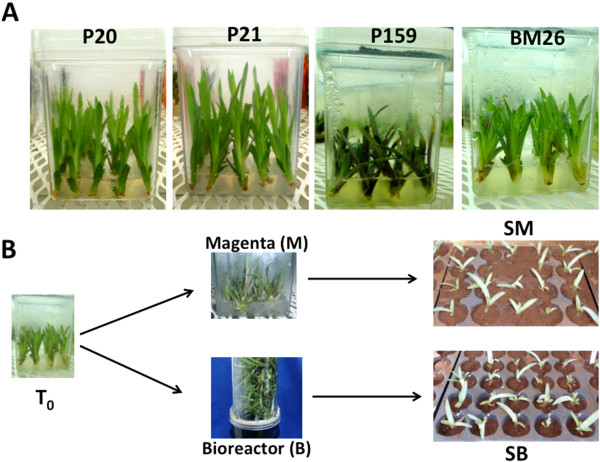
The micropropagation is a powerful tool to scale up plants of economical and agronomical importance, enhancing crop productivity. However, a small but growing body of evidence suggests that epigenetic mechanisms, such as DNA methylation and histone modifications, can be affected under the in vitro conditions characteristic of micropropagation. Here, we tested whether the adaptation to different in vitro systems (Magenta boxes and Bioreactors) modified epigenetically different clones of Agave fourcroydes and A. angustifolia. Furthermore, we assessed whether these epigenetic changes affect the regulatory expression of KNOTTED1-like HOMEOBOX (KNOX) transcription factors.
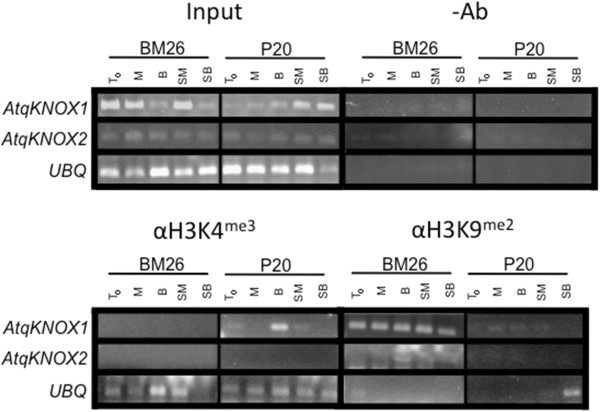
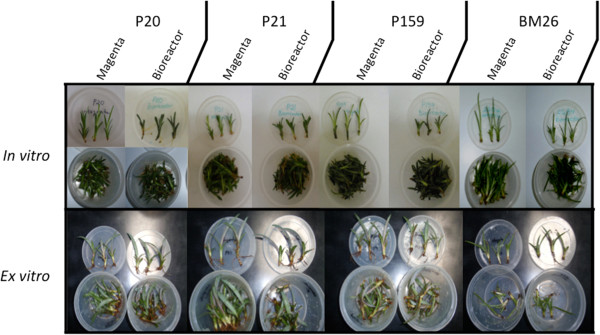
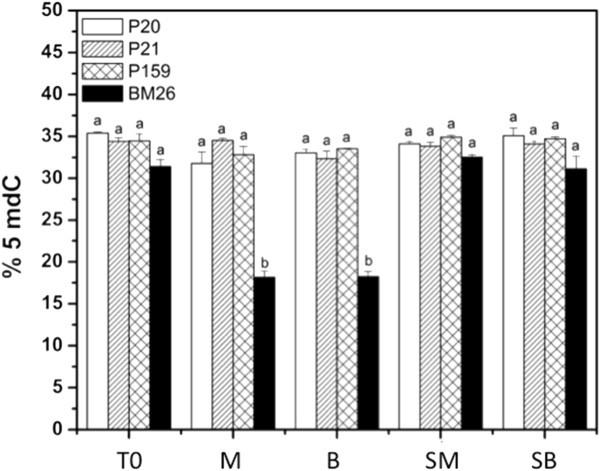
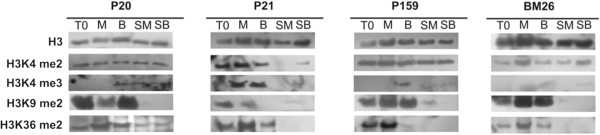
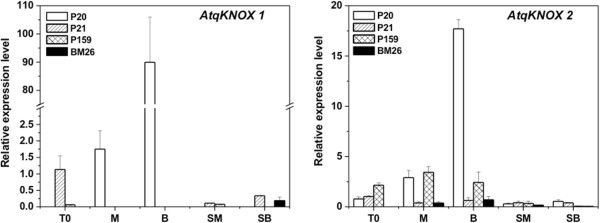
To gain a better understanding of epigenetic changes during in vitro and ex vitro conditions in Agave fourcroydes and A. angustifolia, we analyzed global DNA methylation, as well as different histone modification marks, in two different systems: semisolid in Magenta boxes (M) and temporary immersion in modular Bioreactors (B). No significant difference was found in DNA methylation in A. fourcroydes grown in either M or B. However, when A. fourcroydes was compared with A. angustifolia, there was a two-fold difference in DNA methylation between the species, independent of the in vitro system used. Furthermore, we detected an absence or a low amount of the repressive mark H3K9me2 in ex vitro conditions in plants that were cultured earlier either in M or B. Moreover, the expression of AtqKNOX1 and AtqKNOX2, on A. fourcroydes and A. angustifolia clones, is affected during in vitro conditions. Therefore, we used Chromatin ImmunoPrecipitation (ChIP) to know whether these genes were epigenetically regulated. In the case of AtqKNOX1, the H3K4me3 and H3K9me2 were affected during in vitro conditions in comparison with AtqKNOX2.
Agave clones plants with higher DNA methylation during in vitro conditions were better adapted to ex vitro conditions. In addition, A. fourcroydes and A. angustifolia clones displayed differential expression of the KNOX1 gene during in vitro conditions, which is epigenetically regulated by the H3K4me3 and H3K9me2 marks. The finding of an epigenetic regulation in key developmental genes will make it important in future studies to identify factors that help to find climate-resistant micropropagated plants.
微繁殖是一种强大的工具,可以扩大具有经济和农学重要性的植物规模,提高作物生产力。然而,越来越多的证据表明,在微繁殖特有的体外条件下,如 DNA 甲基化和组蛋白修饰等表观遗传机制可能会受到影响。在这里,我们测试了不同的体外系统(Magenta 盒和生物反应器)是否会使不同的龙舌兰属克隆适应表观遗传修饰,如 Agave fourcroydes 和 A. angustifolia。此外,我们还评估了这些表观遗传变化是否会影响 KNOTTED1 样 HOMEOBOX(KNOX)转录因子的调控表达。
为了更好地了解龙舌兰属在 Agave fourcroydes 和 A. angustifolia 的体外和外植体条件下的表观遗传变化,我们分析了两种不同系统(Magenta 盒中的半固体(M)和模块化生物反应器中的临时浸入(B))中的全局 DNA 甲基化以及不同的组蛋白修饰标记。在 M 或 B 中生长的 A. fourcroydes 中未发现 DNA 甲基化有显著差异。然而,当 A. fourcroydes 与 A. angustifolia 进行比较时,在不考虑所使用的体外系统的情况下,两个物种之间的 DNA 甲基化存在两倍的差异。此外,我们在早些时候在 M 或 B 中培养的植物的外植体条件下检测到 H3K9me2 的缺乏或低量。此外,A. fourcroydes 和 A. angustifolia 克隆的 AtqKNOX1 和 AtqKNOX2 的表达在体外条件下受到影响。因此,我们使用染色质免疫沉淀(ChIP)来了解这些基因是否受到表观遗传调控。在 AtqKNOX1 的情况下,与 AtqKNOX2 相比,在体外条件下 H3K4me3 和 H3K9me2 受到影响。
在体外条件下具有较高 DNA 甲基化的龙舌兰属克隆植物更能适应外植体条件。此外,A. fourcroydes 和 A. angustifolia 克隆在体外条件下表现出 KNOX1 基因的差异表达,该表达受 H3K4me3 和 H3K9me2 标记的表观遗传调控。在关键发育基因中发现的表观遗传调控将使未来的研究确定有助于寻找具有抗气候能力的微繁殖植物的因素变得非常重要。