School of Immunity and Infection, University of Birmingham, Birmingham, UK.
Cell Microbiol. 2013 Mar;15(3):430-45. doi: 10.1111/cmi.12047. Epub 2012 Nov 20.
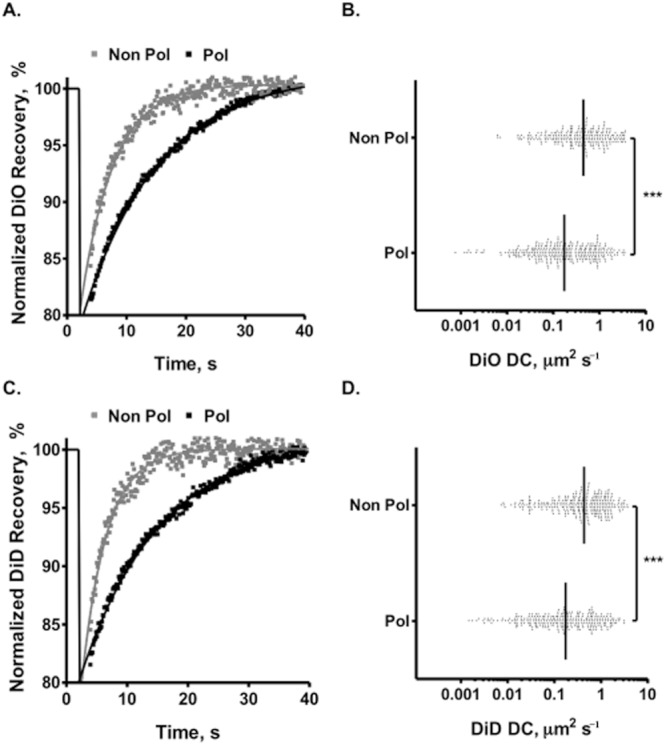
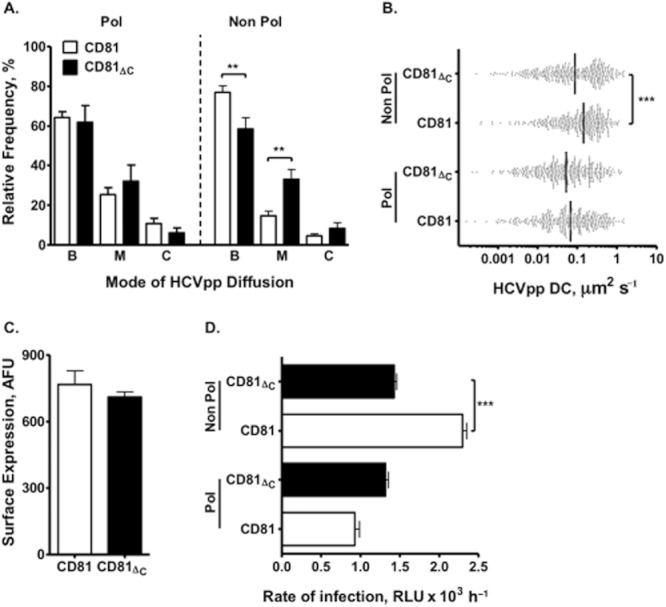
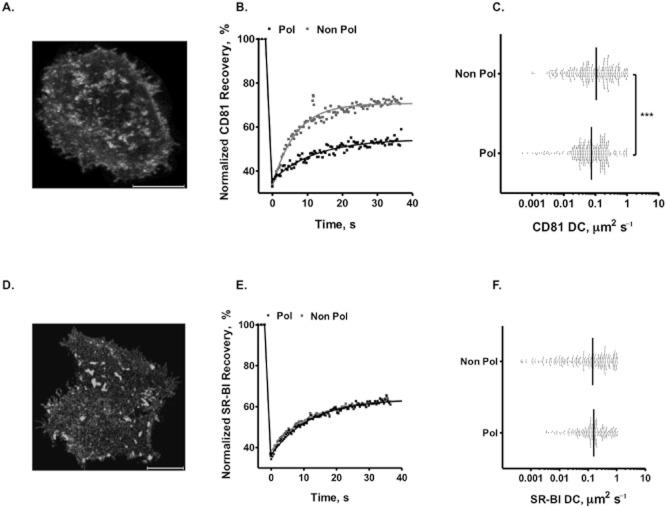
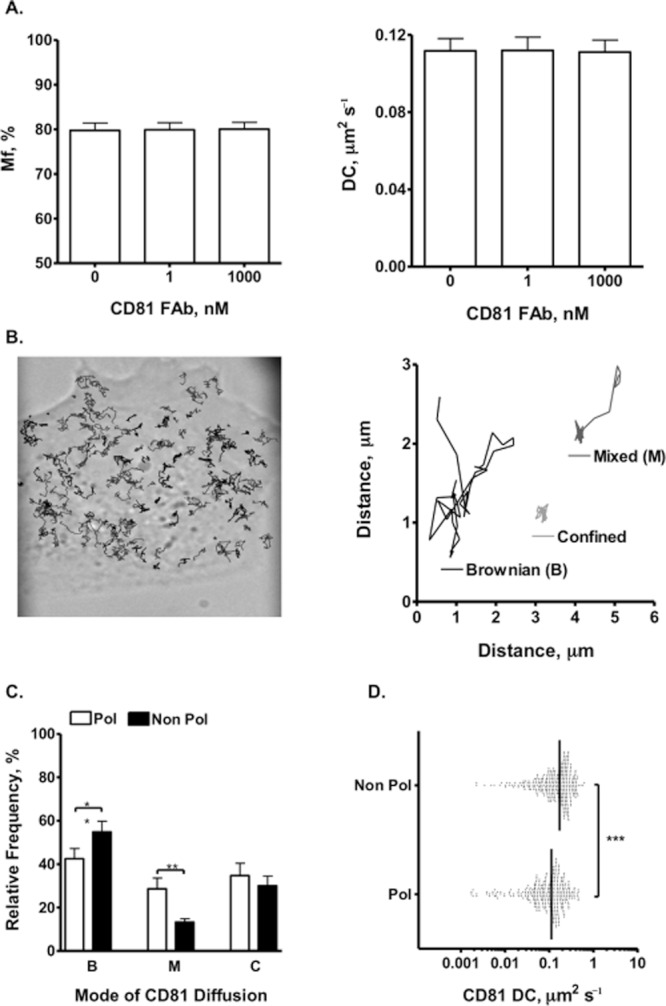
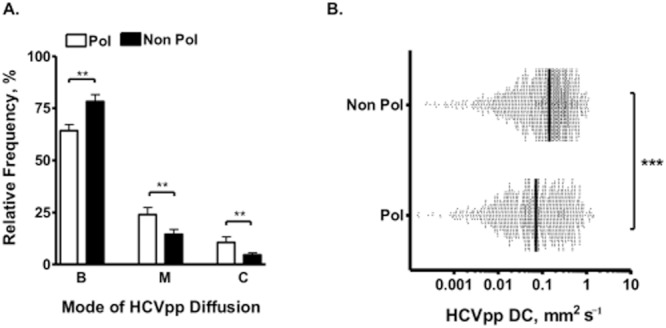
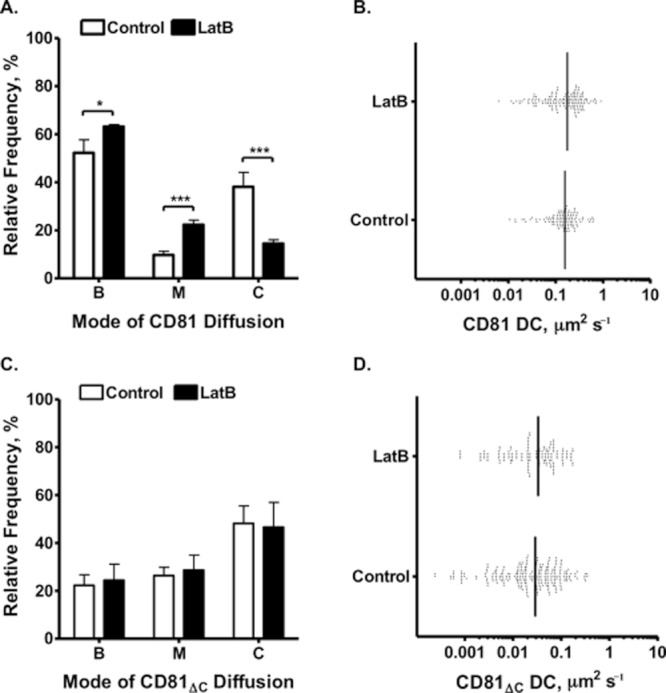
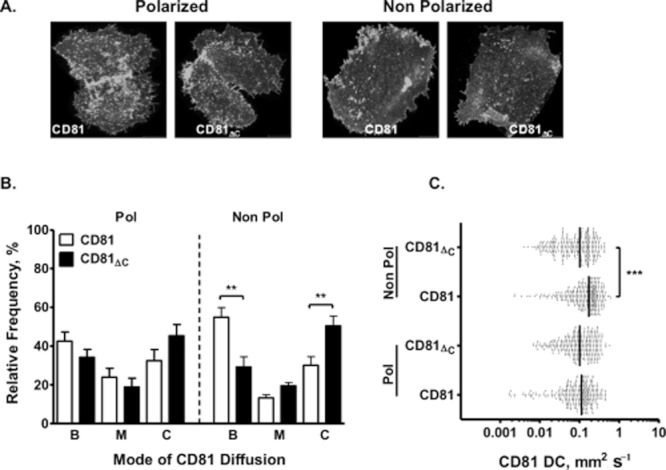
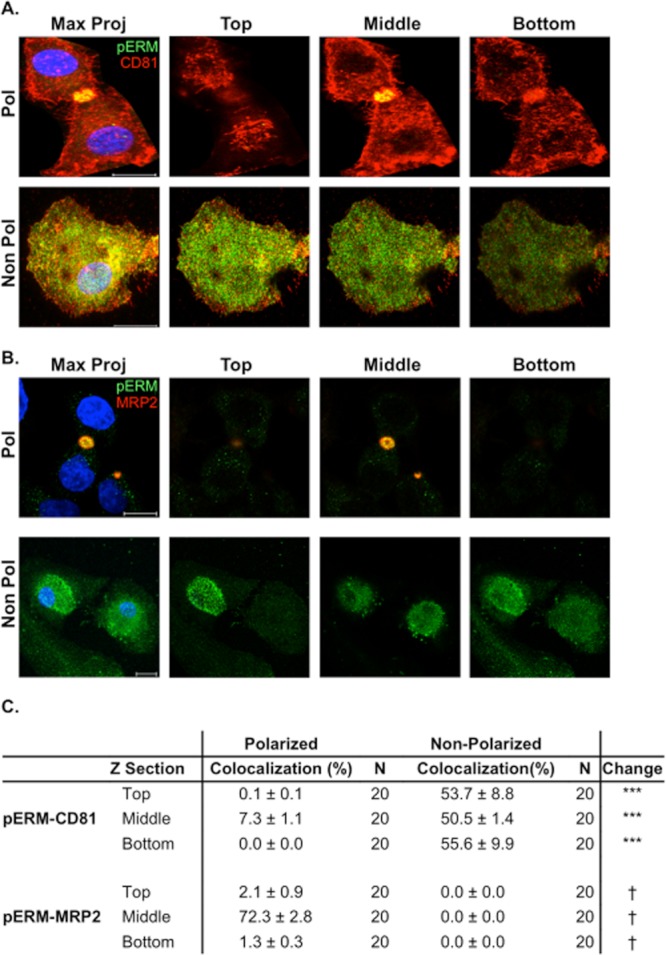
Many viruses target the polarized epithelial apex during host invasion. In contrast, hepatitis C virus (HCV) engages receptors at the basal surface of hepatocytes in the polarized liver parenchyma. Hepatocyte polarization limits HCV entry by undefined mechanism(s). Given the recent reports highlighting a role for receptor mobility in pathogen entry, we studied the effect(s) of hepatocyte polarization on viral receptor and HCV pseudoparticle (HCVpp) dynamics using real-time fluorescence recovery after photobleaching and single particle tracking. Hepatoma polarization reduced CD81 and HCVpp dynamics at the basal membrane. Since cell polarization is accompanied by changes in the actin cytoskeleton and CD81 links to actin via its C-terminus, we studied the dynamics of a mutant CD81 lacking a C-terminal tail (CD81(ΔC)) and its effect(s) on HCVpp mobility and infection. CD81(ΔC) showed an increased frequency of confined trajectories and a reduction of Brownian diffusing molecules compared to wild-type protein in non-polarized cells. However, these changes were notobserved in polarized cells. HCVpp showed a significant reduction in Brownian diffusion and infection of CD81(ΔC) expressing non-polarized cells. In summary, these data highlight the dynamic nature of CD81 and demonstrate a role for CD81 lateral diffusion to regulate HCV infection in a polarization-dependent manner.
许多病毒在宿主入侵时靶向极化的上皮顶端。相比之下,丙型肝炎病毒(HCV)在极化的肝实质中与肝细胞基底表面的受体结合。肝细胞极化通过未定义的机制限制 HCV 的进入。鉴于最近的报道强调了受体流动性在病原体进入中的作用,我们使用实时荧光恢复后光漂白和单颗粒跟踪研究了肝细胞极化对病毒受体和 HCV 假病毒(HCVpp)动力学的影响。肝癌细胞极化降低了基底膜上的 CD81 和 HCVpp 动力学。由于细胞极化伴随着肌动蛋白细胞骨架的变化,并且 CD81 通过其 C 末端与肌动蛋白连接,我们研究了缺乏 C 末端尾巴的突变型 CD81(CD81ΔC)的动力学及其对 HCVpp 迁移和感染的影响。与野生型蛋白相比,CD81ΔC 在非极化细胞中表现出更高的受限轨迹频率和布朗扩散分子的减少。然而,在极化细胞中未观察到这些变化。HCVpp 在表达 CD81ΔC 的非极化细胞中的布朗扩散和感染显著减少。总之,这些数据突出了 CD81 的动态性质,并证明了 CD81 侧向扩散在依赖极化的方式调节 HCV 感染中的作用。