Milani Amin Salem, Froughreyhani Mohammad, Rahimi Saeed, Jafarabadi Mohammad Asghari, Paksefat Sara
Dental and periodontal disease research center, Dental School, Tabriz University of Medical Sciences, Tabriz, Iran.
Iran Endod J. 2012 Fall;7(4):177-82. Epub 2012 Oct 13.
Root fracture is not an instant phenomenon but a result of gradual development of tiny craze lines in tooth structure. Recent studies have shown that canal instrumentation has the potential to cause dentinal cracks. The purpose of this study was to evaluate and compare the formation of dentinal cracks caused by ProTaper rotary system to hand instrumentation.
This in vitro study was carried out using 57 mandible incisor teeth. The teeth were decoronated. The roots were then examined to exclude cracked samples. A standard model for PDL simulation was used. The teeth were randomly divided into two experimental and one control group (n=19). The teeth in the experimental groups were prepared using hand or ProTaper Universal rotary instrumentation. The teeth in the control group were left unprepared. The teeth were then sectioned horizontally 3 and 6 mm from the apex, and the number of various dentinal defects was recorded using a dental operating microscope. The differences between groups were analyzed with Fisher's exact test.
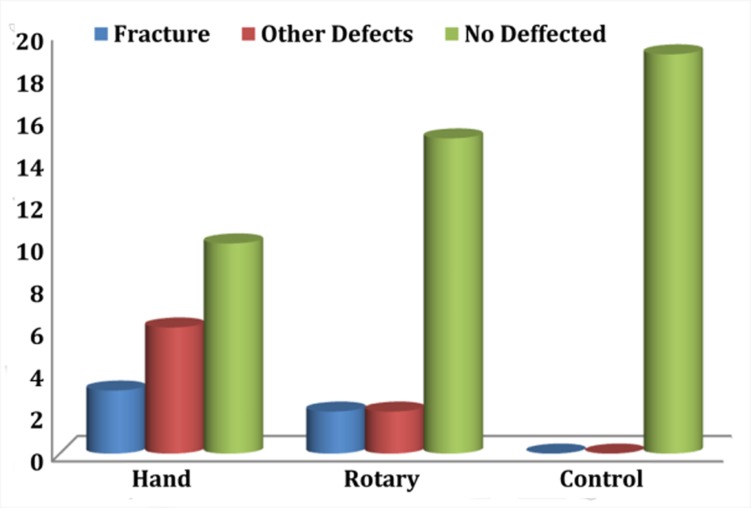
The hand group demonstrated significantly more defects than the control group (P=0.001). However, there was no significant difference between the rotary compared to the control and hand groups (P>0.05). There was no significant difference between groups with regards to fracture (P>0.05). Other defects including internal, external and surface cracks were more frequent in the hand than in the control or rotary groups (P=0.02), but the difference was not significant between the rotary and control groups (P>0.05).
Canal preparation, whether hand or rotary, produces structural defects in dentin. The ProTaper rotary system when used according to the manufacturer's instructions, tends to produce fewer cracks and can be considered a safe preparation technique.
牙根折裂并非瞬间发生的现象,而是牙齿结构中微小裂纹逐渐发展的结果。近期研究表明,根管预备有导致牙本质裂纹的可能性。本研究的目的是评估和比较ProTaper旋转系统与手动器械预备所导致的牙本质裂纹的形成情况。
本体外研究使用了57颗下颌切牙。去除牙冠。然后检查牙根以排除有裂纹的样本。采用了牙周膜模拟的标准模型。将牙齿随机分为两个试验组和一个对照组(n = 19)。试验组的牙齿分别采用手动或ProTaper通用旋转器械进行预备。对照组的牙齿不做预备。然后在距根尖3毫米和6毫米处水平剖切牙齿,使用牙科手术显微镜记录各种牙本质缺陷的数量。采用Fisher精确检验分析组间差异。
手动组显示出的缺陷显著多于对照组(P = 0.001)。然而,旋转组与对照组和手动组相比,差异无统计学意义(P>0.05)。各组在折裂方面差异无统计学意义(P>0.05)。包括内部、外部和表面裂纹在内的其他缺陷在手动组中比在对照组或旋转组中更常见(P = 0.02),但旋转组与对照组之间的差异无统计学意义(P>0.05)。
根管预备,无论是手动还是旋转方式,都会在牙本质中产生结构缺陷。按照制造商说明使用的ProTaper旋转系统往往产生较少的裂纹,可被视为一种安全的预备技术。