Department of Mouse Molecular Genetics and Center for Applied Genomics, Institute of Molecular Genetics of the Academy of Sciences of the Czech Republic, Prague, Czech Republic.
PLoS Genet. 2012;8(11):e1003044. doi: 10.1371/journal.pgen.1003044. Epub 2012 Nov 1.
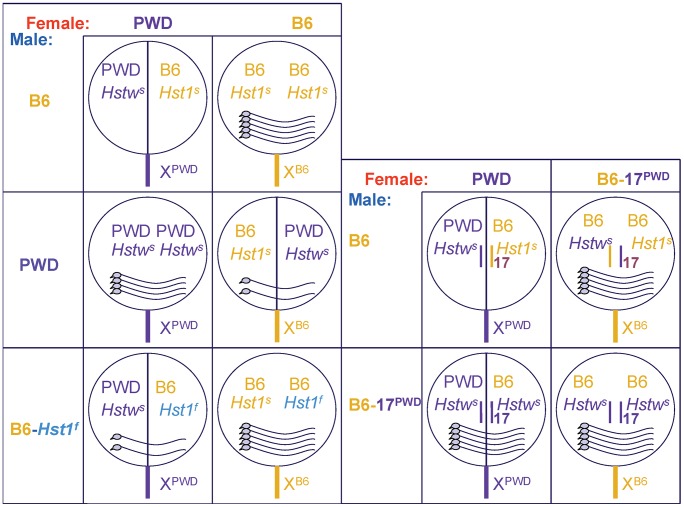
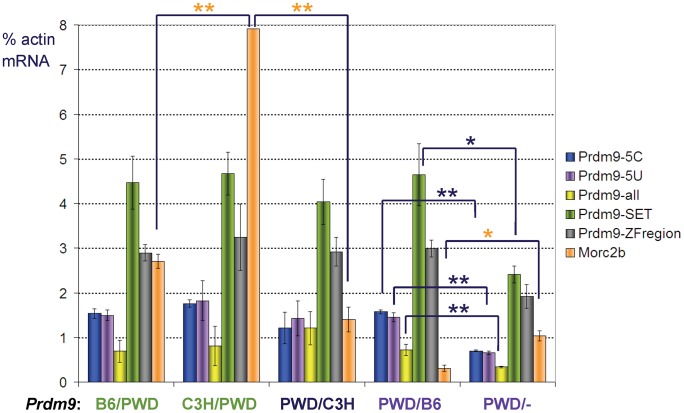
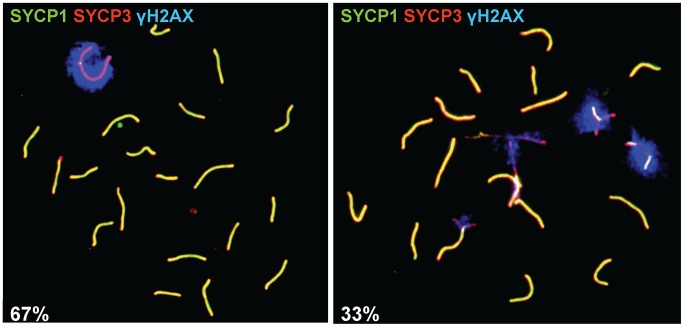
The Dobzhansky-Muller model of incompatibilities explains reproductive isolation between species by incorrect epistatic interactions. Although the mechanisms of speciation are of great interest, no incompatibility has been characterized at the gene level in mammals. The Hybrid sterility 1 gene (Hst1) participates in the arrest of meiosis in F(1) males of certain strains from two Mus musculus subspecies, e.g., PWD from M. m. musculus and C57BL/6J (henceforth B6) from M. m. domesticus. Hst1 has been identified as a meiotic PR-domain gene (Prdm9) encoding histone 3 methyltransferase in the male offspring of PWD females and B6 males, (PWD×B6)F(1). To characterize the incompatibilities underlying hybrid sterility, we phenotyped reproductive and meiotic markers in males with altered copy numbers of Prdm9. A partial rescue of fertility was observed upon removal of the B6 allele of Prdm9 from the azoospermic (PWD×B6)F(1) hybrids, whereas removing one of the two Prdm9 copies in PWD or B6 background had no effect on male reproduction. Incompatibility(ies) not involving Prdm9(B6) also acts in the (PWD×B6)F(1) hybrids, since the correction of hybrid sterility by Prdm9(B6) deletion was not complete. Additions and subtractions of Prdm9 copies, as well as allelic replacements, improved meiotic progression and fecundity also in the progeny-producing reciprocal (B6×PWD)F(1) males. Moreover, an increased dosage of Prdm9 and reciprocal cross enhanced fertility of other sperm-carrying male hybrids, (PWD×B6-C3H.Prdm9)F(1), harboring another Prdm9 allele of M. m. domesticus origin. The levels of Prdm9 mRNA isoforms were similar in the prepubertal testes of all types of F(1) hybrids of PWD with B6 and B6-C3H.Prdm9 despite their different prospective fertility, but decreased to 53% after removal of Prdm9(B6). Therefore, the Prdm9(B6) allele probably takes part in posttranscriptional dominant-negative hybrid interaction(s) absent in the parental strains.
多布赞斯基-穆勒模型的不相容性通过错误的上位相互作用解释了物种间的生殖隔离。尽管物种形成的机制非常有趣,但在哺乳动物中尚未在基因水平上描述任何不相容性。杂种不育 1 基因 (Hst1) 参与了某些品系的 F1 雄性的减数分裂停滞,例如来自 M. m. musculus 的 PWD 和来自 M. m. domesticus 的 C57BL/6J(简称 B6)。Hst1 已被鉴定为一种减数分裂 PR 结构域基因(Prdm9),在 PWD 雌性和 B6 雄性的雄性后代中编码组蛋白 3 甲基转移酶,即 PWD×B6F1。为了表征杂种不育背后的不相容性,我们对 Prdm9 拷贝数改变的雄性进行了生殖和减数分裂标记的表型分析。从不育的 (PWD×B6)F1 杂种中去除 Prdm9 的 B6 等位基因时观察到部分生育力恢复,而在 PWD 或 B6 背景中去除其中一个 Prdm9 拷贝对雄性生殖没有影响。涉及 Prdm9(B6)的不相容性也作用于 (PWD×B6)F1 杂种中,因为 Prdm9(B6)缺失纠正杂种不育并不完全。Prdm9 拷贝的添加和删减以及等位基因替换也改善了减数分裂进展和生育能力,在产生后代的反向 (B6×PWD)F1 雄性中也是如此。此外,Prdm9 的剂量增加和反向杂交增强了携带另一个来自 M. m. domesticus 起源的 Prdm9 等位基因的其他精子携带雄性杂种(PWD×B6-C3H.Prdm9)F1 的生育能力。尽管它们的潜在生育能力不同,但在所有类型的 PWD 与 B6 和 B6-C3H.Prdm9 的 F1 杂种的未成熟睾丸中,Prdm9 mRNA 同工型的水平相似,但在去除 Prdm9(B6)后降低到 53%。因此,Prdm9(B6)等位基因可能参与了在亲本品系中不存在的转录后显性负杂种相互作用。