Department of Mechanical Engineering, Texas A&M University, College Station, Texas, United States of America.
PLoS One. 2012;7(11):e47822. doi: 10.1371/journal.pone.0047822. Epub 2012 Nov 2.
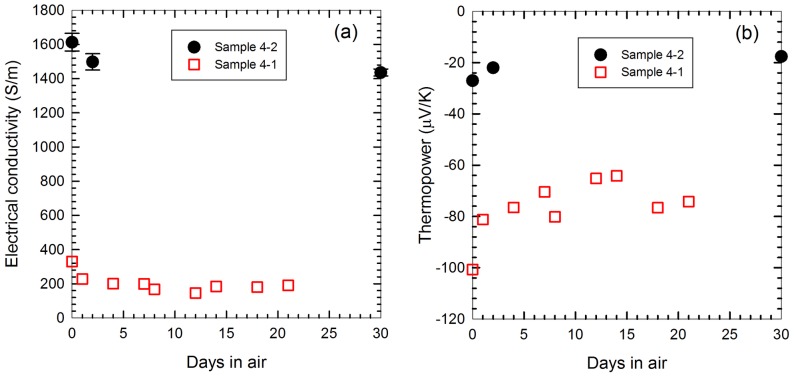
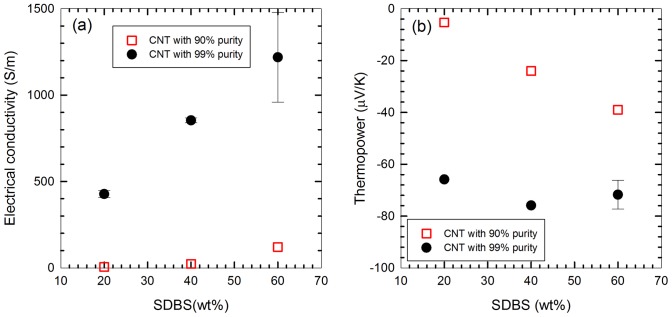
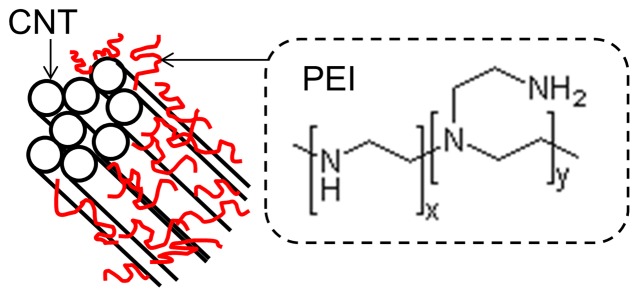
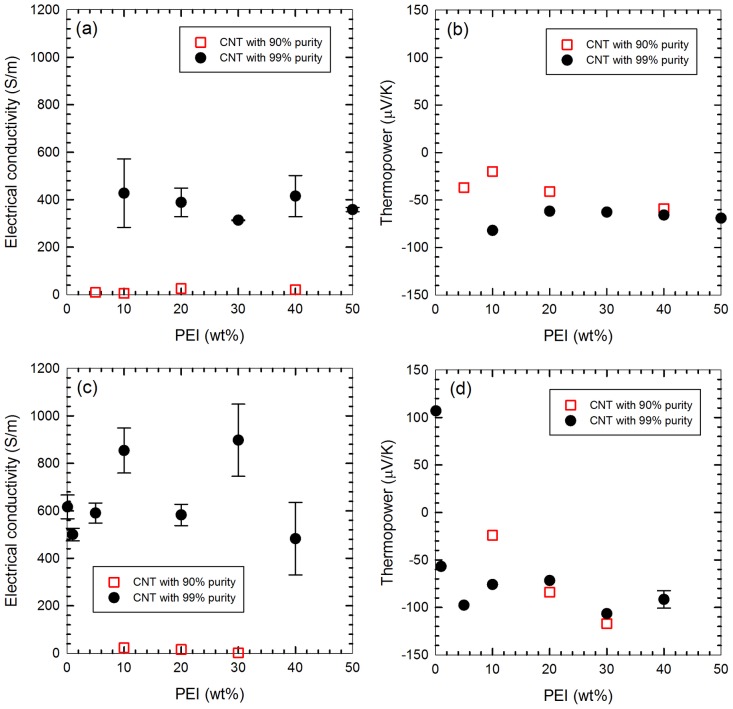
Carbon nanotubes (CNTs) were functionalized with polyethyleneimine (PEI) and made into composites with polyvinyl acetate (PVAc). CNTs were dispersed with different amounts of sodium dodecylbenzenesulfonate (SDBS) prior to the PEI functionalization. The resulting samples exhibit air-stable n-type characteristics with electrical conductivities as great as 1500 S/m and thermopowers as large as -100 µV/K. Electrical conductivity and thermopower were strongly affected by CNT dispersion, improving the properties with better dispersion with high concentrations of SDBS. This improvement is believed to be due to the increase in the number of tubes that are evenly coated with PEI in a better-dispersed sample. Increasing the amount of PEI relative to the other constituents positively affects thermopower but not conductivity. Air exposure reduces both thermopower and conductivity presumably due to oxygen doping (which makes CNTs p-type), but stable values were reached within seven days following sample fabrication.
碳纳米管(CNTs)经过聚乙烯亚胺(PEI)功能化,并与聚醋酸乙烯酯(PVAc)制成复合材料。在进行 PEI 功能化之前,用不同量的十二烷基苯磺酸钠(SDBS)分散 CNTs。所得样品表现出稳定的 n 型特性,电导率高达 1500 S/m,热电势高达-100 µV/K。电导率和热电势受 CNT 分散性的强烈影响,通过高浓度 SDBS 的更好分散来改善性能。这种改善被认为是由于均匀涂覆有 PEI 的管的数量增加,在分散性更好的样品中。与其他成分相比,增加 PEI 的量会对热电势产生积极影响,但对电导率没有影响。空气暴露会降低热电势和电导率,可能是由于氧掺杂(使 CNT 呈 p 型)所致,但在样品制造后七天内达到了稳定的值。