Paleo Antonio J, Martinez-Rubi Yadienka, Krause Beate, Pötschke Petra, Jakubinek Michael B, Ashrafi Behnam, Kingston Christopher
2C2T-Centre for Textile Science and Technology, University of Minho, 4800-058 Guimarães, Portugal.
Security and Disruptive Technologies Research Centre, National Research Council Canada, Ottawa, Ontario K1A 0R6, Canada.
ACS Appl Nano Mater. 2023 Sep 19;6(19):17986-17995. doi: 10.1021/acsanm.3c03247. eCollection 2023 Oct 13.
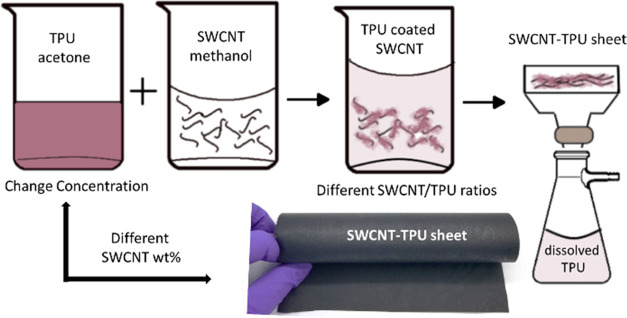
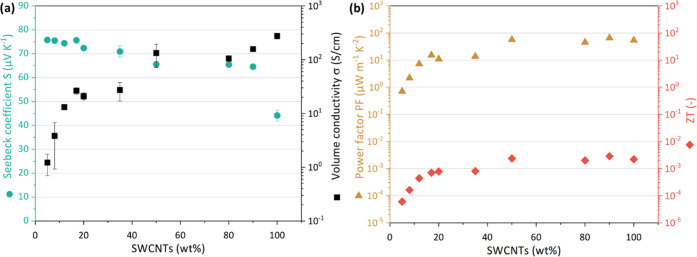
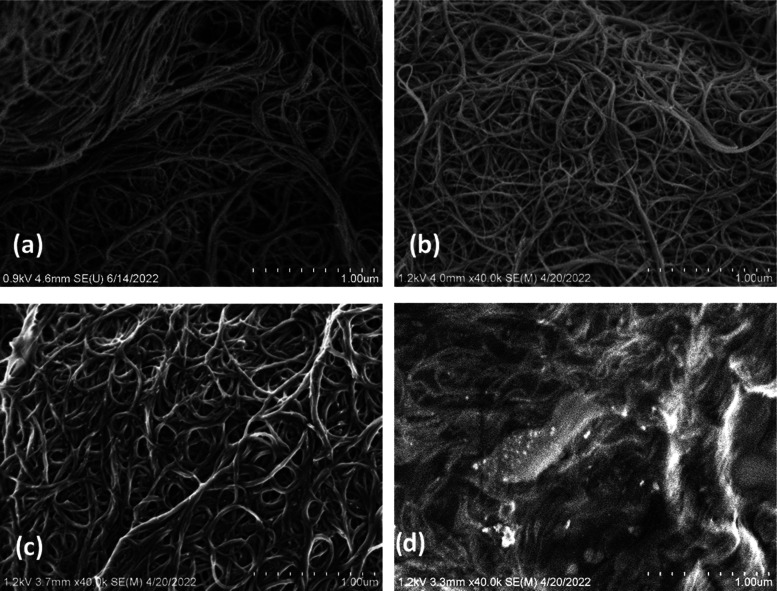
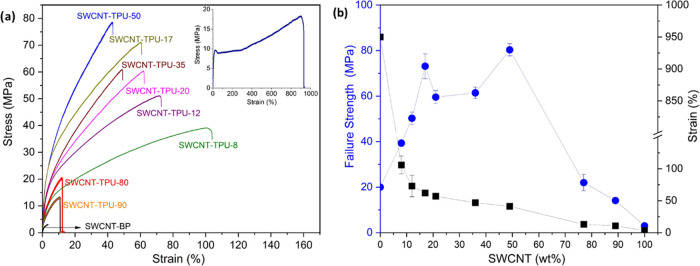
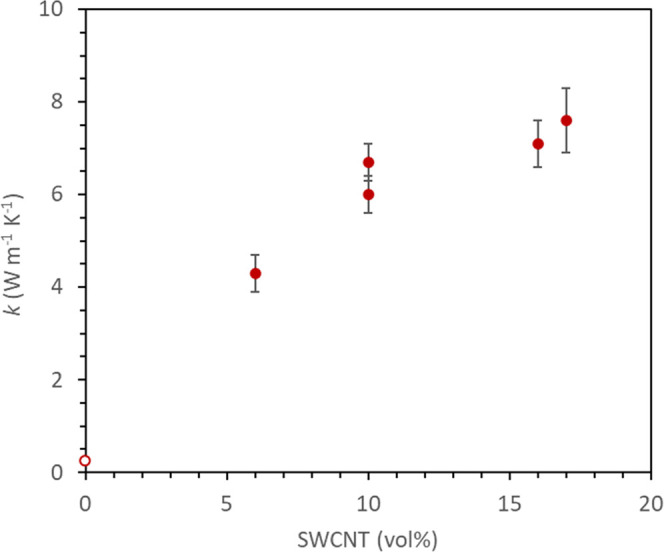
Integration of single-wall carbon nanotubes (SWCNTs) in the form of fabriclike sheets or other preformed assemblies (films, fibers, etc.) simplifies their handling and allows for composites with higher nanotube contents, which is needed to better exploit their outstanding properties and achieve multifunctional materials with improved performance. Here, we show the development of p-type SWCNT-thermoplastic polyurethane (TPU) fabric materials with a wide range of SWCNT contents (from 5 to 90 wt %) by employing a one-step filtration method using a suspension of SWCNTs in a TPU solvent/nonsolvent mixture. The mechanical and thermoelectric (TE) properties of these SWCNT-TPU nanocomposites were tailored by varying the SWCNT/TPU wt % ratio, achieving significant advantages relative to the pristine SWCNT buckypaper (BP) sheets in terms of strength and stretchability. In particular, the SWCNT-TPU nanocomposite with a 50/50 wt % ratio composition (equivalent to 15 vol % of SWCNTs) shows a power factor (PF) of 57 μW m K, slightly higher compared to the PF of the SWCNT BP prepared under the same conditions (54 μW m K), while its mechanical properties significantly increased (e.g., ∼7-, 25-, and 250-fold improvements in stiffness, strength, and tensile toughness, respectively). These results represent a significant step toward the development of easy-to-process self-supporting and stretchable materials with robust mechanical properties for flexible thermoelectric devices.
以织物状薄片或其他预制组件(薄膜、纤维等)形式存在的单壁碳纳米管(SWCNT)的集成简化了其处理过程,并允许制备具有更高纳米管含量的复合材料,这对于更好地利用其优异性能并实现性能改进的多功能材料是必要的。在此,我们展示了通过使用SWCNT在热塑性聚氨酯(TPU)溶剂/非溶剂混合物中的悬浮液采用一步过滤法来制备具有广泛SWCNT含量(5至90 wt%)的p型SWCNT-热塑性聚氨酯(TPU)织物材料。通过改变SWCNT/TPU重量百分比比例来调整这些SWCNT-TPU纳米复合材料的机械和热电(TE)性能,相对于原始的SWCNT巴基纸(BP)薄片,在强度和拉伸性方面具有显著优势。特别是,具有50/50 wt%比例组成(相当于15 vol%的SWCNT)的SWCNT-TPU纳米复合材料显示出57 μW m K的功率因子(PF),与在相同条件下制备的SWCNT BP的PF(54 μW m K)相比略高,而其机械性能显著提高(例如,刚度、强度和拉伸韧性分别提高了约7倍、25倍和250倍)。这些结果代表了朝着开发具有坚固机械性能的易于加工的自支撑和可拉伸材料以用于柔性热电装置迈出的重要一步。