
鉴定抑制蓖麻毒素诱导的应激激活信号通路的小分子。
Identification of small molecules that suppress ricin-induced stress-activated signaling pathways.
机构信息
Division of Infectious Diseases, Wadsworth Center, New York State Department of Health, Albany, New York, United States of America.
出版信息
PLoS One. 2012;7(11):e49075. doi: 10.1371/journal.pone.0049075. Epub 2012 Nov 1.
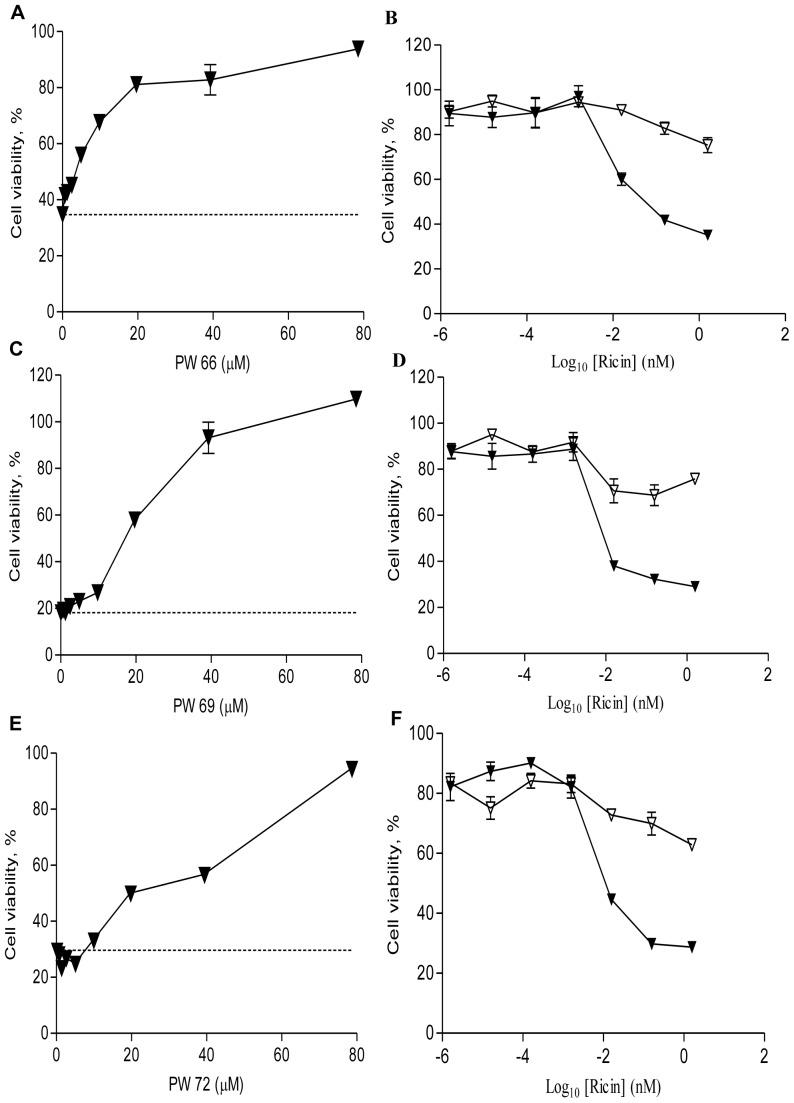
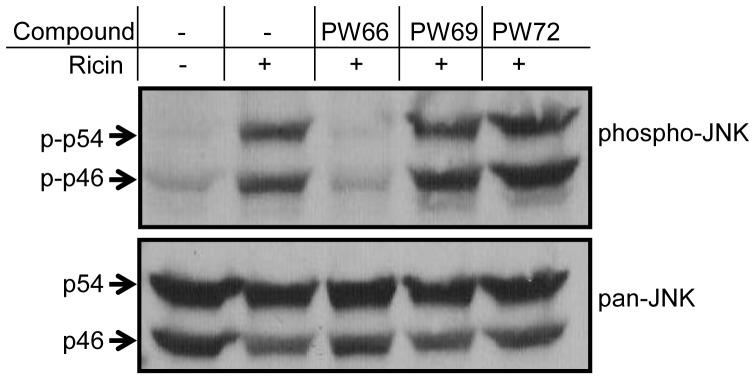
Ricin is a member of the ribosome-inactivating protein (RIP) family of plant and bacterial toxins. In this study we used a high-throughput, cell-based assay to screen more than 118,000 compounds from diverse chemical libraries for molecules that reduced ricin-induced cell death. We describe three compounds, PW66, PW69, and PW72 that at micromolar concentrations significantly delayed ricin-induced cell death. None of the compounds had any demonstrable effect on ricin's ability to arrest protein synthesis in cells or on ricin's enzymatic activity as assessed in vitro. Instead, all three compounds appear to function by blocking downstream stress-induced signaling pathways associated with the toxin-mediated apoptosis. PW66 virtually eliminated ricin-induced TNF-α secretion by J774A.1 macrophages and concomitantly blocked activation of the p38 MAPK and JNK signaling pathways. PW72 suppressed ricin-induced TNF-α secretion, but not p38 MAPK and JNK signaling. PW69 suppressed activity of the executioner caspases 3/7 in ricin toxin- and Shiga toxin 2-treated cells. While the actual molecular targets of the three compounds have yet to be identified, these data nevertheless underscore the potential of small molecules to down-regulate inflammatory signaling pathways associated with exposure to the RIP family of toxins.
蓖麻毒素是核糖体失活蛋白(RIP)家族的植物和细菌毒素之一。在这项研究中,我们使用高通量的基于细胞的测定法,从各种化学文库中筛选了超过 118,000 种化合物,以寻找能降低蓖麻毒素诱导的细胞死亡的分子。我们描述了三种化合物 PW66、PW69 和 PW72,它们在微摩尔浓度下能显著延迟蓖麻毒素诱导的细胞死亡。这些化合物中没有一种能明显影响蓖麻毒素在细胞中抑制蛋白质合成的能力,也没有明显影响蓖麻毒素的酶活性。相反,这三种化合物似乎都通过阻断与毒素介导的细胞凋亡相关的下游应激诱导信号通路来发挥作用。PW66 几乎消除了 J774A.1 巨噬细胞中蓖麻毒素诱导的 TNF-α分泌,并同时阻断了 p38 MAPK 和 JNK 信号通路的激活。PW72 抑制了 ricin 诱导的 TNF-α分泌,但不抑制 p38 MAPK 和 JNK 信号通路。PW69 抑制了 ricin 毒素和志贺毒素 2 处理的细胞中执行细胞凋亡的半胱天冬酶 3/7 的活性。虽然这三种化合物的实际分子靶点尚未确定,但这些数据强调了小分子在下调与 RIP 家族毒素暴露相关的炎症信号通路方面的潜力。



 Zotero 插件