Department of Medicine, Division of Hematology, Brigham and Women's Hospital, Harvard Medical School, Boston, Massachusetts 02115, USA.
Nature. 2012 Nov 22;491(7425):608-12. doi: 10.1038/nature11536. Epub 2012 Nov 7.
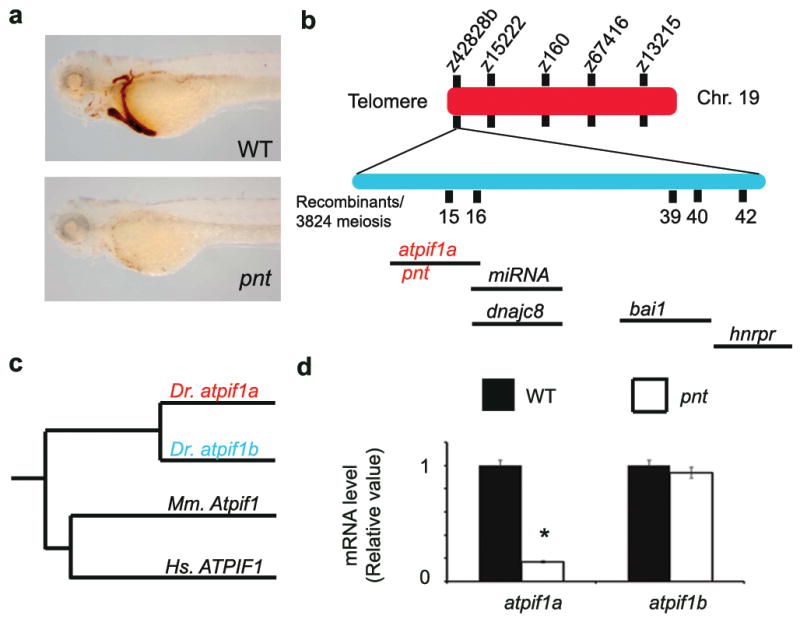
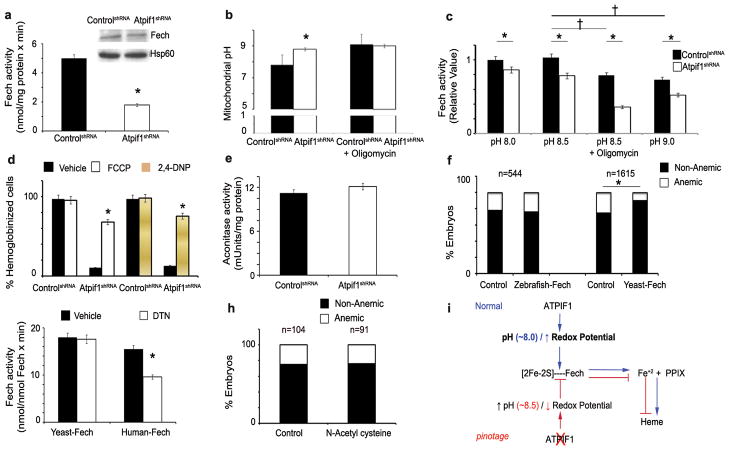
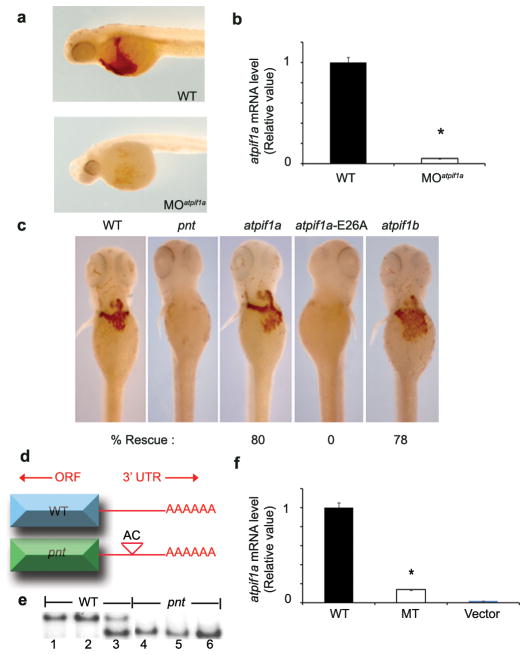
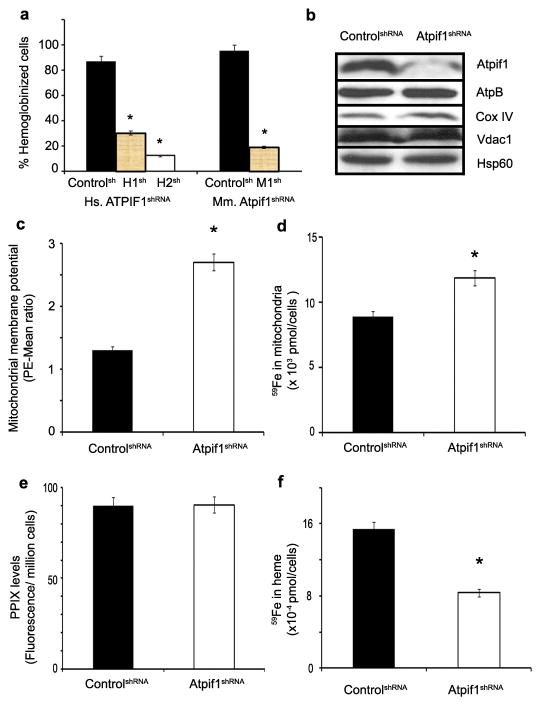
Defects in the availability of haem substrates or the catalytic activity of the terminal enzyme in haem biosynthesis, ferrochelatase (Fech), impair haem synthesis and thus cause human congenital anaemias. The interdependent functions of regulators of mitochondrial homeostasis and enzymes responsible for haem synthesis are largely unknown. To investigate this we used zebrafish genetic screens and cloned mitochondrial ATPase inhibitory factor 1 (atpif1) from a zebrafish mutant with profound anaemia, pinotage (pnt (tq209)). Here we describe a direct mechanism establishing that Atpif1 regulates the catalytic efficiency of vertebrate Fech to synthesize haem. The loss of Atpif1 impairs haemoglobin synthesis in zebrafish, mouse and human haematopoietic models as a consequence of diminished Fech activity and elevated mitochondrial pH. To understand the relationship between mitochondrial pH, redox potential, [2Fe-2S] clusters and Fech activity, we used genetic complementation studies of Fech constructs with or without [2Fe-2S] clusters in pnt, as well as pharmacological agents modulating mitochondrial pH and redox potential. The presence of [2Fe-2S] cluster renders vertebrate Fech vulnerable to perturbations in Atpif1-regulated mitochondrial pH and redox potential. Therefore, Atpif1 deficiency reduces the efficiency of vertebrate Fech to synthesize haem, resulting in anaemia. The identification of mitochondrial Atpif1 as a regulator of haem synthesis advances our understanding of the mechanisms regulating mitochondrial haem homeostasis and red blood cell development. An ATPIF1 deficiency may contribute to important human diseases, such as congenital sideroblastic anaemias and mitochondriopathies.
血红素底物的可用性或血红素生物合成的末端酶——亚铁螯合酶(Fech)的催化活性缺陷会损害血红素合成,从而导致人类先天性贫血。线粒体稳态调节剂和血红素合成相关酶的功能依赖性尚未被充分了解。为了研究这一问题,我们使用了斑马鱼遗传筛选,并从一种严重贫血的斑马鱼突变体——皮诺塔吉(pnt(tq209))中克隆了线粒体 ATP 酶抑制因子 1(atpif1)。在这里,我们描述了一个直接的机制,该机制确立了 Atpif1 调节脊椎动物 Fech 的催化效率以合成血红素。由于 Fech 活性降低和线粒体 pH 值升高,Atpif1 的缺失会损害斑马鱼、小鼠和人类造血模型中的血红蛋白合成。为了理解线粒体 pH 值、氧化还原电位、[2Fe-2S]簇和 Fech 活性之间的关系,我们使用了具有或不具有[2Fe-2S]簇的 Fech 构建体的 pnt 遗传互补研究,以及调节线粒体 pH 值和氧化还原电位的药理学药物。[2Fe-2S]簇的存在使脊椎动物 Fech 易受 Atpif1 调节的线粒体 pH 值和氧化还原电位波动的影响。因此,Atpif1 缺乏会降低脊椎动物 Fech 合成血红素的效率,导致贫血。线粒体 Atpif1 作为血红素合成调节剂的鉴定,推进了我们对调节线粒体血红素稳态和红细胞发育的机制的理解。ATPIF1 缺乏可能导致重要的人类疾病,如先天性铁粒幼细胞性贫血和线粒体疾病。