NARO Western Region Agricultural Research Center , 1-3-1 Senyuu, Zentsuuji, Kagawa 765-8508, Japan.
Breed Sci. 2012 Jan;61(5):625-30. doi: 10.1270/jsbbs.61.625. Epub 2012 Feb 4.
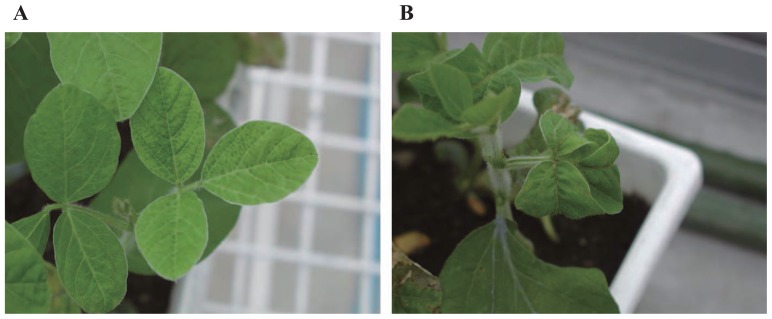
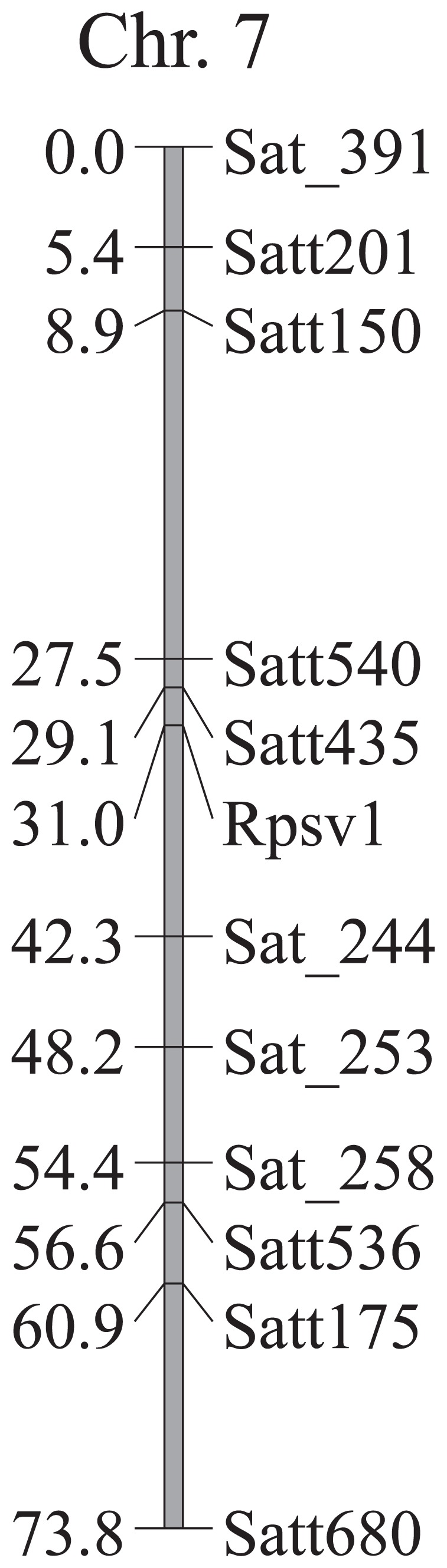
The peanut stunt virus (PSV) causes yield losses in soybean and reduced seed quality due to seed mottling. The objectives of this study were to determine the phenotypic reactions of soybean germplasms to inoculation with two PSV isolates (PSV-K, PSV-T), the inheritance of PSV resistance in soybean cultivars, and the locus of the PSV resistance gene. We investigated the PSV resistance of 132 soybean cultivars to both PSV isolates; of these, 73 cultivars exhibited resistance to both PSV isolates. Three resistant cultivars (Harosoy, Tsurunotamago 1 and Hyuga) were crossed with the susceptible cultivar Enrei. The crosses were evaluated in the F(1), F(2) and F(2:3) generations for their reactions to inoculation with the two PSV isolates. In an allelism test, we crossed Harosoy and Tsurunotamago 1 with the resistant cultivar Hyuga. The results revealed that PSV resistance in these cultivars is controlled by a single dominant gene at the same locus. We have proposed Rpsv1, as the name of the resistance gene in Hyuga. We also constructed a linkage map using recombinant inbred lines between Hyuga × Enrei using 176 SSR markers. We mapped Rpsv1 near the Satt435 locus on soybean chromosome 7.
花生丛矮病毒(PSV)会导致大豆减产和种子质量下降,出现种子斑驳的现象。本研究的目的是确定两个 PSV 分离株(PSV-K、PSV-T)对大豆种质接种的表型反应、大豆品种对 PSV 抗性的遗传以及 PSV 抗性基因的位置。我们调查了 132 个大豆品种对这两种 PSV 分离株的抗性;其中,73 个品种对这两种 PSV 分离株均表现出抗性。三个抗性品种(Harosoy、Tsurunotamago 1 和 Hyuga)与易感品种 Enrei 杂交。对这些杂交种的 F(1)、F(2)和 F(2:3)代进行了接种两种 PSV 分离株的反应评估。在等位基因测试中,我们将 Harosoy 和 Tsurunotamago 1 与抗性品种 Hyuga 进行了杂交。结果表明,这些品种的 PSV 抗性由同一基因座上的单个显性基因控制。我们提议将 Hyuga 中的抗性基因命名为 Rpsv1。我们还使用 Hyuga × Enrei 的重组自交系,通过 176 个 SSR 标记构建了一个连锁图谱。我们将 Rpsv1 定位在大豆 7 号染色体上的 Satt435 位点附近。