The Shraga Segal Department of Microbiology and Immunology, Faculty of Health Sciences, Ben-Gurion University of the Negev, P,O, Box 653, Beer-Sheva, 84105, Israel.
Malar J. 2012 Nov 8;11:371. doi: 10.1186/1475-2875-11-371.
The study of the Plasmodium falciparum heavy metal transporter gene pfmdr2 employed radioactive labelled heavy metal. As the use of radioactive isotopes shrank considerably during the last few years, resulting in the cessation of the production of some isotopes, amongst them Cadmium109 which was used for that purpose, a different approach had to be developed. Herein, a dual fluorescent labelling of heavy metals accumulation in the P. falciparum parasite is proposed as an alternative to the use of radioactive labelled heavy metals.
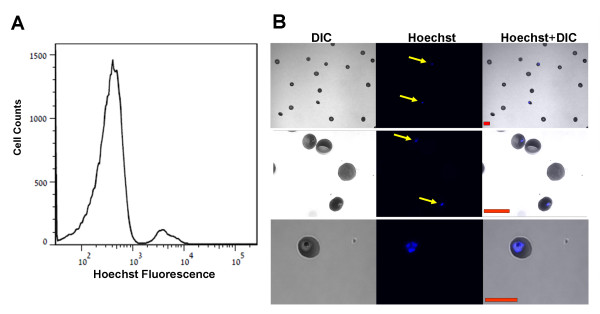
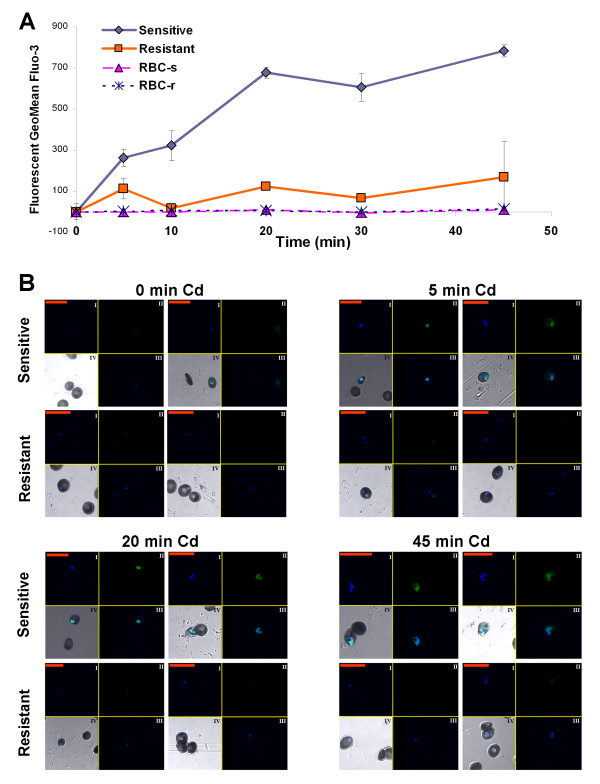
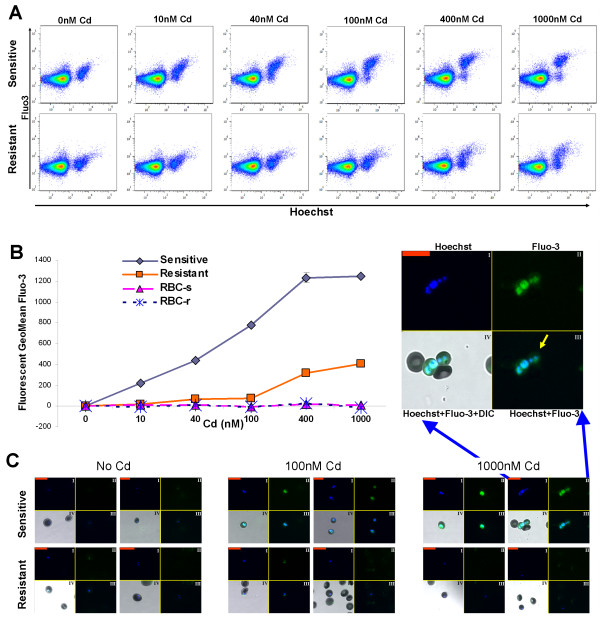
Plasmodium falciparum Cd resistant and sensitive strains at the trophozoite stage were used in this study. The cells were cultured at different CdCl2 concentrations and for different time periods followed by staining of the infected red blood cells with Fluo-3/AM for Cd detection and Hoechst 33342 for parasite DNA labelling. The fluorescent analysis was done by flow cytometry and confocal microscopy.
The results show that the sensitive strain has a higher Fluo-3/AM fluorescence in a Cd concentration and time dependent manner, whereas in the resistant strain Fluo-3/AM fluorescence levels were negligible and increased only at high concentrations of Cd and at long incubation periods, but to a much lesser extent than the sensitive strain. No Cd uptake is observed in uninfected red blood cells populations originating from cultures infected with either sensitive or resistant strain. In addition, confocal microscopy overlay of Fluo-3/AM and Hoechst staining shows that the Cd metal accumulates in the parasite itself.
The dual fluorescent labelling is a valid method for detecting heavy metal accumulation in P. falciparum. Furthermore, in contrast to the use of radioactive labelled heavy metal, the fluorescent labelling enables us to differentiate between the different populations existing in a P. falciparum infected red blood cells cultures and thus actually study a phenomenon at the level of a single cell.
本研究采用放射性标记重金属研究恶性疟原虫 Pfmdr2 基因。由于近年来放射性同位素的使用大大减少,导致一些同位素的生产停止,其中包括用于该目的的镉 109,因此必须开发一种不同的方法。本文提出了一种双荧光标记重金属在疟原虫寄生虫中的积累,作为替代放射性标记重金属的方法。
本研究使用恶性疟原虫 Cd 抗性和敏感株的滋养体阶段。将细胞在不同的 CdCl2 浓度和不同的时间段培养,然后用 Fluo-3/AM 对感染的红细胞进行染色以检测 Cd,用 Hoechst 33342 对寄生虫 DNA 进行标记。通过流式细胞术和共聚焦显微镜进行荧光分析。
结果表明,敏感株在 Cd 浓度和时间依赖性方面具有更高的 Fluo-3/AM 荧光强度,而在抗性株中 Fluo-3/AM 荧光水平可以忽略不计,仅在高浓度的 Cd 和长时间孵育后才增加,但程度远低于敏感株。未感染的红细胞群中未观察到 Cd 摄取,这些红细胞群来源于敏感或抗性株感染的培养物。此外,Fluo-3/AM 和 Hoechst 染色的共聚焦显微镜叠加显示,Cd 金属积聚在寄生虫本身。
双荧光标记是一种检测恶性疟原虫中重金属积累的有效方法。此外,与放射性标记重金属的使用相比,荧光标记使我们能够区分在恶性疟原虫感染的红细胞培养物中存在的不同群体,从而实际上在单个细胞水平上研究一种现象。