Groupe de recherche sur les maladies infectieuses du porc (GREMIP), Centre de recherche en infectiologie porcine (CRIP), Faculté de médecine vétérinaire Université de Montréal, 3200 rue Sicotte, Saint-Hyacinthe, J2S 7C6, Québec, Canada.
Virol J. 2012 Nov 13;9:267. doi: 10.1186/1743-422X-9-267.
Airborne transmitted pathogens, such as porcine reproductive and respiratory syndrome virus (PRRSV), need to interact with host cells of the respiratory tract in order to be able to enter and disseminate in the host organism. Pulmonary alveolar macrophages (PAM) and MA104 derived monkey kidney MARC-145 cells are known to be permissive to PRRSV infection and replication and are the most studied cells in the literature. More recently, new cell lines developed to study PRRSV have been genetically modified to make them permissive to the virus. The SJPL cell line origin was initially reported to be epithelial cells of the respiratory tract of swine. Thus, the goal of this study was to determine if SJPL cells could support PRRSV infection and replication in vitro.
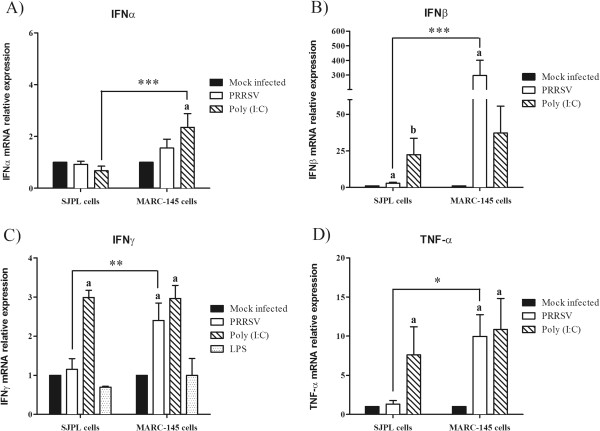
The SJPL cell growth was significantly slower than MARC-145 cell growth. The SJPL cells were found to express the CD151 protein but not the CD163 and neither the sialoadhesin PRRSV receptors. During the course of the present study, the SJPL cells have been reported to be of monkey origin. Nevertheless, SJPL cells were found to be permissive to PRRSV infection and replication even if the development of the cytopathic effect was delayed compared to PRRSV-infected MARC-145 cells. Following PRRSV replication, the amount of infectious viral particles produced in SJPL and MARC-145 infected cells was similar. The SJPL cells allowed the replication of several PRRSV North American strains and were almost efficient as MARC-145 cells for virus isolation. Interestingly, PRRSV is 8 to 16 times more sensitive to IFNα antiviral effect in SJPL cell in comparison to that in MARC-145 cells. PRRSV induced an increase in IFNβ mRNA and no up regulation of IFNα mRNA in both infected cell types. In addition, PRRSV induced an up regulation of IFNγ and TNF-α mRNAs only in infected MARC-145 cells.
In conclusion, the SJPL cells are permissive to PRRSV. In addition, they are phenotypically different from MARC-145 cells and are an additional tool that could be used to study PRRSV pathogenesis mechanisms in vitro.
空气传播的病原体,如猪繁殖与呼吸综合征病毒(PRRSV),需要与呼吸道宿主细胞相互作用,才能进入并在宿主生物体内传播。肺肺泡巨噬细胞(PAM)和 MA104 衍生的猴肾 MARC-145 细胞被认为允许 PRRSV 感染和复制,是文献中研究最多的细胞。最近,为研究 PRRSV 而开发的新细胞系已被遗传修饰以使其对病毒具有易感性。SJPL 细胞系的起源最初被报道为猪呼吸道的上皮细胞。因此,本研究的目的是确定 SJPL 细胞是否能够支持 PRRSV 在体外的感染和复制。
SJPL 细胞的生长速度明显慢于 MARC-145 细胞的生长速度。发现 SJPL 细胞表达 CD151 蛋白,但不表达 CD163 和唾液酸黏附素 PRRSV 受体。在本研究过程中,SJPL 细胞被报道为猴源性的。尽管如此,SJPL 细胞被发现允许 PRRSV 感染和复制,即使与感染 PRRSV 的 MARC-145 细胞相比,细胞病变效应的发展延迟。在 PRRSV 复制后,在 SJPL 和 MARC-145 感染细胞中产生的传染性病毒颗粒的量相似。SJPL 细胞允许几种北美 PRRSV 株的复制,并且对于病毒分离几乎与 MARC-145 细胞一样有效。有趣的是,与 MARC-145 细胞相比,PRRSV 在 SJPL 细胞中对 IFNα 抗病毒作用的敏感性高 8 至 16 倍。PRRSV 诱导两种感染细胞类型中 IFNβ mRNA 的增加,而 IFNα mRNA 没有上调。此外,PRRSV 仅在感染的 MARC-145 细胞中诱导 IFNγ 和 TNF-α mRNA 的上调。
总之,SJPL 细胞允许 PRRSV 感染。此外,它们与 MARC-145 细胞表型不同,是可用于体外研究 PRRSV 发病机制的另一种工具。