Département de Microbiologie et Infectiologie, Université de Sherbrooke, 3001 12ième Avenue Nord, Sherbrooke, J1H 5N4, Canada.
J Ovarian Res. 2012 Nov 15;5(1):34. doi: 10.1186/1757-2215-5-34.
Resistance to apoptosis is a major problem in ovarian cancer and correlates with poor prognosis. Osteoprotegerin (OPG) is a secreted factor in malignant ascites and acts as a decoy receptor for receptor activator of NF-κB ligand (RANKL) and tumor necrosis factor-related apoptosis-inducing ligand (TRAIL). TRAIL promotes apoptosis in ovarian cancer cells. Ovarian cancer ascites attenuate TRAIL-induced apoptosis raising the possibility that OPG contained in ascites may abrogate the anti-tumor activity of TRAIL.
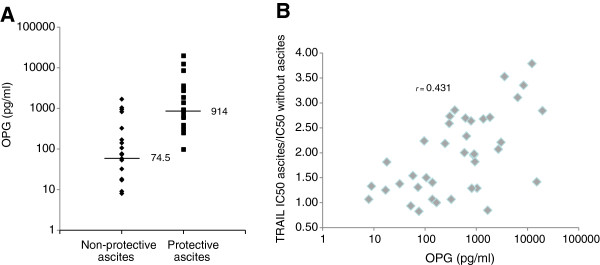
Determination of OPG levels in ascites was measured by ELISA. Effect of OPG on TRAIL-induced cell death was determined by XTT and colony forming assays in ovarian cancer cell lines and primary tumor cells. Apoptosis was assessed by ELISA.
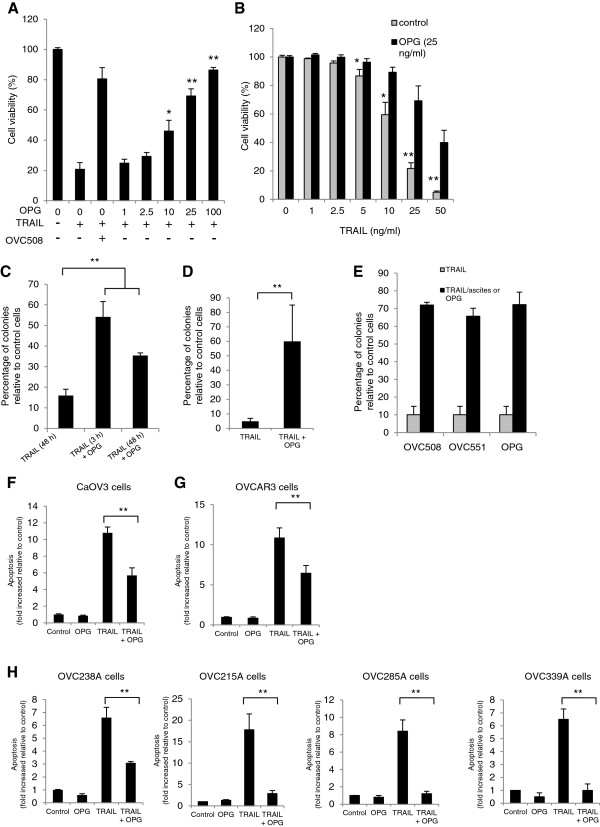
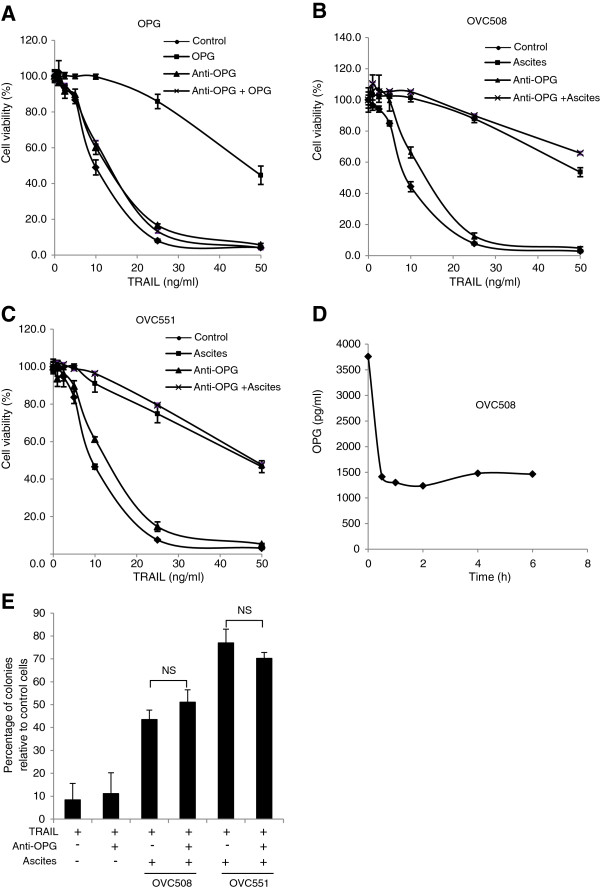
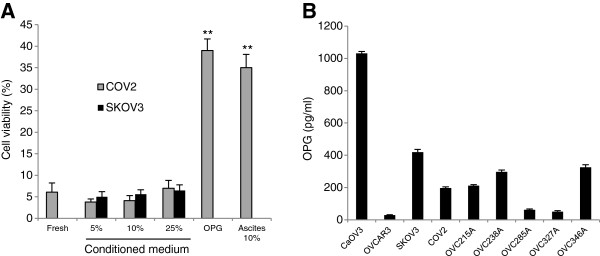
We found that recombinant OPG and malignant ascites attenuates TRAIL-induced cell death and apoptosis in a dose-dependent manner in ovarian cancer cell lines and primary ovarian tumor cells. OPG is present at high levels in the ascites of patients with ovarian cancer. We found a positive correlation between the levels of OPG in ascites and the ability of the ascites to attenuate TRAIL-induced cell death. The anti-apoptotic effect of ascites was not reversed by co-incubation with an OPG blocking antibody.
OPG and malignant ascites protect ovarian cancer cells from TRAIL-induced apoptosis. Although malignant ascites contain high levels of OPG, OPG is not a critical component that contributes to ascites-mediated attenuation of TRAIL-induced apoptosis.
抗细胞凋亡是卵巢癌的一个主要问题,与预后不良相关。护骨素(OPG)是恶性腹水的一种分泌因子,作为核因子-κB 配体(RANKL)和肿瘤坏死因子相关凋亡诱导配体(TRAIL)的诱饵受体起作用。TRAIL 可促进卵巢癌细胞凋亡。卵巢癌腹水会减弱 TRAIL 诱导的细胞凋亡,这使得腹水内可能存在的 OPG 会消除 TRAIL 的抗肿瘤活性。
通过 ELISA 测定腹水内 OPG 水平。通过 XTT 和集落形成测定法,在卵巢癌细胞系和原代肿瘤细胞中检测 OPG 对 TRAIL 诱导的细胞死亡的影响。通过 ELISA 评估细胞凋亡。
我们发现重组 OPG 和恶性腹水以剂量依赖的方式减弱了卵巢癌细胞系和原代卵巢肿瘤细胞中 TRAIL 诱导的细胞死亡和凋亡。OPG 在卵巢癌患者的腹水中含量很高。我们发现腹水内 OPG 水平与腹水减弱 TRAIL 诱导的细胞死亡的能力之间存在正相关。与 OPG 阻断抗体共孵育不能逆转腹水的抗凋亡作用。
OPG 和恶性腹水可保护卵巢癌细胞免受 TRAIL 诱导的凋亡。尽管恶性腹水含有高水平的 OPG,但 OPG 不是导致腹水介导的 TRAIL 诱导的凋亡减弱的关键成分。