Department of Medical Oncology, Nara Hospital, Kinki University Faculty of Medicine, Japan.
Int J Med Sci. 2012;9(10):833-7. doi: 10.7150/ijms.4914. Epub 2012 Nov 1.
Reports have been accumulating that genetic properties are predictive of clinical response after and/or toxicity during cancer chemotherapy, but little information is available concerning effects on long-term survival. In this study, 49 Japanese patients with esophageal squamous cell carcinoma (ESCC) were followed up for 5 years after treatment with a definitive 5-fluorouracil (5-FU)/cisplatin (CDDP)-based chemoradiotherapy (CRT), and the effects of genotypes of vascular endothelial growth factor (VEGF) were retrospectively revaluated in terms of prediction of long-term survival.
A course consisted of the continuous infusion of 5-FU at 400 mg/m(2)/day for days 1-5 and 8-12, the infusion of CDDP at 40 mg/m(2)/day on days 1 and 8, and radiation at 2 Gy/day on days 1 to 5, 8 to 12, and 15 to 19, with a second course repeated after a 2-week interval. The VEGF genotypes -1498T/C, -1154G/A, -634C/G, -7C/T, 936C/T, and 1612G/A were evaluated.
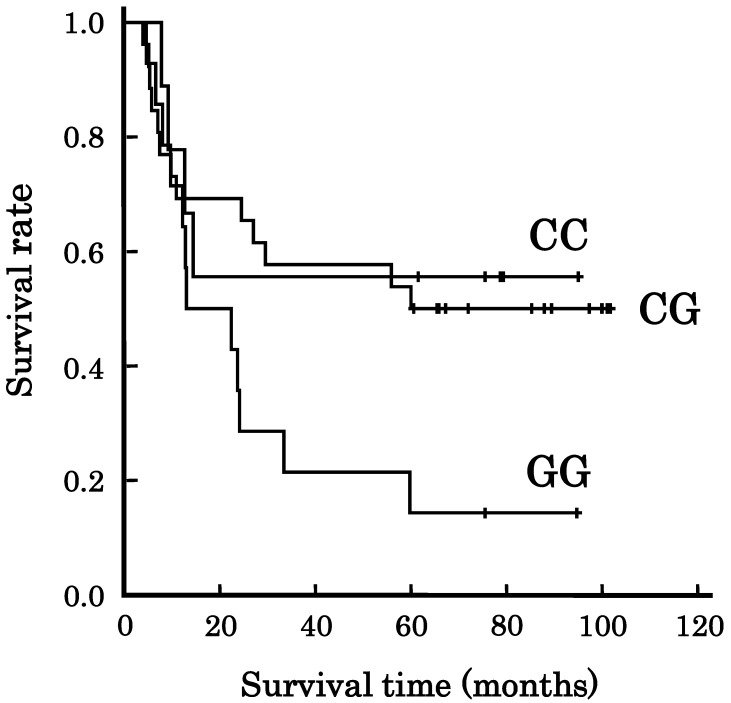
The complete response (CR) rate was 46.9% (23/49). The 5-year survival rate was 42.9 % (21/49). There were 7 patients with a CR, but survival of less than 5 years. They died from myocardial infarction (N=1), sudden cardiac death after suffering from heart failure (N=1), acute myeloid leukemia that developed from myelodysplastic syndromes (N=1), factors not specified (N=2), oropharynx cancer (N=1), and tongue cancer (N=1). VEGF -634C/G had no effect on clinical response, but long-term survival depended on the genotype (p=0.033, Fisher's; p=0.038, Cochran-Armitage; p=0.079, Log-rank). The genotype frequency of 7 patients with a CR, but survival of less than 5 years was different from that for the other 42 patients (p=0.032, Fisher's). None of the other 5 genotypes evaluated affected either clinical response or survival.
VEGF -634C/G is possibly predictive of long-term survival after treatment with a definitive 5-FU/CDDP-based CRT. Further clinical studies with a larger number of cases are needed to clarify the effects of this genotype.
越来越多的报告表明,遗传特性可预测癌症化疗后的临床反应和/或毒性,但关于对长期生存的影响,相关信息有限。在这项研究中,对 49 名接受确定性氟尿嘧啶(5-FU)/顺铂(CDDP)为基础的放化疗(CRT)治疗的食管鳞状细胞癌(ESCC)患者进行了 5 年的随访,并回顾性评估了血管内皮生长因子(VEGF)基因型对长期生存的预测效果。
该方案包括 5-FU 连续输注 400mg/m2/天,第 1-5 天和第 8-12 天;CDDP 输注 40mg/m2/天,第 1 天和第 8 天;第 1-5 天、第 8-12 天和第 15-19 天每天给予 2Gy 放疗,2 周后重复第二疗程。评估了 VEGF 的 -1498T/C、-1154G/A、-634C/G、-7C/T、936C/T 和 1612G/A 基因型。
完全缓解(CR)率为 46.9%(23/49)。5 年生存率为 42.9%(21/49)。有 7 名患者达到 CR,但生存时间不到 5 年。他们死于心肌梗死(N=1)、心力衰竭后心源性猝死(N=1)、从骨髓增生异常综合征发展而来的急性髓系白血病(N=1)、未指明的因素(N=2)、口咽癌(N=1)和舌癌(N=1)。VEGF-634C/G 对临床反应没有影响,但长期生存取决于基因型(p=0.033,Fisher 检验;p=0.038,Cochran-Armitage 检验;p=0.079,Log-rank 检验)。7 名 CR 但生存时间不足 5 年患者的基因型频率与其他 42 名患者不同(p=0.032,Fisher 检验)。评估的其他 5 种基因型均未影响临床反应或生存。
VEGF-634C/G 可能是预测接受确定性 5-FU/CDDP 为基础的 CRT 治疗后长期生存的指标。需要进一步的大样本临床试验来阐明这种基因型的影响。