Department of Crop and Forest Sciences and AGROTECNIO (Centre for Research in Agrotechnology), University of Lleida, Av. Rovira Roure 191, 25198 Lleida, Spain.
J Exp Bot. 2013 Jan;64(1):169-84. doi: 10.1093/jxb/ers320. Epub 2012 Nov 16.
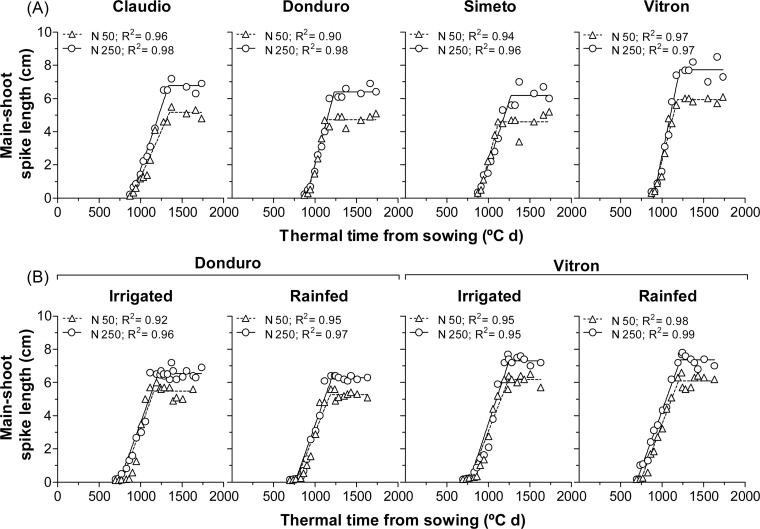
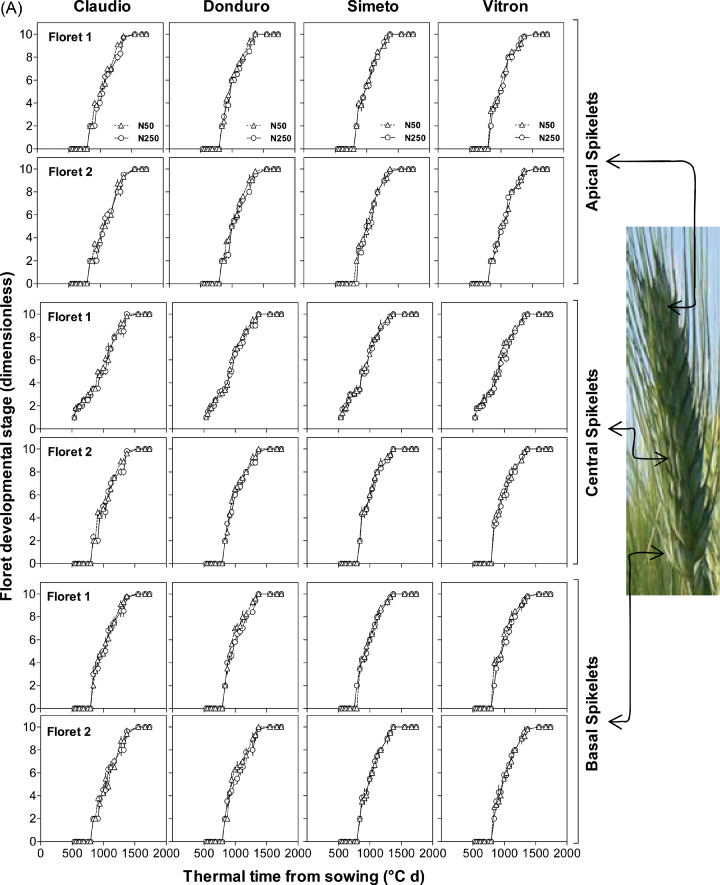
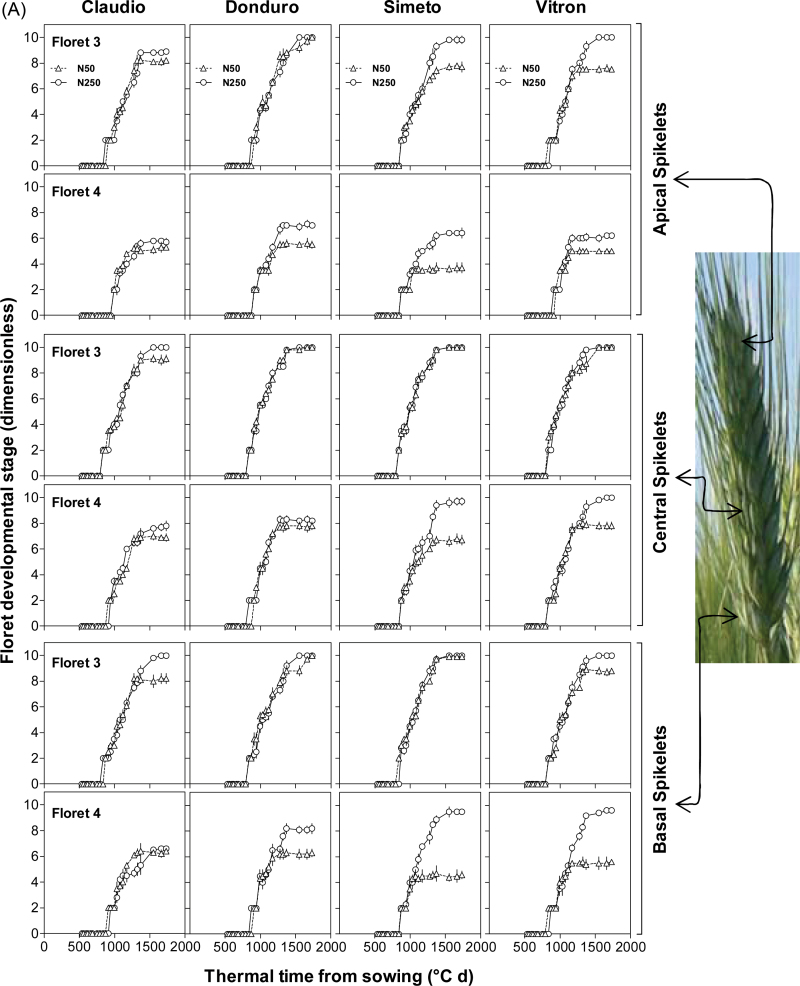
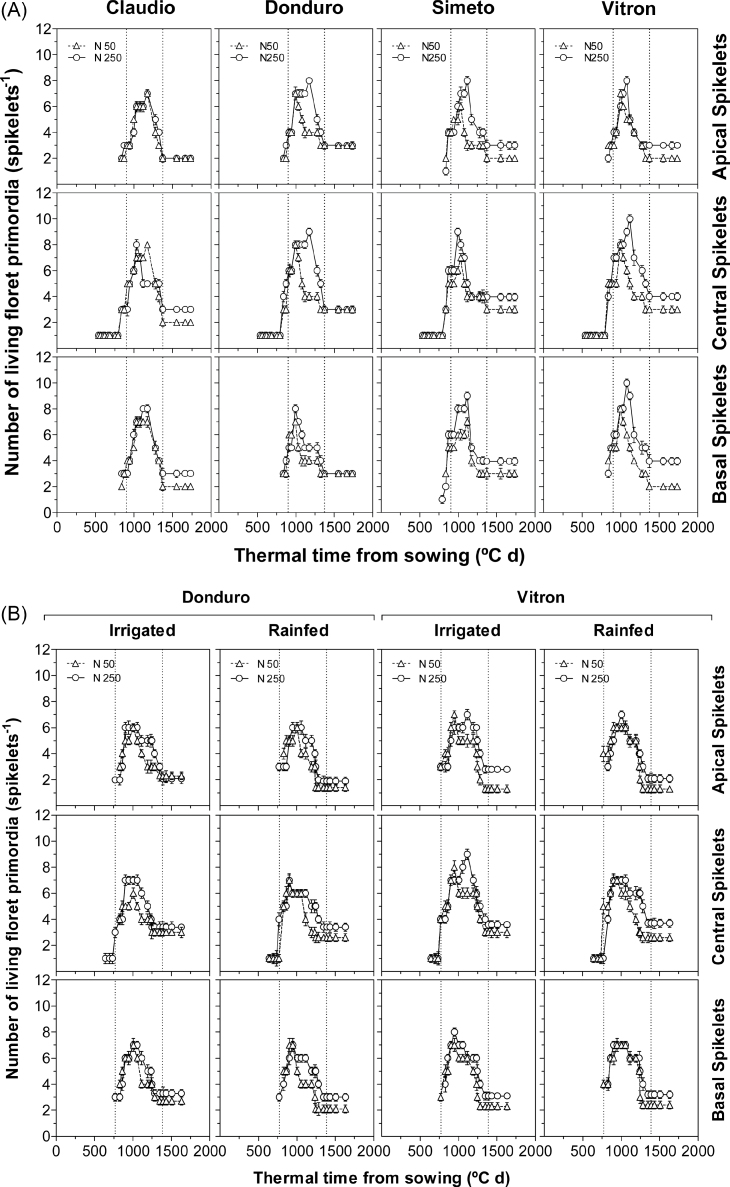
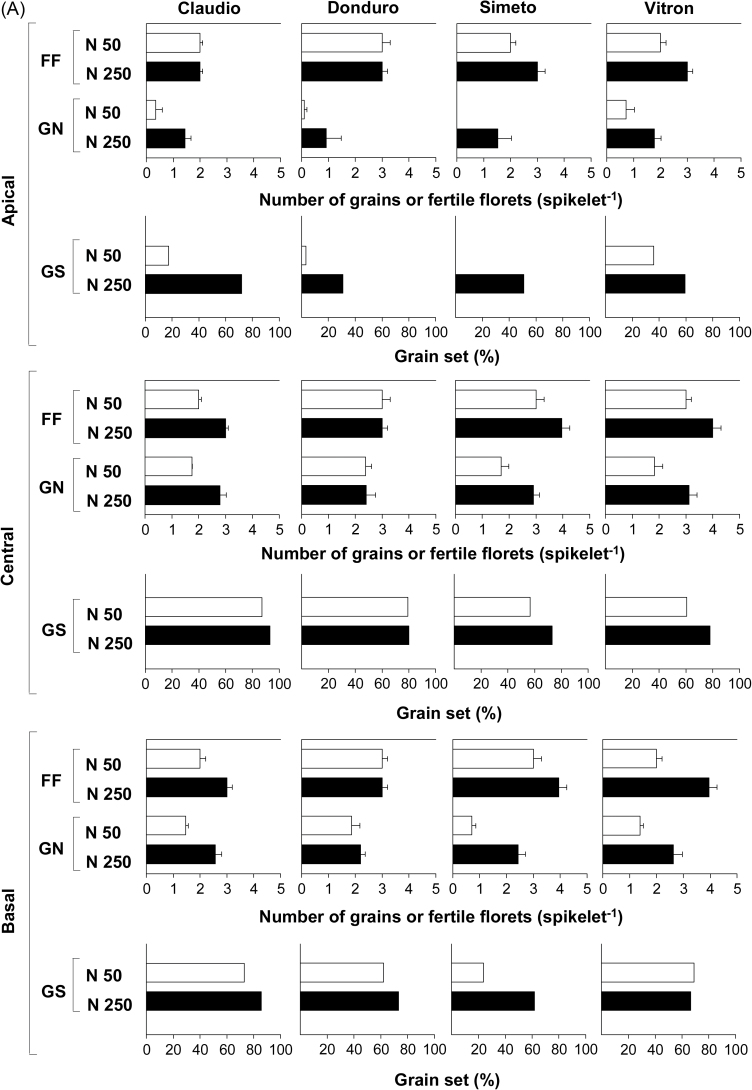
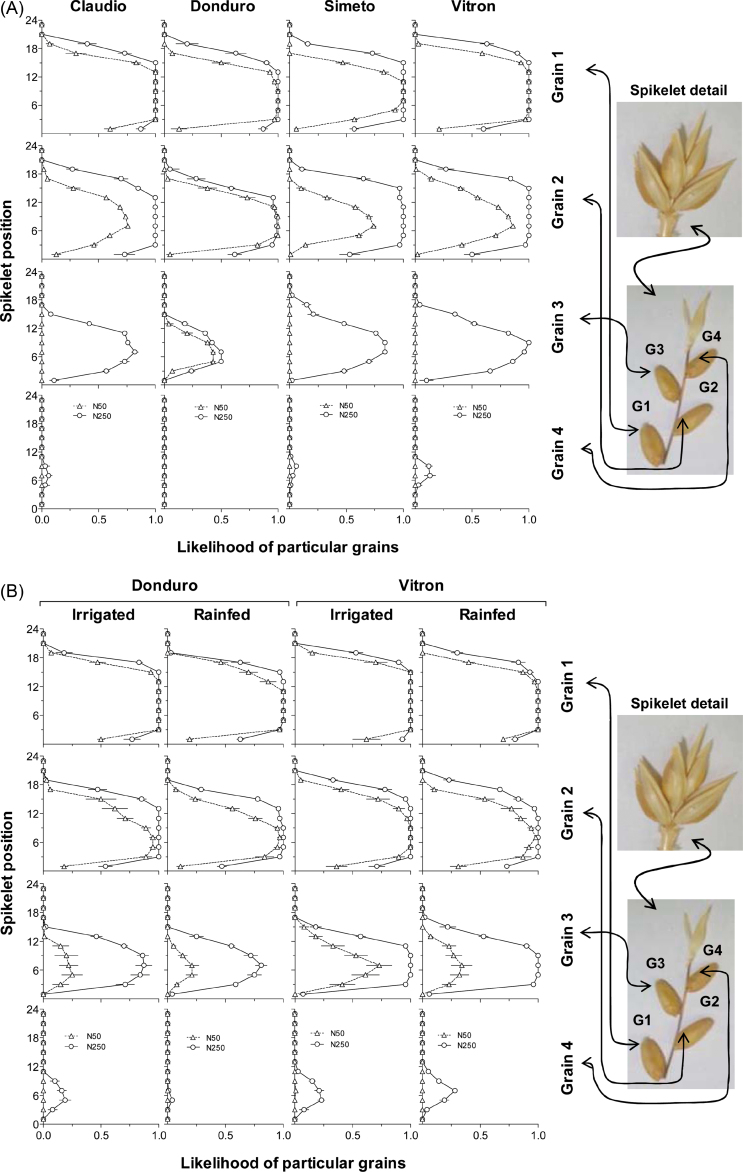
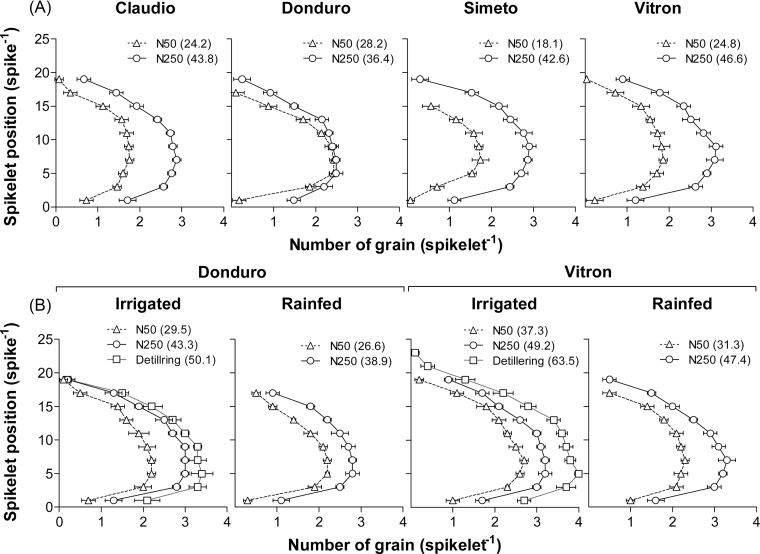
Wheat yield depends on the number of grains per square metre, which in turn is related to the number of fertile florets at anthesis. The dynamics of floret generation/degeneration were studied in contrasting conditions of nitrogen (N) and water availability of modern, well-adapted, durum wheats in order to understand further the bases for grain number determination. Experiments were carried out during the 2008-2009 and 2009-2010 growing seasons at Lleida (NE Spain). The first experiment involved four cultivars (Claudio, Donduro, Simeto, and Vitron) and two contrasting N availabilities (50 kgN ha(-1) and 250 kgN ha(-1); N50 and N250) while experiment 2 included the two cultivars most contrasting in grain setting responsiveness to N in experiment 1, and two levels of N (N50 and N250), under irrigated (IR) and rainfed (RF) conditions. In addition, a detillering treatment was imposed on both cultivars under the IR+N250 condition. The number of fertile florets at anthesis was increased by ~30% in response to N fertilization (averaging across treatments and spikelet positions). The effect of N and water availability was evident on floret developmental rates from the third floret primordium onwards, as these florets in the central spikelets of all genotypes reached the stage of a fertile floret in N250 while in N50 they did not. In this study, clear differences were found between the cultivars in their responsiveness to N by producing more fertile florets at anthesis (through accelerating developmental rates of floret primordia), by increasing the likelihood of particular grains to be set, or by both traits.
小麦的产量取决于每平方米的粒数,而每平方米的粒数又与开花期的可育小花数有关。为了进一步了解籽粒数决定的基础,本研究在氮(N)和水分供应不同的条件下,对现代适应性强的硬粒小麦品种小花的发生/退化动态进行了研究。试验于 2008-2009 年和 2009-2010 年在莱里达(西班牙东北部)进行。第一个试验涉及 4 个品种(Claudio、Donduro、Simeto 和 Vitron)和两种不同的 N 供应(50 kgN ha(-1)和 250 kgN ha(-1);N50 和 N250),而试验 2 则包括在试验 1 中对 N 响应差异最大的两个品种,以及在灌溉(IR)和雨养(RF)条件下的两个 N 水平(N50 和 N250)。此外,在 IR+N250 条件下对两个品种进行了去蘖处理。N 施肥使开花期可育小花数增加了约 30%(平均处理和小穗位置)。N 和水分供应的影响在小花发育速率上从第三个小花原基开始显现,因为所有基因型的中央小穗中的这些小花在 N250 下达到可育小花的阶段,而在 N50 下则没有。在这项研究中,不同品种对 N 的响应存在明显差异,通过加速小花原基的发育速率(通过增加特定籽粒结实的可能性),或通过这两种特性,在开花期产生更多的可育小花。