Center of Excellence in Environmental Toxicology, Department of Pharmacology, Perelman School of Medicine, University of Pennsylvania Philadelphia, PA, USA.
Front Pharmacol. 2012 Nov 16;3:193. doi: 10.3389/fphar.2012.00193. eCollection 2012.
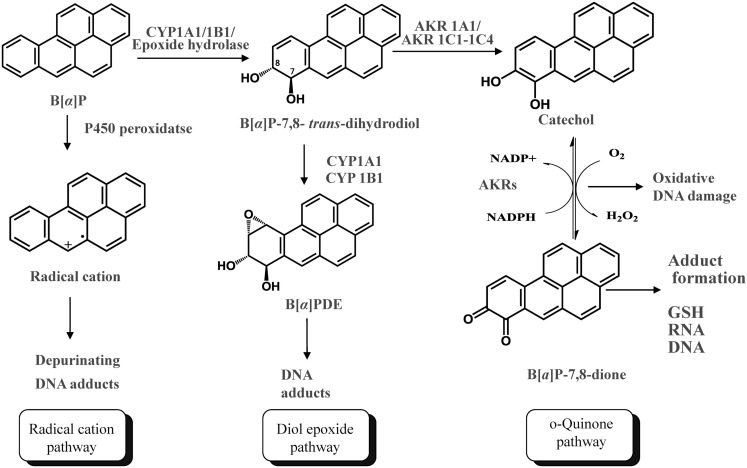
Polycyclic aromatic hydrocarbons (PAH) are ubiquitous environmental pollutants. They are procarcinogens requiring metabolic activation to elicit their deleterious effects. Aldo-keto reductases (AKR) catalyze the oxidation of proximate carcinogenic PAH trans-dihydrodiols to yield electrophilic and redox-active PAH o-quinones. AKRs are also found to be capable of reducing PAH o-quinones to form PAH catechols. The interconversion of o-quinones and catechols results in the redox-cycling of PAH o-quinones to give rise to the generation of reactive oxygen species and subsequent oxidative DNA damage. On the other hand, PAH catechols can be intercepted through phase II metabolism by which PAH o-quinones could be detoxified and eliminated. The aim of the present review is to summarize the role of human AKRs in the metabolic activation/detoxication of PAH and the relevance of phase II conjugation reactions to human lung carcinogenesis.
多环芳烃(PAH)是普遍存在的环境污染物。它们是前致癌物质,需要代谢激活才能发挥其有害作用。醛酮还原酶(AKR)催化近致癌性 PAH 反式二氢二醇的氧化,生成亲电和氧化还原活性的 PAH o-醌。AKR 也被发现能够将 PAH o-醌还原为形成 PAH 儿茶酚。o-醌和儿茶酚的相互转化导致 PAH o-醌的氧化还原循环,产生活性氧物种和随后的氧化 DNA 损伤。另一方面,PAH 儿茶酚可以通过 II 相代谢被拦截,通过这种代谢,PAH o-醌可以解毒和消除。本综述的目的是总结人 AKR 在 PAH 的代谢激活/解毒中的作用,以及 II 相结合反应与人类肺癌发生的相关性。