Hu Zhongwu, Wang Wenli, Zhang Jie, Mao Feng, Shen-Tu Yang
Department of Thoracic Surgery, Shanghai Chest Hospital/Shanghai Lung Tumor Clinical Medical Center, Shanghai 200030, China.
Zhongguo Fei Ai Za Zhi. 2012 Nov;15(11):656-62. doi: 10.3779/j.issn.1009-3419.2012.11.09.
Studies have shown that tumor metastasis in a variety of tumors is associated with lymphangiogenesis and lymphatic vessel invasion (LVI). Tumor metastasis is an important factor that affects the prognosis of patients. The aim of this study is to determine the prognostic value of lymphangiogenesis and LVI in non-small cell lung cancer (NSCLC).
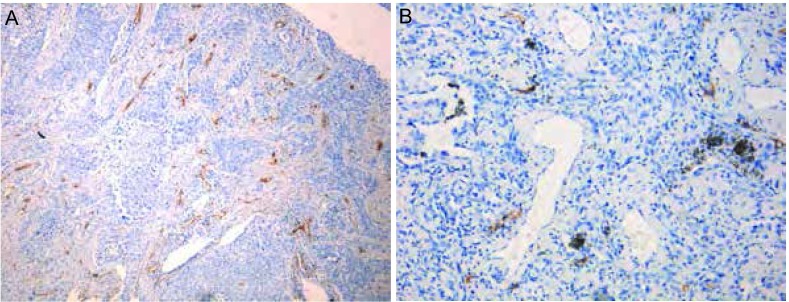
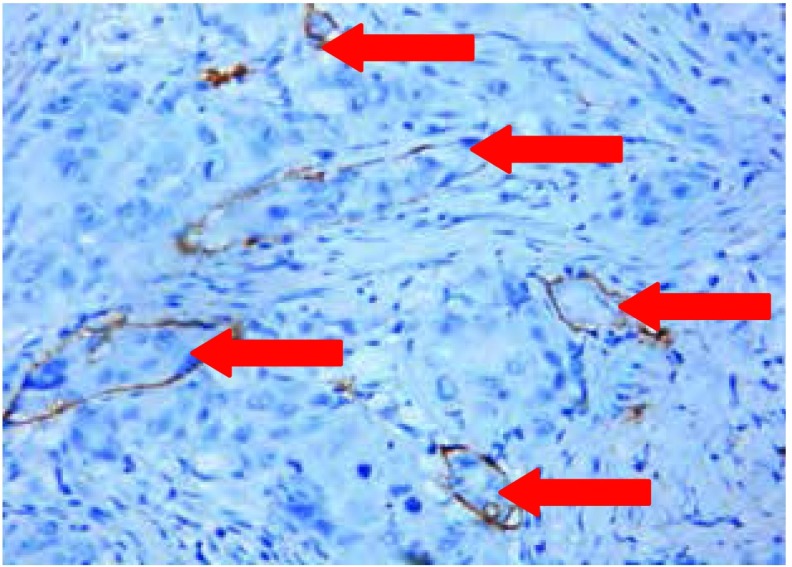
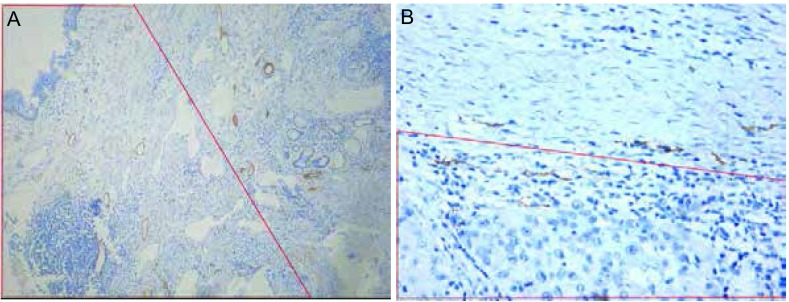
We marked the endothelial cells of lymph vessels in lymphangiogenesis with specific monoclonal antibody D2-40. Immunohistochemistry was used to detect the expression of lymphangiogenesis and LVI in 79 cases of stage I-III NSCLC.
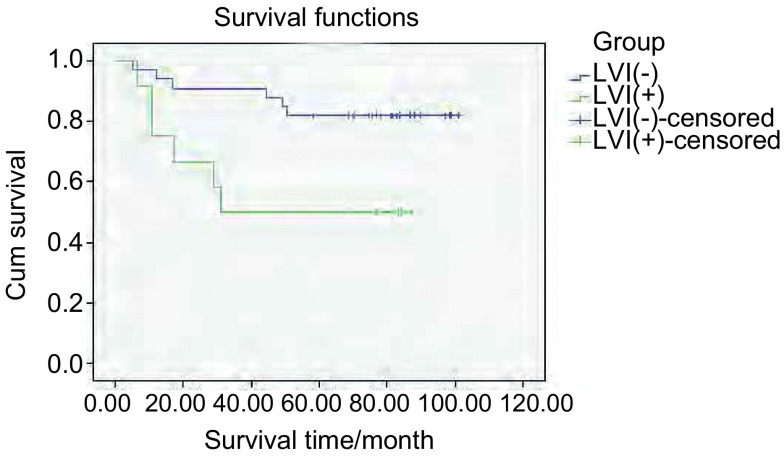
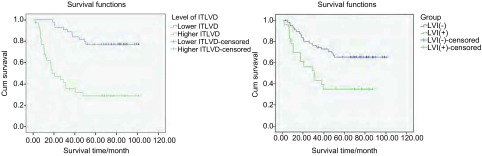
The intratumoral lymphatic vessel density (ITLVD) was significantly higher in patients with N2 disease than those with N0 disease (P=0.015). The ITLVD was significantly higher in patients with LVI+ than that in those with LVI- (P = 0.009). The ITLVD was also remarkably higher in poorly differentiated tumors than that in highly differentiated ones (P = 0.007). The ITLVD was remarkably higher in adenocarcinoma than that in squamous cell carcinomas (P = 0.025). Kaplan-Meier revealed that the survival rates of patients with higher ITLVD were remarkably poorer than those with lower ITLVD (P = 0.007). Thus, the ITLVD is an important prognostic factor of NSCLC. The peritumoral lymphatic vessel density is not correlated with the prognosis.
The ITLVD level is an important prognostic factor of NSCLC.
研究表明,多种肿瘤中的肿瘤转移与淋巴管生成及淋巴管浸润(LVI)相关。肿瘤转移是影响患者预后的重要因素。本研究旨在确定淋巴管生成及LVI在非小细胞肺癌(NSCLC)中的预后价值。
我们用特异性单克隆抗体D2-40标记淋巴管生成中淋巴管的内皮细胞。采用免疫组织化学法检测79例Ⅰ-Ⅲ期NSCLC中淋巴管生成及LVI的表达情况。
N2期患者的瘤内淋巴管密度(ITLVD)显著高于N0期患者(P=0.015)。LVI+患者的ITLVD显著高于LVI-患者(P = 0.009)。低分化肿瘤的ITLVD也显著高于高分化肿瘤(P = 0.007)。腺癌的ITLVD显著高于鳞状细胞癌(P = 0.025)。Kaplan-Meier分析显示,ITLVD较高的患者生存率显著低于ITLVD较低的患者(P = 0.007)。因此,ITLVD是NSCLC的重要预后因素。瘤周淋巴管密度与预后无关。
ITLVD水平是NSCLC的重要预后因素。