Copenhagen Center for Glycomics, Department of Cellular and Molecular Medicine, University of Copenhagen, Copenhagen N, DK-2200, Denmark.
Br J Cancer. 2013 Jan 15;108(1):107-14. doi: 10.1038/bjc.2012.517. Epub 2012 Nov 20.
Recent reports from cancer screening trials in high-risk populations suggest that autoantibodies can be detected before clinical diagnosis. However, there is minimal data on the role of autoantibody signatures in cancer screening in the general population.
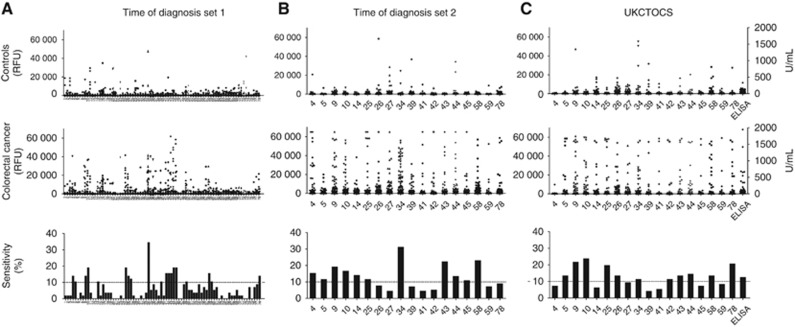
Informative p53 peptides were identified in sera from patients with colorectal cancer using an autoantibody microarray with 15-mer overlapping peptides covering the complete p53 sequence. The selected peptides were evaluated in a blinded case-control study using stored serum from the multimodal arm of the United Kingdom Collaborative Trial of Ovarian Cancer Screening where women gave annual blood samples. Cases were postmenopausal women who developed colorectal cancer following recruitment, with 2 or more serum samples preceding diagnosis. Controls were age-matched women with no history of cancer.
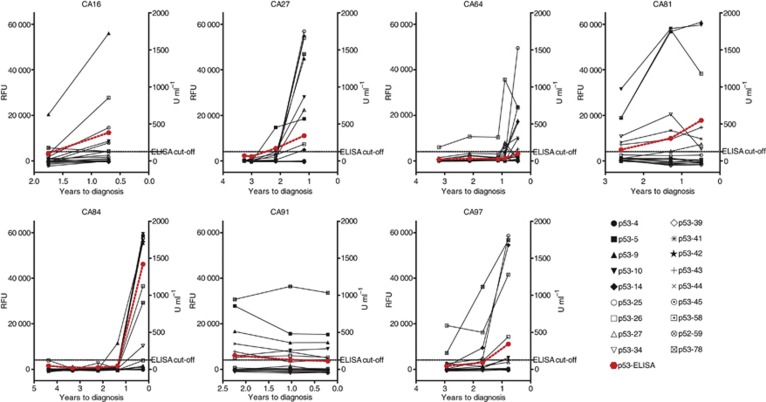
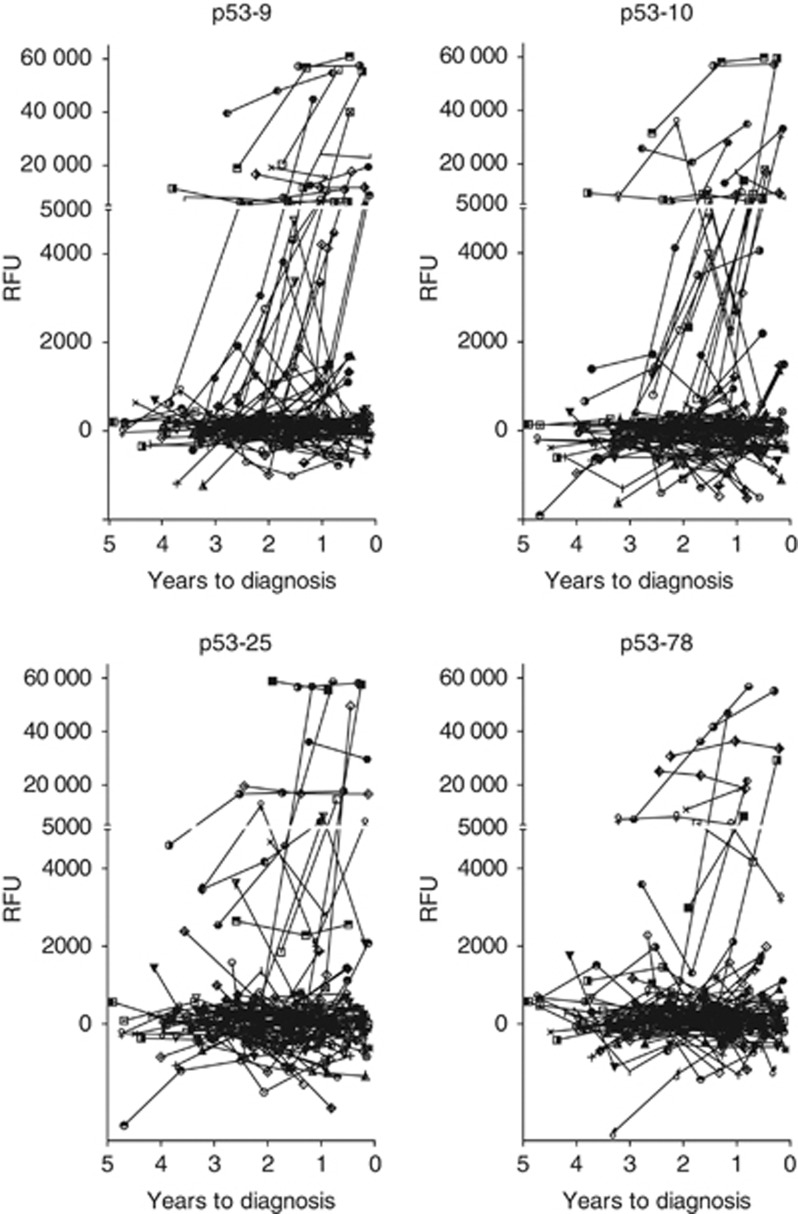
The 50 640 women randomised to the multimodal group were followed up for a median of 6.8 (inter-quartile range 5.9-8.4) years. Colorectal cancer notification was received in 101 women with serial samples of whom 97 (297 samples) had given consent for secondary studies. They were matched 1 : 1 with 97 controls (296 serial samples). The four most informative peptides identified 25.8% of colorectal cancer patients with a specificity of 95%. The median lead time was 1.4 (range 0.12-3.8) years before clinical diagnosis.
Our findings suggest that in the general population, autoantibody signatures are detectable during preclinical disease and may be of value in cancer screening. In colorectal cancer screening in particular, where the current need is to improve compliance, it suggests that p53 autoantibodies may contribute towards risk stratification.
最近来自高危人群癌症筛查试验的报告表明,在临床诊断之前可以检测到自身抗体。然而,在普通人群中,关于自身抗体特征在癌症筛查中的作用的数据很少。
使用包含全长 p53 序列的 15 个重叠肽的自身抗体微阵列,从结直肠癌患者的血清中鉴定出信息性 p53 肽。在英国卵巢癌筛查多模式试验的多模式臂中储存的血清中使用经盲法病例对照研究评估了所选肽,其中女性每年采集一次血液样本。病例为绝经后妇女,在招募后患有结直肠癌,在诊断前有 2 个或更多血清样本。对照是无癌症史的年龄匹配女性。
在多模式组中随机分配的 50640 名女性中位随访 6.8 年(四分位距 5.9-8.4)。在收到 101 名有连续样本的妇女的结直肠癌通知后,其中 97 名(297 个样本)已同意进行二次研究。他们与 97 名对照(296 个连续样本)按 1:1 匹配。鉴定出的四个最具信息量的肽识别了 25.8%的结直肠癌患者,特异性为 95%。中位领先时间为临床诊断前 1.4 年(范围 0.12-3.8)。
我们的研究结果表明,在普通人群中,在临床前疾病期间可以检测到自身抗体特征,并且可能对癌症筛查有价值。在结直肠癌筛查中,特别是在需要提高依从性的情况下,这表明 p53 自身抗体可能有助于风险分层。