Division of Nutritional Sciences, Cornell University, Ithaca, NY, USA.
Nutr Diabetes. 2012 Oct 8;2(10):e49. doi: 10.1038/nutd.2012.23.
We aimed to test the hypotheses that (i) plasma choline metabolites differ between normal (body mass index (BMI)<25 kg m(-2)) and overweight (BMI 25 kg m(-2)) men, and (ii) an elevated BMI alters associations between plasma choline metabolites and indicators of metabolic stress.
This was a cross-sectional study. A one-time fasting blood sample was obtained for measurements of the choline metabolites and metabolic stress indicators (that is, serum alanine aminotransferase (ALT), glucose, high-density lipoprotein cholesterol, low-density lipoprotein cholesterol, triglycerides and homocysteine), and for genotype determination.
The analysis was conducted with 237 Mexican American men with a median age of 22 years.
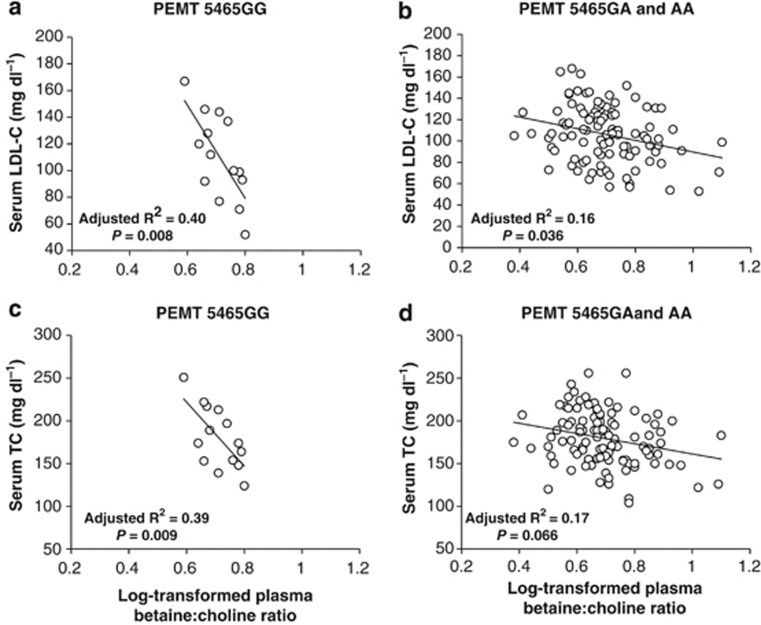
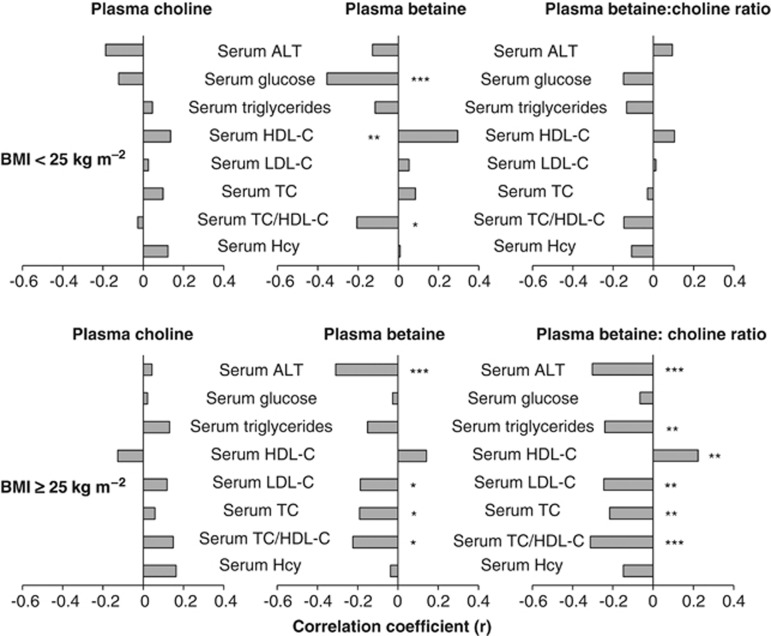
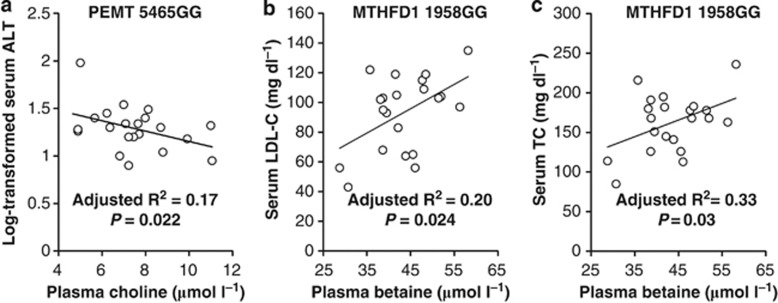
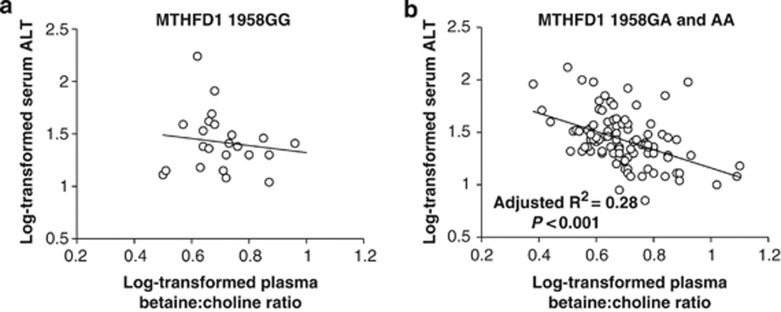
Compared with men with a normal BMI (n=98), those with an elevated BMI (n=139) had 6% lower (P=0.049) plasma betaine and an 11% lower (P=0.002) plasma betaine to choline ratio. Among men with an elevated BMI, plasma betaine and the plasma betaine to choline ratio positively associated (P0.044) with a favorable serum cholesterol profile, and inversely associated (P=0.001) with serum ALT, a marker of liver dysfunction. The phosphatidylethanolamine N-methyltransferase (PEMT) 5465GA (rs7946) genotype interacted (P0.007) with the plasma betaine to choline ratio to modulate indicators of metabolic stress with stronger inverse associations observed among overweight men with the PEMT 5465GG genotype.
Plasma choline metabolites predict metabolic stress among overweight men often in a genotype-specific manner. The diminished betaine among overweight men coupled with the inverse association between betaine and metabolic stress suggest that betaine supplementation may be effective in mitigating some of the metabolic insults arising from lipid overload.
我们旨在检验以下两个假设:(i)正常体重(BMI<25kg/m2)和超重(BMI≥25kg/m2)男性的血浆胆碱代谢物不同;(ii)BMI 升高改变了血浆胆碱代谢物与代谢应激指标之间的关联。
这是一项横断面研究。采集一次空腹血样,用于测量胆碱代谢物和代谢应激指标(即血清丙氨酸氨基转移酶(ALT)、血糖、高密度脂蛋白胆固醇、低密度脂蛋白胆固醇、甘油三酯和同型半胱氨酸),并进行基因型测定。
分析对象为 237 名中位年龄为 22 岁的墨西哥裔美国男性。
与 BMI 正常的男性(n=98)相比,BMI 升高的男性(n=139)的血浆甜菜碱水平低 6%(P=0.049),血浆甜菜碱与胆碱的比值低 11%(P=0.002)。在 BMI 升高的男性中,血浆甜菜碱和血浆甜菜碱与胆碱的比值与良好的血清胆固醇谱呈正相关(P<0.044),与血清丙氨酸氨基转移酶(ALT)呈负相关(P=0.001),后者是肝功能障碍的标志物。磷酸乙醇胺 N-甲基转移酶(PEMT)5465G>A(rs7946)基因型与血浆甜菜碱与胆碱的比值相互作用(P<0.007),调节代谢应激指标,在 PEMT 5465GG 基因型的超重男性中观察到更强的负相关。
血浆胆碱代谢物可预测超重男性的代谢应激,且通常呈基因型特异性。超重男性的甜菜碱水平降低,以及甜菜碱与代谢应激之间的负相关提示,甜菜碱补充可能有效减轻脂质过载引起的一些代谢损伤。