Department of Biology, University of Missouri - St. Louis, One University Blvd. St. Louis, Missouri, 63121 ; Whitney R. Harris World Ecology Center, University of Missouri - St. Louis, One University Blvd. St. Louis, Missouri, 63121.
Ecol Evol. 2012 Nov;2(11):2775-87. doi: 10.1002/ece3.386. Epub 2012 Oct 4.
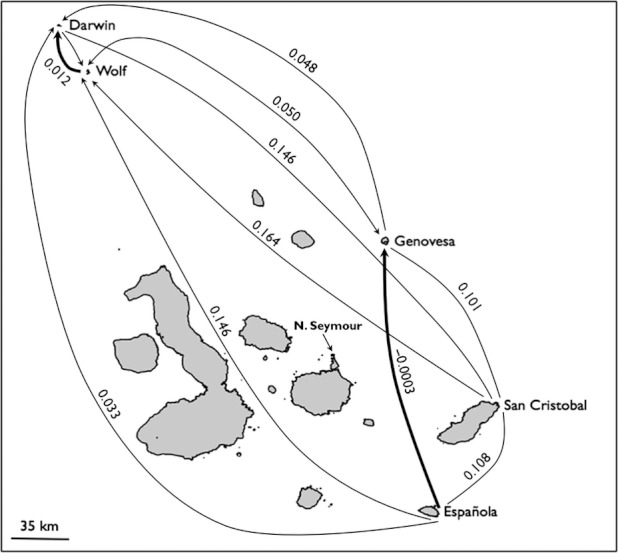
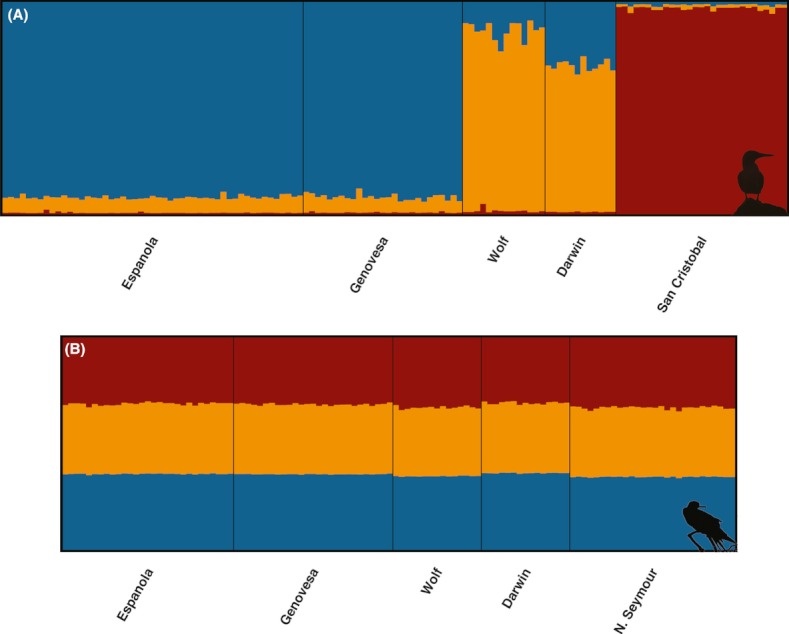
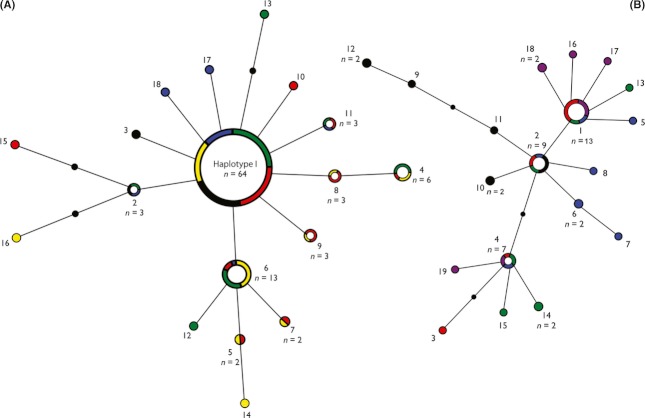
Seabirds are considered highly mobile, able to fly great distances with few apparent barriers to dispersal. However, it is often the case that seabird populations exhibit strong population genetic structure despite their potential vagility. Here we show that Galapagos Nazca booby (Sula granti) populations are substantially differentiated, even within the small geographic scale of this archipelago. On the other hand, Galapagos great frigatebird (Fregata minor) populations do not show any genetic structure. We characterized the genetic differentiation by sampling five colonies of both species in the Galapagos archipelago and analyzing eight microsatellite loci and three mitochondrial genes. Using an F-statistic approach on the multilocus data, we found significant differentiation between nearly all island pairs of Nazca booby populations and a Bayesian clustering analysis provided support for three distinct genetic clusters. Mitochondrial DNA showed less differentiation of Nazca booby colonies; only Nazca boobies from the island of Darwin were significantly differentiated from individuals throughout the rest of the archipelago. Great frigatebird populations showed little to no evidence for genetic differentiation at the same scale. Only two island pairs (Darwin - Wolf, N. Seymour - Wolf) were significantly differentiated using the multilocus data, and only two island pairs had statistically significant φ(ST) values (N. Seymour - Darwin, N. Seymour - Wolf) according to the mitochondrial data. There was no significant pattern of isolation by distance for either species calculated using both markers. Seven of the ten Nazca booby migration rates calculated between island pairs were in the south or southeast to north or northwest direction. The population differentiation found among Galapagos Nazca booby colonies, but not great frigatebird colonies, is most likely due to differences in natal and breeding philopatry.
海鸟被认为具有高度的流动性,能够在不明显阻碍扩散的情况下长距离飞行。然而,尽管海鸟可能具有较强的扩散能力,但它们的种群通常表现出强烈的种群遗传结构。在这里,我们表明,加拉帕戈斯海雀(Sula granti)种群尽管在该群岛的小地理尺度内,但分化程度很大。另一方面,加拉帕戈斯军舰鸟(Fregata minor)种群没有表现出任何遗传结构。我们通过在加拉帕戈斯群岛采样这两个物种的五个群体,并分析了 8 个微卫星位点和 3 个线粒体基因来描述遗传分化。在多基因座数据上使用 F 统计量方法,我们发现纳扎尔雀种群的几乎所有岛屿对之间都存在显著的分化,贝叶斯聚类分析为三个不同的遗传聚类提供了支持。线粒体 DNA 显示纳扎尔雀群体的分化程度较低;只有达尔文岛上的纳扎尔雀与整个群岛其他地方的个体有明显的分化。军舰鸟种群在同一规模上几乎没有表现出遗传分化的证据。只有两组岛屿(达尔文 - 沃尔夫、北西摩 - 沃尔夫)在多基因座数据上表现出显著的分化,只有两组岛屿的线粒体数据显示出统计学上显著的 φ(ST)值(北西摩 - 达尔文、北西摩 - 沃尔夫)。使用两种标记物计算,无论是物种的隔离与距离都没有显著的模式。在计算的 10 对纳扎尔雀岛屿对之间的迁徙率中,有 7 对在南或东南方向到北或西北方向。在加拉帕戈斯海雀群体中发现的种群分化,而不是军舰鸟群体,最有可能是由于繁殖地和繁殖地的差异。