Wen Wei, Shi Chuanbing, Shi Yan, Ji Guozhong, Wu Ping, Fan Zhining, Zhang Faming
Institute of Digestive Endoscopy and Medical Center for Digestive Diseases and.
Exp Ther Med. 2012 Sep;4(3):419-424. doi: 10.3892/etm.2012.626. Epub 2012 Jun 29.
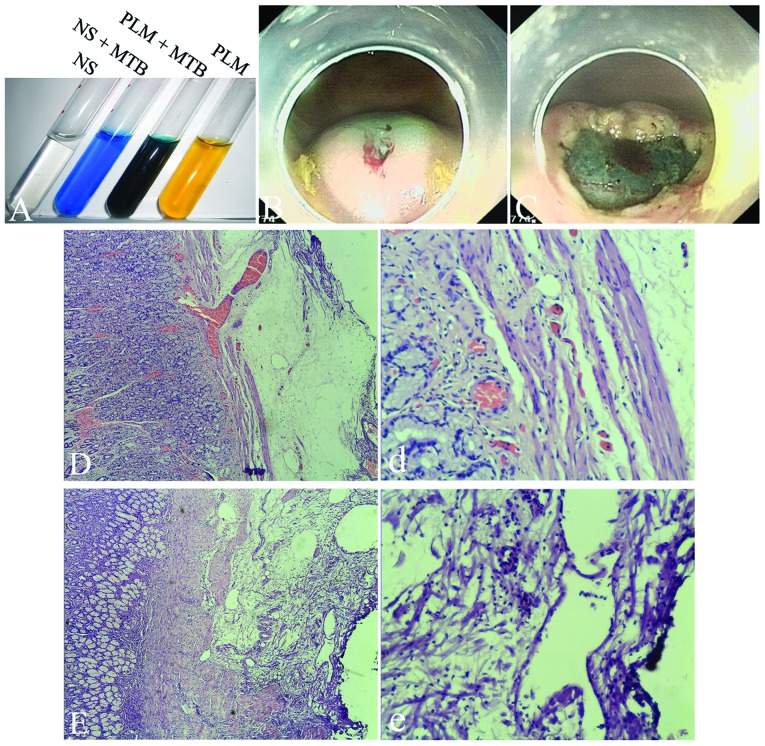
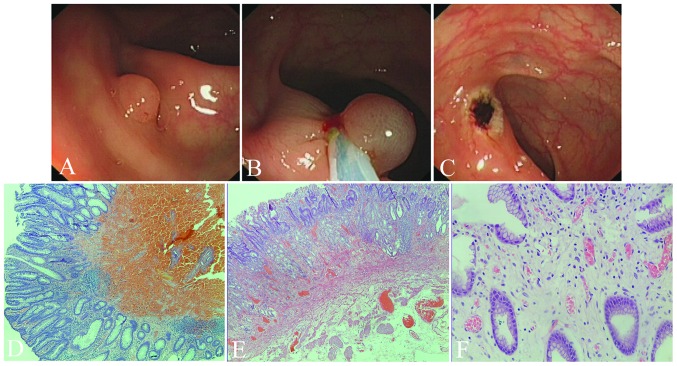
Normal saline is the most popular agent used during endoscopic submucosal injection. However, endoscopists have never identified an optimal submucosal injection solution, which is not only safe and cost-effective but has a unique lifting ability with endoscopic submucosal cushion and causes less tissue damage. This study aimed to evaluate the effectiveness and microscopic characteristics of a blood solution, including whole blood and plasma solution, as a submucosal cushioning agent, compared with normal saline. Endoscopic submucosal dissection (ESD) procedures in pig stomachs were performed by injecting plasma solution (n=4) and normal saline (n=4). A total of 38 patients with gastrointestinal neoplasms underwent endoscopic musocal resection (EMR) procedures. Of 38 EMRs, 7 used whole blood injection, and 31 of 38 acting as the control group used normal saline. A tissue damage scoring system was developed based on injection-induced hydrops and tears for the evaluation of tissue damage. In animal experiments, the lifting time of the injection with normal saline in the pig colon was shorter than that of the group with plasma solution (18.25±5.44 min vs. 6.5±2.38 min, P=0.007). In animal experiments with ESD procedures in the stomach, the hydrops in the normal saline injection group were more extensive than those in the group with plasma (P=0.011). The degree of tearing in the group with normal saline was observed to be less than that in the group with plasma (P=0.008). In patients with EMR, using the histological scoring method, it was determined that the degree of hydrops in the group with normal saline injection was more extensive than that in the group with whole blood (P<0.001). The effective submucosal tearing in the group with normal saline was less than that in the group with blood (P<0.001). The blood solution, including whole blood and plasma solution, as a novel submucosal injection agent, may outperform normal saline with a unique lifting ability, less pronounced tissue damage and marked effective submucosal blunt dissection.
生理盐水是内镜黏膜下注射时最常用的药物。然而,内镜医师从未确定过一种最佳的黏膜下注射溶液,这种溶液不仅安全且具有成本效益,而且在内镜黏膜下垫起方面具有独特的提升能力,并且对组织的损伤较小。本研究旨在评估血液溶液(包括全血和血浆溶液)作为黏膜下缓冲剂与生理盐水相比的有效性和微观特征。通过注射血浆溶液(n = 4)和生理盐水(n = 4)对猪胃进行内镜黏膜下剥离(ESD)手术。共有38例胃肠道肿瘤患者接受了内镜黏膜切除术(EMR)。在38例EMR中,7例使用全血注射,38例中的31例作为对照组使用生理盐水。基于注射引起的水肿和撕裂情况开发了一种组织损伤评分系统,用于评估组织损伤。在动物实验中,猪结肠中注射生理盐水的提升时间短于注射血浆溶液的组(18.25±5.44分钟对6.5±2.38分钟,P = 0.oo7)。在胃ESD手术的动物实验中,生理盐水注射组的水肿比血浆组更广泛(P = 0.011)。观察到生理盐水组的撕裂程度小于血浆组(P = 0.008)。在EMR患者中,使用组织学评分方法确定,生理盐水注射组的水肿程度比全血组更广泛(P<0.001)。生理盐水组有效的黏膜下撕裂少于血液组(P<0.001)。血液溶液,包括全血和血浆溶液,作为一种新型的黏膜下注射剂,可能在独特的提升能力、不太明显的组织损伤和显著有效的黏膜下钝性剥离方面优于生理盐水。