Division of Internal Medicine, University Hospital Raemistrasse 100, Zurich, CH-8091, Switzerland.
BMC Fam Pract. 2012 Nov 24;13:113. doi: 10.1186/1471-2296-13-113.
General practitioners often care for patients with several concurrent chronic medical conditions (multimorbidity). Recent data suggest that multimorbidity might be observed more often than isolated diseases in primary care. We explored the age- and gender-related prevalence of multimorbidity and compared these estimates to the prevalence estimates of other common specific diseases found in Swiss primary care.
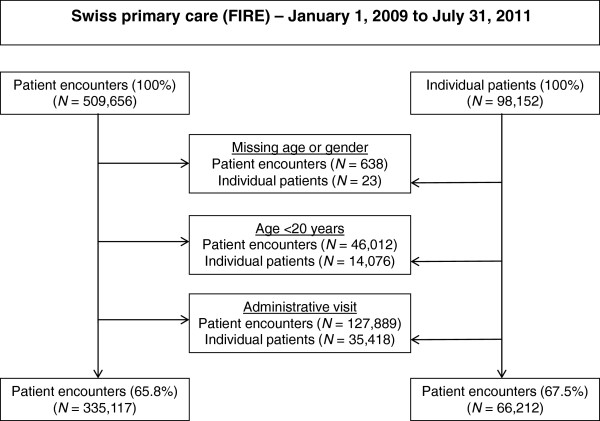
We analyzed data from the Swiss FIRE (Family Medicine ICPC Research using Electronic Medical Record) project database, representing a total of 509,656 primary care encounters in 98,152 adult patients between January 1, 2009 and July 31, 2011. For each encounter, medical problems were encoded using the second version of the International Classification of primary Care (ICPC-2). We defined chronic health conditions using 147 pre-specified ICPC-2 codes and defined multimorbidity as 1) two or more chronic health conditions from different ICPC-2 rubrics, 2) two or more chronic health conditions from different ICPC-2 chapters, and 3) two or more medical specialties involved in patient care. We compared the prevalence estimates of multimorbidity defined by the three methodologies with the prevalence estimates of common diseases encountered in primary care.
Overall, the prevalence estimates of multimorbidity were similar for the three different definitions (15% [95%CI 11-18%], 13% [95%CI 10-16%], and 14% [95%CI 11-17%], respectively), and were higher than the prevalence estimates of any specific chronic health condition (hypertension, uncomplicated 9% [95%CI 7-11%], back syndrome with and without radiating pain 6% [95%CI 5-7%], non-insulin dependent diabetes mellitus 3% [95%CI 3-4%]), and degenerative joint disease 3% [95%CI 2%-4%]). The prevalence estimates of multimorbidity rose more than 20-fold with age, from 2% (95%CI 1-2%) in those aged 20-29 years, to 38% (95%CI 31-44%) in those aged 80 or more years. The prevalence estimates of multimorbidity were similar for men and women (15% vs. 14%, p=0.288).
In primary care, prevalence estimates of multimorbidity are higher than those of isolated diseases. Among the elderly, more than one out of three patients suffer from multimorbidity. Management of multimorbidity is a principal concern in this vulnerable patient population.
全科医生经常照顾同时患有多种慢性疾病(共病)的患者。最近的数据表明,在初级保健中,共病的发病率可能高于单一疾病。我们探讨了年龄和性别相关的共病患病率,并将这些估计与瑞士初级保健中发现的其他常见特定疾病的患病率进行了比较。
我们分析了瑞士 FIRE(家庭医学国际初级保健分类研究使用电子病历)项目数据库的数据,该数据库代表了 2009 年 1 月 1 日至 2011 年 7 月 31 日期间 98,152 名成年患者的 509,656 次初级保健就诊。对于每次就诊,使用国际初级保健分类第二版(ICPC-2)对医疗问题进行编码。我们使用 147 个预先指定的 ICPC-2 代码定义慢性健康状况,并将共病定义为 1)来自不同 ICPC-2 分类的两种或多种慢性健康状况,2)来自不同 ICPC-2 章节的两种或多种慢性健康状况,以及 3)参与患者护理的两种或多种医学专业。我们将这三种方法定义的共病患病率估计与初级保健中常见疾病的患病率估计进行了比较。
总体而言,三种不同定义的共病患病率估计值相似(分别为 15%[95%CI 11-18%]、13%[95%CI 10-16%]和 14%[95%CI 11-17%]),且高于任何特定慢性健康状况(单纯性高血压,9%[95%CI 7-11%]、伴有和不伴有放射痛的背部综合征,6%[95%CI 5-7%]、非胰岛素依赖型糖尿病,3%[95%CI 3-4%])和退行性关节病(3%[95%CI 2%-4%])的患病率估计值。共病的患病率估计值随着年龄的增长增加了 20 倍以上,从 20-29 岁人群的 2%(95%CI 1-2%)增加到 80 岁或以上人群的 38%(95%CI 31-44%)。男女之间的共病患病率估计值相似(15%对 14%,p=0.288)。
在初级保健中,共病的患病率估计值高于单一疾病。在老年人中,三分之一以上的患者患有共病。在这个脆弱的患者群体中,共病的管理是一个主要关注点。