Yoon Yeonyee E, Kim Hyun-Jin, Kim Sung-Ai, Kim Seong Hwan, Park Jae-Hyeong, Park Kyoung-Ha, Choi Seonghoon, Kim Min-Kyu, Kim Hyun-Sook, Cho Goo-Yeong
Division of Cardiology, Cardiovascular Center, Seoul National University Bundang Hospital, Seongnam, Korea.
J Cardiovasc Ultrasound. 2012 Sep;20(3):140-5. doi: 10.4250/jcu.2012.20.3.140. Epub 2012 Sep 21.
Abnormalities in the left atrial (LA) structure and function may develop in patients with paroxysmal atrial fibrillation (AF). We sought to determine the contribution of LA mechanical function, including LA stiffness, to AF by comparing patients with paroxysmal AF with normal control subjects, and to evaluate whether LA mechanical function and stiffness are related with the structural changes of LA.
Sixty-four paroxysmal AF patients (57 ± 13 years, 59% male) were studied, using a speckle tracking echocardiography, and were compared with 34 age-, gender-, and left ventricular (LV) mass-matched controls (53 ± 14 years, 61% male). LA volume indices, expansion index for reservoir function, active emptying fraction for contractile function, mitral annular velocities, and global longitudinal LA strain were measured. The ratio of E/e' to LA strain was used as an index of LA stiffness.
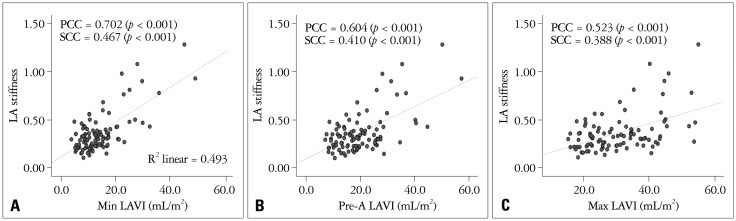
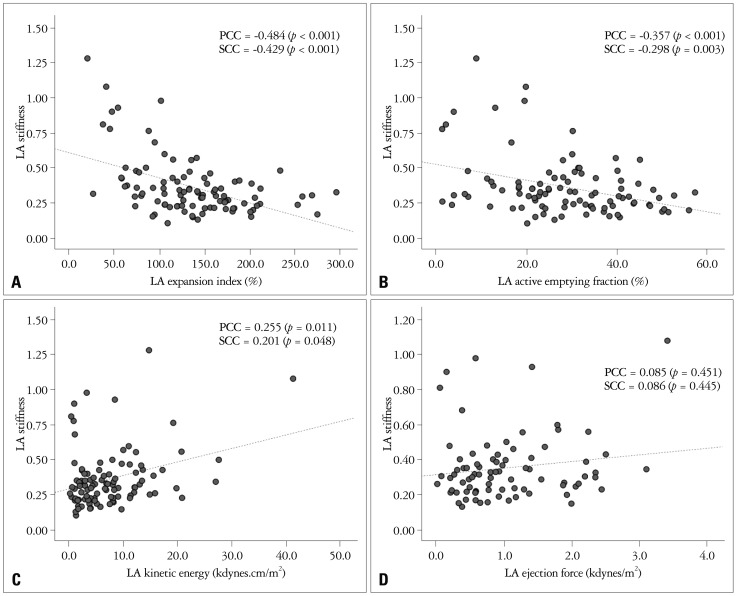
Patients with paroxysmal AF had similar LV volume indices, ejection fraction, and diastolic function, when compared with that of the normal controls. However, paroxysmal AF patients showed increased LA volume indices and decreased LA reservoir function, but similar contractile function. LA stiffness was increased in patients with paroxysmal AF than in the control subjects (0.40 ± 0.25 vs. 0.29 ± 0.10, p = 0.002), and was related with LA volume indices and reservoir function.
Patients with paroxysmal AF have decreased LA reservoir function and increased stiffness, in comparison with that of the control subjects. LA stiffness was significantly related with LA volume indices and reservoir function. LA stiffness can be used for the assessment of LA function in patients with paroxysmal AF.
阵发性心房颤动(AF)患者可能会出现左心房(LA)结构和功能异常。我们试图通过比较阵发性AF患者与正常对照受试者来确定LA机械功能(包括LA僵硬度)对AF的影响,并评估LA机械功能和僵硬度是否与LA的结构变化相关。
使用斑点追踪超声心动图对64例阵发性AF患者(年龄57±13岁,男性占59%)进行研究,并与34例年龄、性别和左心室(LV)质量匹配的对照者(年龄53±14岁,男性占61%)进行比较。测量LA容积指数、储存功能的扩张指数、收缩功能的主动排空分数、二尖瓣环速度和LA整体纵向应变。E/e'与LA应变的比值用作LA僵硬度的指标。
与正常对照组相比,阵发性AF患者的LV容积指数、射血分数和舒张功能相似。然而,阵发性AF患者的LA容积指数增加,LA储存功能降低,但收缩功能相似。阵发性AF患者的LA僵硬度高于对照者(0.40±0.25对0.29±0.10,p = 0.002),且与LA容积指数和储存功能相关。
与对照者相比,阵发性AF患者的LA储存功能降低,僵硬度增加。LA僵硬度与LA容积指数和储存功能显著相关。LA僵硬度可用于评估阵发性AF患者的LA功能。