National Reference Lab for Poultry Diseases, Animal Sciences Institute, National Agricultural Research Centre, Islamabad, 45500, Pakistan.
Virol J. 2012 Dec 3;9:300. doi: 10.1186/1743-422X-9-300.
Since the first outbreak recorded in northern areas of Pakistan in early 2006, highly pathogenic avian influenza H5N1 viruses were isolated from commercial poultry and wild/domestic birds from different areas of Pakistan up to July 2008. Different isolates of H5N1 were sequenced to explore the genetic diversity of these viruses.
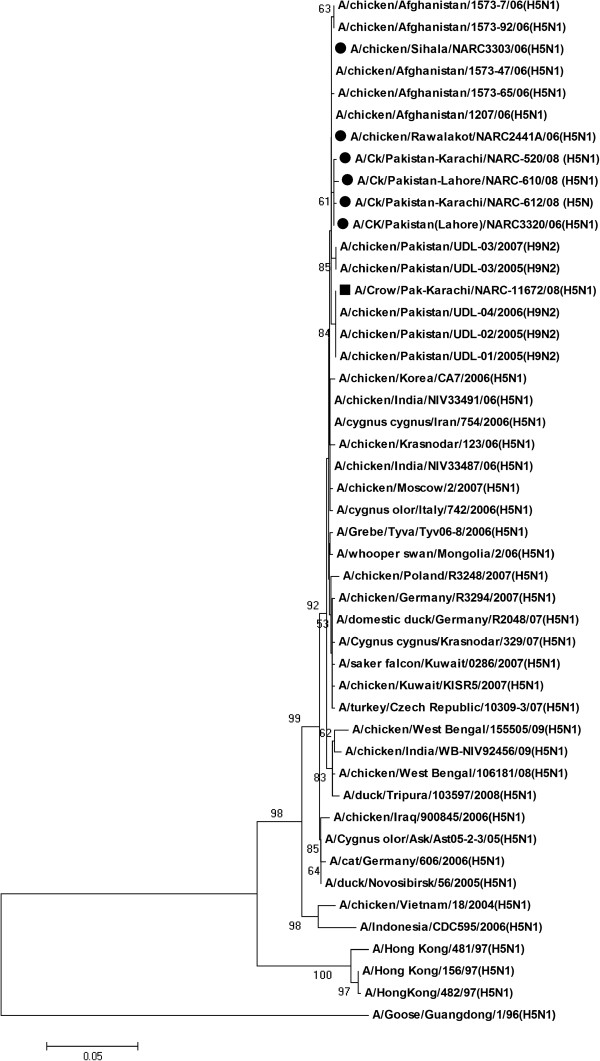
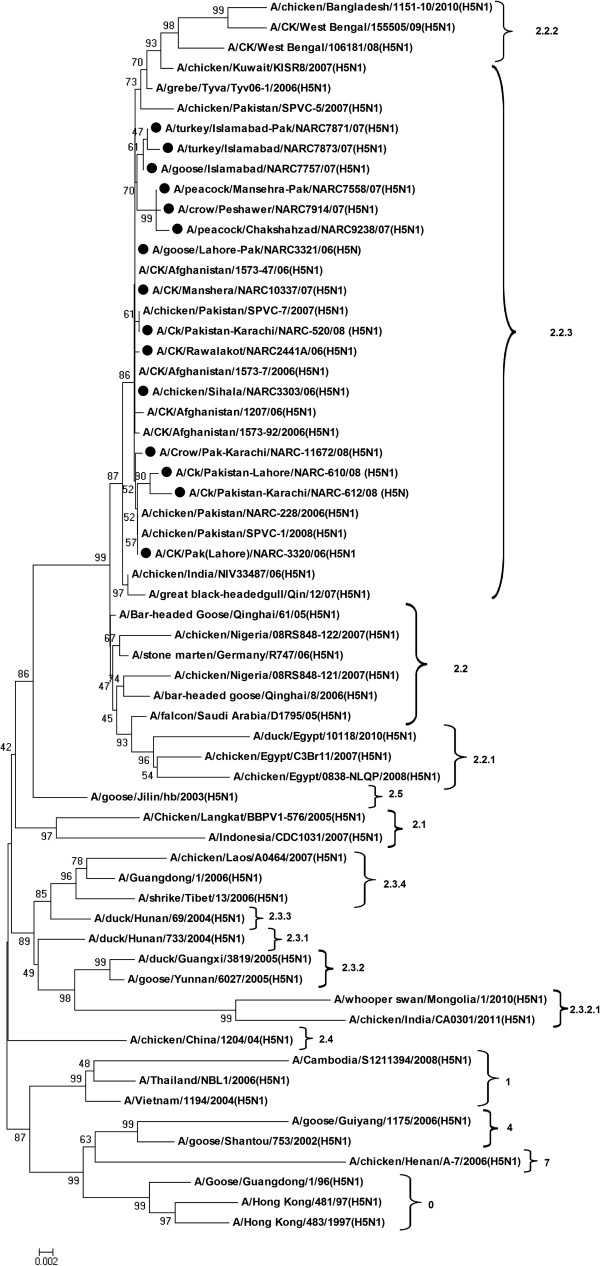
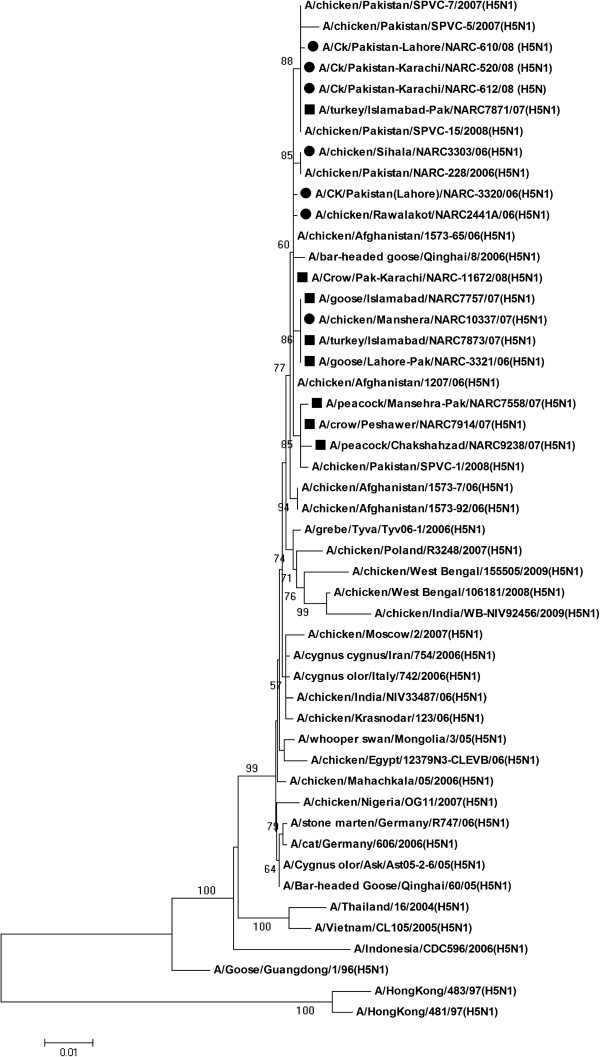
Phylogenetic analysis revealed close clustering and highest sequence identity in all 8 genes to HPAI H5N1 isolates belonging to unified H5 clade 2.2, sub-lineage EMA-3 recovered from Afghanistan during the same time period. Two subgroups within Pakistani H5N1 viruses, from domestic and wild birds, were observed on the basis of their sequence homology and mutations. HPAI motif, preferred receptor specificity for α-(2, 3) linkages, potential N-linked glycosylation sites and an additional glycosylation site at the globular head of HA protein of four Pakistani H5N1 isolates. While, the amino acids associated with sensitivities to various antiviral drugs (Oseltamivir, Zanamivir, Amantadine) were found conserved for the Pakistani H5N1 isolates. Conspicuously, some important mutations observed at critical positions of antigenic sites (S141P, D155S, R162I & P181S) and at receptor binding pocket (A185T, R189K & S217P) of HA-1. A high sequence similarity between Pakistani HP H5N1 and LP H9N2 viruses was also observed. Avian like host specific markers with the exception of E627K in PB2, K356R in PA, V33I in NP, I28V in M2 and L107F in NS2 proteins were also observed.
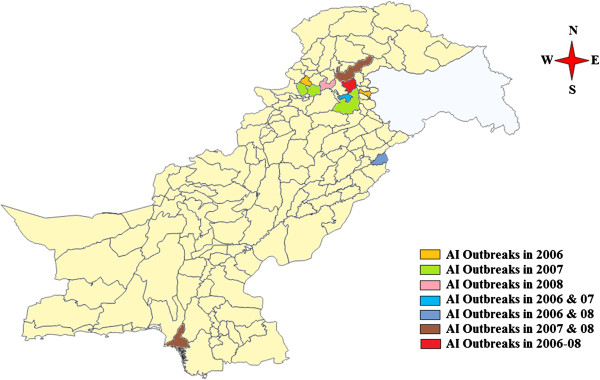
Various point mutations in different genes of H5 viruses from Pakistan were observed during its circulation in the field. The outbreaks started in Khyber Pakhtoon Khawa (North West) province in 2006 and spread to the Southern regions over a period of time. Though migratory birds may have a role for this continued endemicity of clade 2.2 H5N1 viruses during 2006-2008 in Pakistan, the possibility of their transmission through legal or illegal poultry trade across the borders cannot be ignored.
自 2006 年初巴基斯坦北部地区首次爆发以来,从不同地区的商业家禽和野生/家养鸟类中分离出了高致病性禽流感 H5N1 病毒,直至 2008 年 7 月。对不同的 H5N1 分离株进行测序以探索这些病毒的遗传多样性。
系统发育分析显示,所有 8 个基因与同一时期从阿富汗分离的属于统一 H5 分支 2.2 的 HPAI H5N1 分离株密切聚类,具有最高的序列同一性。根据序列同源性和突变,在巴基斯坦 H5N1 病毒的家养和野生鸟类之间观察到两个亚群。在巴基斯坦 H5N1 分离株中观察到 4 个 HPAI 基序、偏好的α-(2,3) 连接受体特异性、潜在的 N-连接糖基化位点和 HA 蛋白球形头部的额外糖基化位点。而与各种抗病毒药物(奥司他韦、扎那米韦、金刚烷胺)敏感性相关的氨基酸在巴基斯坦 H5N1 分离株中被发现保守。值得注意的是,在抗原位点的关键位置(S141P、D155S、R162I 和 P181S)和受体结合口袋(A185T、R189K 和 S217P)观察到一些重要的突变HA-1。还观察到巴基斯坦 HP H5N1 和 LP H9N2 病毒之间的高度序列相似性。除了 PB2 中的 E627K、PA 中的 K356R、NP 中的 V33I、M2 中的 I28V 和 NS2 蛋白中的 L107F 之外,还观察到禽样宿主特异性标记。
在 H5 病毒在田间传播期间,观察到巴基斯坦不同基因中的各种点突变。疫情于 2006 年在开伯尔-普赫图赫瓦省(西北部)爆发,并在一段时间后蔓延到南部地区。虽然候鸟可能在 2006-2008 年期间在巴基斯坦持续出现 2.2 分支 H5N1 病毒地方性流行中发挥了作用,但不能忽视它们通过合法或非法家禽贸易跨境传播的可能性。