School of Mathematical Sciences, Mathematical Sciences Building, University of Nottingham, University Park, Nottingham NG7 2RD, UK.
Math Biosci. 2013 Feb;241(2):149-66. doi: 10.1016/j.mbs.2012.11.004. Epub 2012 Nov 28.
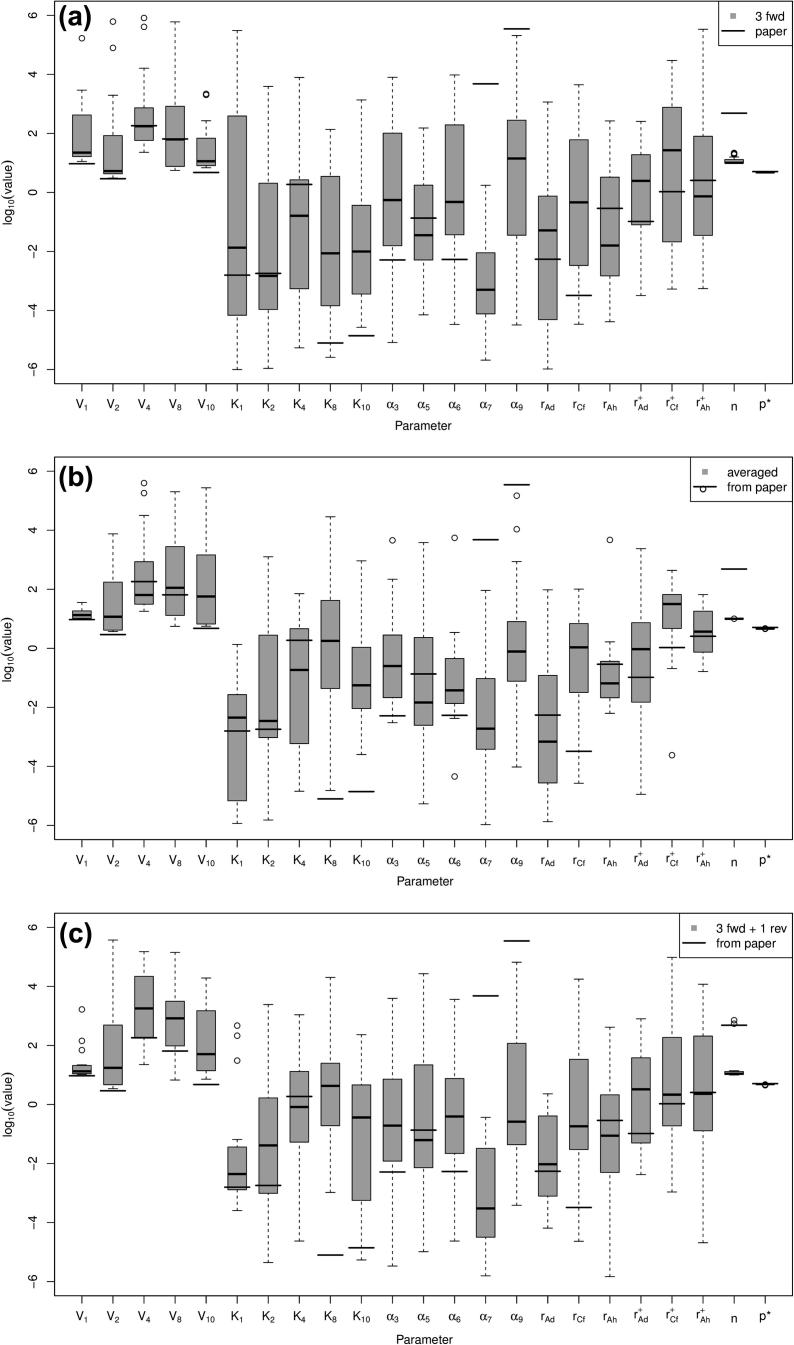
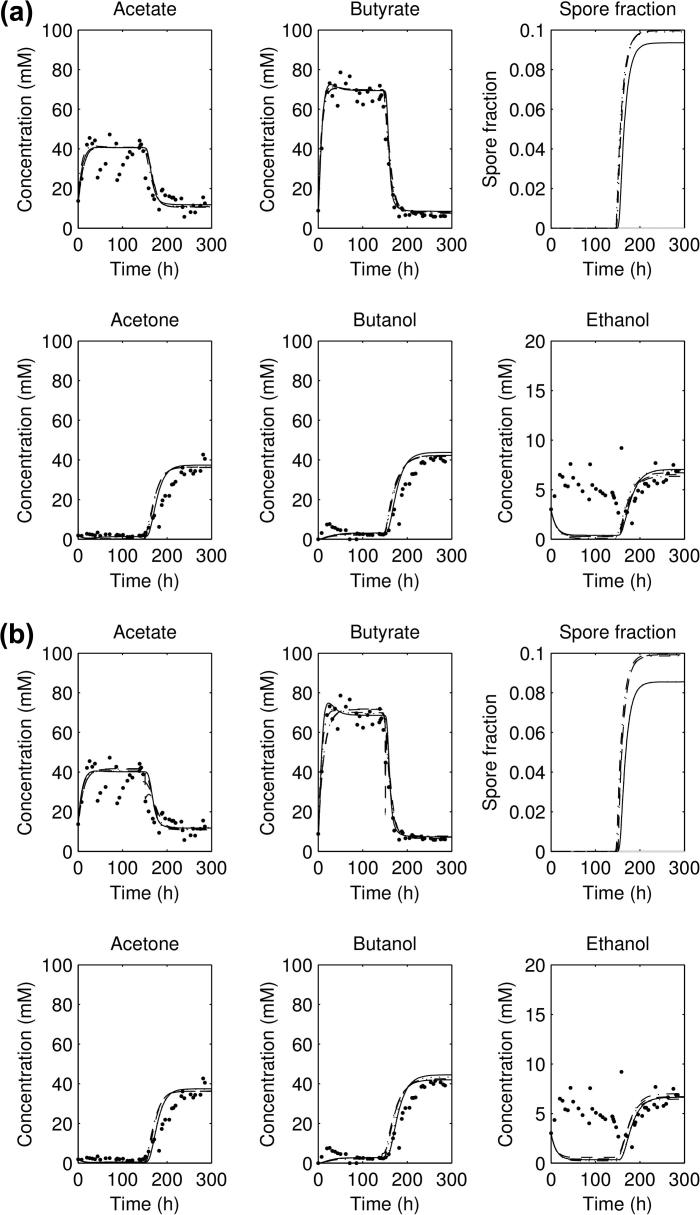
The acetone-butanol (AB) fermentation process in the anaerobic endospore-forming Gram-positive bacterium Clostridium acetobutylicum is useful as a producer of biofuels, particularly butanol. Recent work has concentrated on trying to improve the efficiency of the fermentation method, either through changes in the environmental conditions or by modifying the genome to selectively favour the production of one particular solvent over others. Fermentation of glucose by C. acetobutylicum occurs in two stages: initially the acids acetate and butyrate are produced and excreted and then, as the external pH falls, acetate and butyrate are ingested and further metabolised into the solvents acetone, butanol and ethanol. In order to optimise butanol production, it is important to understand how pH affects the enzyme-controlled reactions in the metabolism process. We adapt an ordinary differential equation model of the metabolic network with regulation at the genetic level for the required enzymes; parametrising the model using experimental data generated from continuous culture, we improve on previous point predictions (S. Haus, S. Jabbari, T. Millat, H. Janssen, R.-J. Fisher, H. Bahl, J. R. King, O. Wolkenhauer, A systems biology approach to investigate the effect of pH-induced gene regulation on solvent production by Clostridium acetobutylicum in continuous culture, BMC Systems Biology 5 (2011)) [1] both by using a different optimisation approach and by computing confidence intervals and correlation coefficients. We find in particular that the parameters are ill-determined from the data and that two separate clusters of parameters appear correlated, reflecting the importance of two metabolic intermediates. We extend the model further to include another aspect of the clostridial survival mechanism, sporulation, and by computation of the Akaike Information Criterion values find that the there is some evidence for the presence of sporulation during the shift.
丙酮丁醇(AB)发酵过程在厌氧芽孢形成革兰氏阳性菌丙酮丁醇梭菌是有用的生物燃料,特别是丁醇的生产者。最近的工作集中在试图提高发酵方法的效率,无论是通过改变环境条件,还是通过修饰基因组以有选择地有利于生产一种特定的溶剂而不是其他溶剂。丙酮丁醇梭菌发酵葡萄糖分两个阶段进行:最初产生和分泌乙酸和丁酸,然后,随着外部 pH 值下降,乙酸和丁酸被摄取并进一步代谢成溶剂丙酮、丁醇和乙醇。为了优化丁醇的生产,了解 pH 值如何影响代谢过程中酶控制的反应非常重要。我们采用了一种带有遗传水平调控的代谢网络常微分方程模型;使用连续培养生成的实验数据对模型进行参数化,我们改进了以前的点预测(S. Haus、S. Jabbari、T. Millat、H. Janssen、R.-J. Fisher、H. Bahl、J. R. King、O. Wolkenhauer,一种系统生物学方法来研究 pH 诱导基因调控对连续培养中丙酮丁醇溶剂生产的影响,BMC 系统生物学 5 (2011))[1],不仅采用了不同的优化方法,还计算了置信区间和相关系数。我们发现,特别是参数从数据中确定得很差,并且两个单独的参数簇似乎相关,这反映了两种代谢中间产物的重要性。我们进一步扩展模型以包括梭菌生存机制的另一个方面,即孢子形成,并通过计算 Akaike 信息准则值发现,在转变过程中存在孢子形成的一些证据。