Department of Nutritional Sciences, Rutgers University, The State University of New Jersey, New Brunswick, NJ 08901, USA.
Nutrients. 2012 Nov 13;4(11):1723-39. doi: 10.3390/nu4111723.
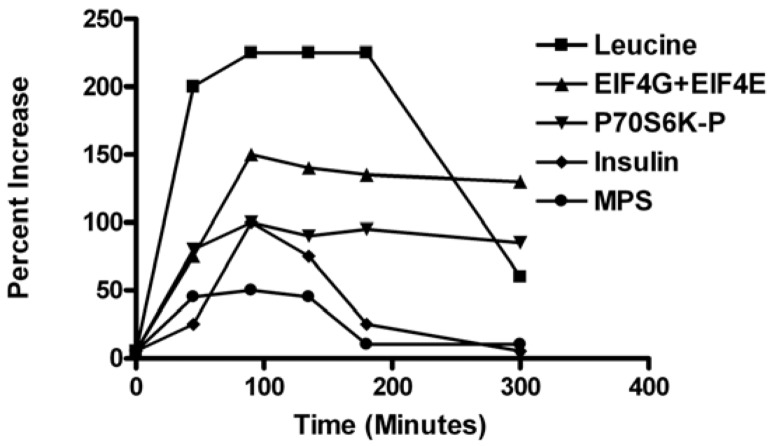
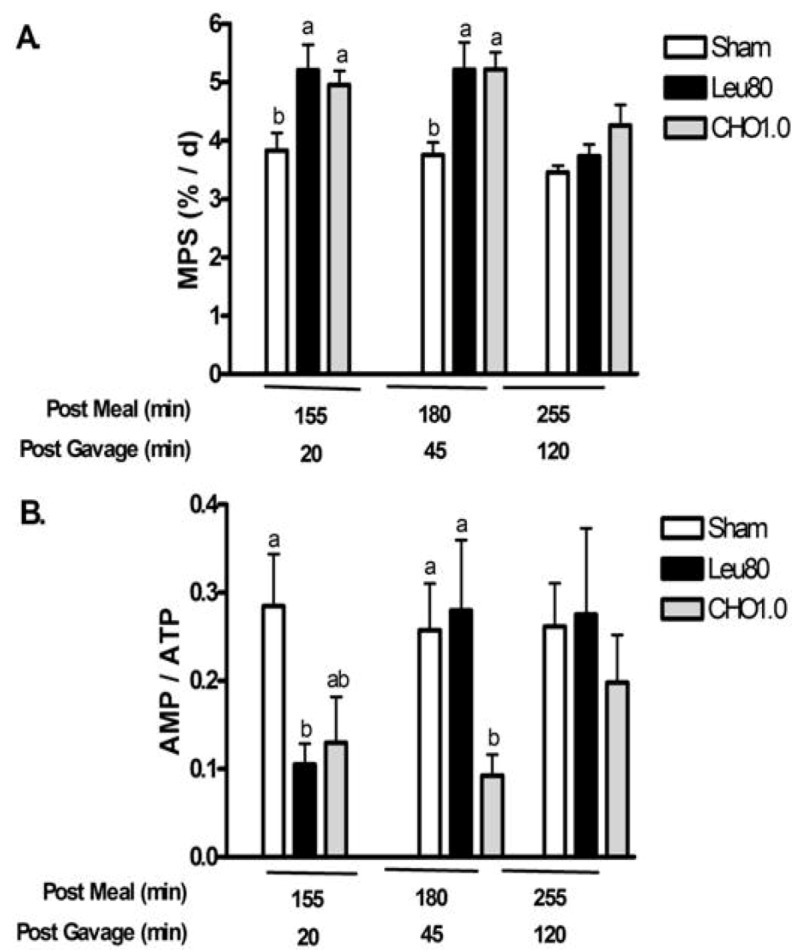
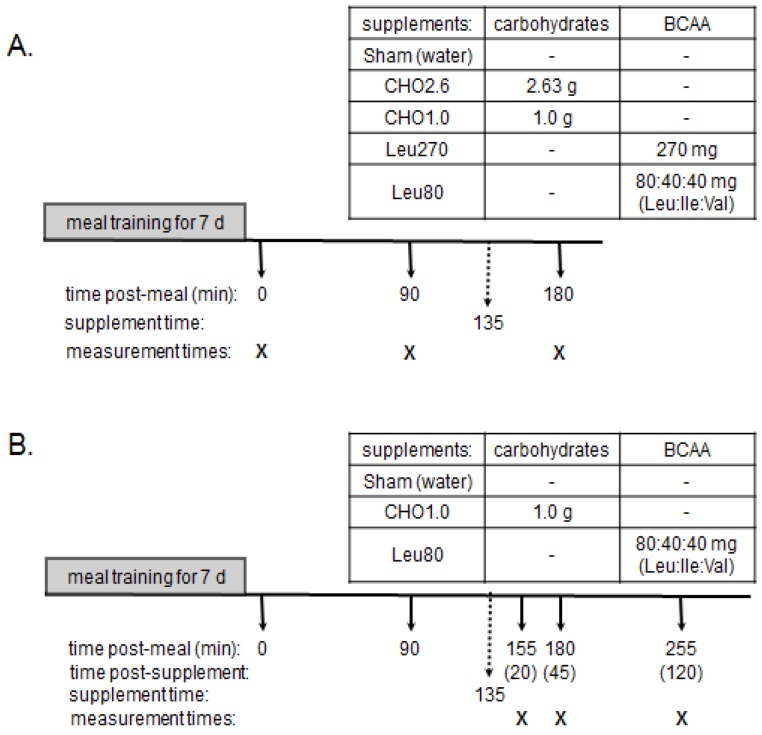
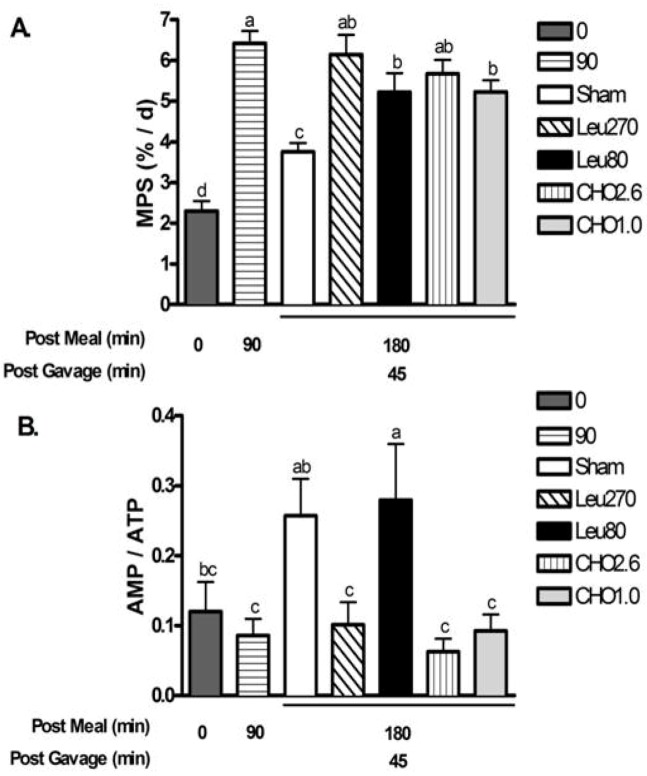
Previous research demonstrates that the anabolic response of muscle protein synthesis (MPS) to a meal is regulated at the level of translation initiation with signals derived from leucine (Leu) and insulin to activate mTORC1 signaling. Recent evidence suggests that the duration of the meal response is limited by energy status of the cell and inhibition of translation elongation factor 2 (eEF2). This study evaluates the potential to extend the anabolic meal response with post-meal supplements of Leu or carbohydrates. Adult (~256 g) male Sprague-Dawley rats were food deprived for 12 h, then either euthanized before a standard meal (time 0) or at 90 or 180 min post-meal. At 135 min post-meal, rats received one of five oral supplements: 270 mg leucine (Leu270), 80:40:40 mg leucine, isoleucine, and valine (Leu80), 2.63 g carbohydrates (CHO2.6), 1 g carbohydrates (CHO1.0), or water (Sham control). Following the standard meal, MPS increased at 90 min then declined to pre-meal baseline at 180 min. Rats administered Leu270, Leu80, CHO2.6, or CHO1.0 maintained elevated rates of MPS at 180 min, while Sham controls declined from peak values. Leu80 and CHO1.0 treatments maintained MPS, but with values intermediate between Sham controls and Leu270 and CHO2.6 supplements. Consistent with MPS findings, the supplements maintained elongation activity and cellular energy status by preventing increases in AMP/ATP and phosphorylation of adenosine monophosphate-activated protein kinase (AMPK), acetyl-CoA carboxylase ACC and eEF2. The impact of the supplements on MPS and cellular energy status was in proportion to the energy content within the individual treatments (i.e., Leu270 > Leu80; CHO2.6 > CHO1.0), but the Leu supplements produced a disproportionate anabolic stimulation of MPS, eEF2 and energy status with significantly lower energy content. In summary, the incongruity between MPS and translation initiation at 180 min reflects a block in translation elongation due to reduced cellular energy, and the extent to which Leu or carbohydrate supplements are able to enhance energy status and prolong the period of muscle anabolism are dose and time-dependent.
先前的研究表明,肌肉蛋白质合成 (MPS) 的合成代谢反应受膳食调节,其在翻译起始水平上受到来自亮氨酸 (Leu) 和胰岛素的信号调节,以激活 mTORC1 信号通路。最近的证据表明,膳食反应的持续时间受到细胞能量状态的限制,并且翻译延伸因子 2 (eEF2) 的抑制作用限制了膳食反应的持续时间。本研究评估了通过膳食后补充亮氨酸或碳水化合物来延长合成代谢膳食反应的潜力。成年(~256 g)雄性 Sprague-Dawley 大鼠禁食 12 小时,然后在标准膳食前(时间 0)或膳食后 90 或 180 分钟处死。在膳食后 135 分钟,大鼠接受以下五种口服补充剂之一:270 毫克亮氨酸(Leu270)、80:40:40 毫克亮氨酸、异亮氨酸和缬氨酸(Leu80)、2.63 克碳水化合物(CHO2.6)、1 克碳水化合物(CHO1.0)或水(Sham 对照)。在标准膳食后,MPS 在 90 分钟时增加,然后在 180 分钟时下降至餐前基线。给予 Leu270、Leu80、CHO2.6 或 CHO1.0 的大鼠在 180 分钟时维持升高的 MPS 率,而 Sham 对照大鼠的 MPS 率从峰值下降。Leu80 和 CHO1.0 处理维持 MPS,但值介于 Sham 对照和 Leu270 和 CHO2.6 补充剂之间。与 MPS 发现一致,补充剂通过防止 AMP/ATP 增加和单磷酸腺苷激活蛋白激酶 (AMPK)、乙酰辅酶 A 羧化酶 ACC 和 eEF2 的磷酸化来维持延伸活性和细胞能量状态。补充剂对 MPS 和细胞能量状态的影响与个体处理中的能量含量成正比(即,Leu270 > Leu80;CHO2.6 > CHO1.0),但亮氨酸补充剂对 MPS、eEF2 和能量状态的合成代谢刺激不成比例,能量含量明显较低。总之,180 分钟时 MPS 和翻译起始之间的不一致反映了由于细胞能量减少导致的翻译延伸受阻,亮氨酸或碳水化合物补充剂增强能量状态并延长肌肉合成代谢期的程度取决于剂量和时间。