Department of Physiology, School of Life Science, Kuning 605000, China.
BMC Neurosci. 2012 Dec 4;13:147. doi: 10.1186/1471-2202-13-147.
Acute pressure on the sciatic nerve has recently been reported to provide rapid short-term relief of pain in patients with various pathologies. Wide dynamic range (WDR) neurons transmit nociceptive information from the dorsal horn to higher brain centers. In the present study, we examined the effect of a 2-min application of sciatic nerve pressure on WDR neuronal activity in anesthetized male Sprague-Dawley rats.
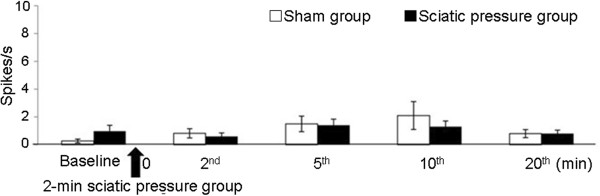
Experiments were carried out on 41 male Sprague-Dawley albino rats weighing 160-280 grams. Dorsal horn WDR neurons were identified on the basis of characteristic responses to mechanical stimuli applied to the cutaneous receptive field. Acute pressure was applied for 2 min to the sciatic nerve using a small vascular clip. The responses of WDR neurons to three mechanical stimuli applied to the cutaneous receptive field were recorded before, and 2, 5 and 20 min after cessation of the 2-min pressure application on the sciatic nerve. Two-min pressure applied to the sciatic nerve caused rapid attenuation of the WDR response to pinching, pressure and brushing stimuli applied to the cutaneous receptive field. Maximal attenuation of the WDR response to pinching and pressure was noted 5 min after release of the 2-min pressure on the sciatic nerve. The mean firing rate decreased from 31.7±1.7 Hz to 13±1.4 Hz upon pinching (p < 0.001), from 31.2±2.3 Hz to 10.9±1.4 Hz (p < 0.001) when pressure was applied, and from 18.9±1.2 Hz to 7.6±1.1 Hz (p < 0.001) upon brushing. Thereafter, the mean firing rates gradually recovered.
Our results indicate that acute pressure applied to the sciatic nerve exerts a rapid inhibitory effect on the WDR response to both noxious and innocuous stimuli. Our results may partially explain the rapid analgesic effect of acute sciatic nerve pressure noted in clinical studies, and also suggest a new model for the study of pain.
最近有报道称,坐骨神经急性受压可迅速缓解多种疾病患者的短期疼痛。宽动态范围 (WDR) 神经元将伤害性信息从背角传递到大脑高级中枢。在本研究中,我们检测了在麻醉雄性 Sprague-Dawley 大鼠中应用 2 分钟坐骨神经压力对 WDR 神经元活性的影响。
实验在 41 只体重 160-280 克的雄性 Sprague-Dawley 白化大鼠上进行。根据施加于皮肤感受野的机械刺激的特征反应,确定背角 WDR 神经元。使用小血管夹对坐骨神经施加 2 分钟的急性压力。在停止施加 2 分钟坐骨神经压力后,分别记录 WDR 神经元对施加于皮肤感受野的三种机械刺激的反应。施加于坐骨神经的 2 分钟压力可迅速抑制 WDR 对皮肤感受野的捏压、压力和刷擦刺激的反应。在解除 2 分钟坐骨神经压力 5 分钟后,WDR 对捏压和压力的反应达到最大抑制。施加捏压时,平均放电率从 31.7±1.7 Hz 降至 13±1.4 Hz(p<0.001),施加压力时从 31.2±2.3 Hz 降至 10.9±1.4 Hz(p<0.001),刷擦时从 18.9±1.2 Hz 降至 7.6±1.1 Hz(p<0.001)。此后,平均放电率逐渐恢复。
我们的结果表明,坐骨神经急性受压对伤害性和无害性刺激的 WDR 反应产生快速抑制作用。我们的结果部分解释了临床研究中观察到的急性坐骨神经压力的快速镇痛作用,并为疼痛研究提供了新的模型。