Department of Public Health and Policy, Institute of Psychology, Health and Society, University of Liverpool, Liverpool L69 3GB, UK.
BMJ. 2012 Dec 4;345:e7831. doi: 10.1136/bmj.e7831.
To investigate whether the uneven rise in prosperity between 1999 and 2008 accounted for differential increases in life expectancy in English local authorities.
Longitudinal ecological study.
324 local authorities in England, classified by their baseline level of deprivation. M: ain outcome measures Multivariable regression was used to investigate the association between trends in prosperity between 1998 and 2007 and trends in life expectancy. Trends in health inequalities were assessed by comparing the experience of Spearhead local authorities (the 70 most deprived in 1998) with the average for all English local authorities.
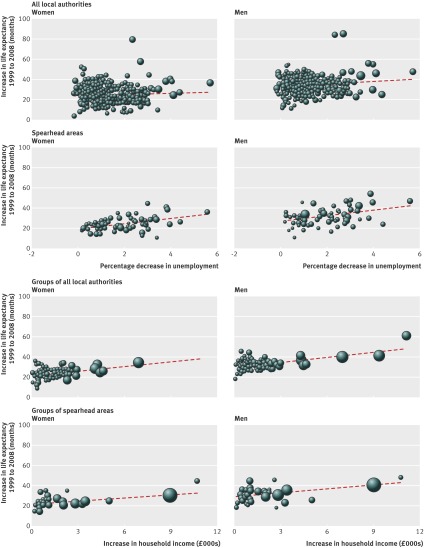
Those local authorities that experienced the greatest improvement in prosperity experienced greater increases in life expectancy. With each 1% absolute decline in unemployment, life expectancy increased by 2.2 (95% confidence interval 0.5 to 3.8) months in men and by 1.7 (0.4 to 3.1) months in women. With each £1000 increase in average household income in a local authority, life expectancy increased by 1.4 (0.3 to 2.5) months in men and by 1.1 (0.2 to 1.9) months in women. The more deprived a local authority was in 1998, the lower the rate at which life expectancy improved.
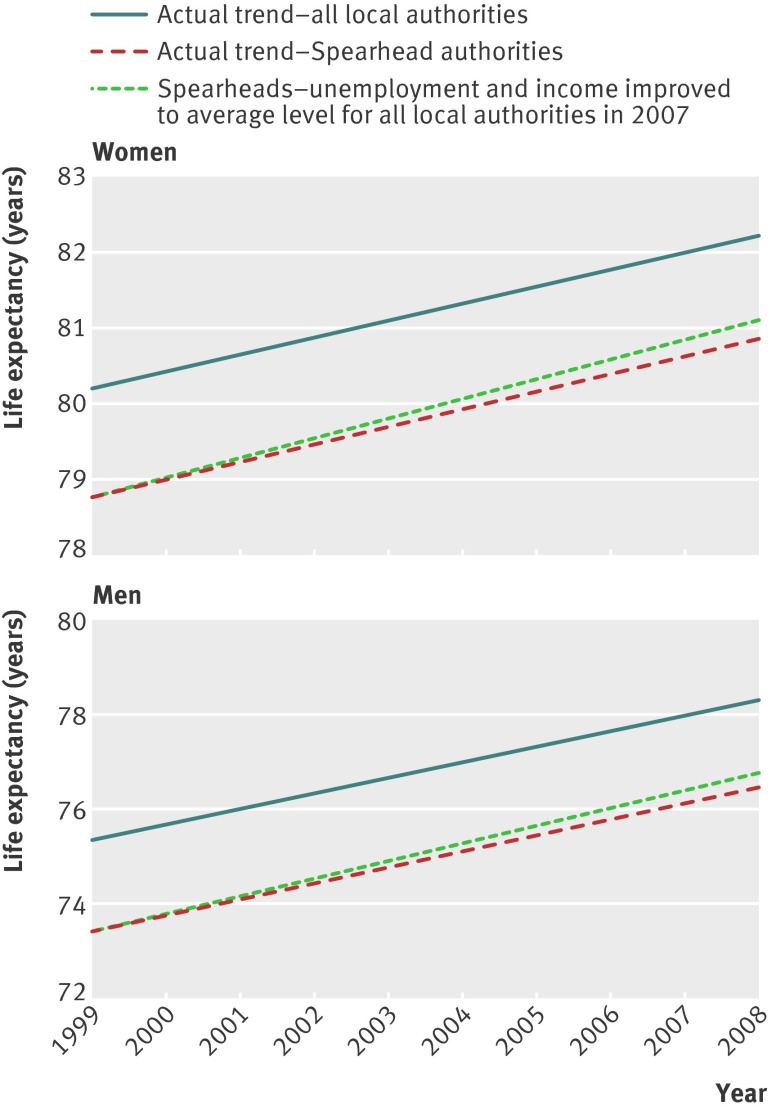
Decreases in unemployment and increases in average income in an area explained, to a large extent, why some local authorities "performed" better than others. Health inequalities between Spearhead and all local authorities widened during the period of rising prosperity, but they would have widened to an even greater extent had unemployment not fallen at a faster rate in more deprived areas. With worsening economic trends over the next 10 years, this research suggests that increases in life expectancy are likely to be smaller and health inequalities may widen at a faster rate than in the previous decade. Allocating resources to local authorities on the basis of their "performance" at increasing life expectancy is likely to reward more affluent areas rather than disadvantaged areas with greater needs, exacerbating the problem.
研究 1999 年至 2008 年期间繁荣程度的不均衡增长是否导致了英国地方当局预期寿命的差异增长。
纵向生态研究。
英格兰的 324 个地方当局,按其基线贫困程度分类。主要结局指标:使用多变量回归来研究 1998 年至 2007 年期间繁荣趋势与预期寿命趋势之间的关系。通过比较 Spearhead 地方当局(1998 年最贫困的 70 个)与所有英国地方当局的平均水平,评估健康不平等的趋势。
繁荣程度改善最大的那些地方当局预期寿命增长幅度最大。男性失业率每下降 1%,预期寿命增加 2.2 个月(95%置信区间 0.5 至 3.8),女性增加 1.7 个月(0.4 至 3.1)。地方当局每户家庭平均收入每增加 1000 英镑,男性预期寿命增加 1.4 个月(0.3 至 2.5),女性增加 1.1 个月(0.2 至 1.9)。1998 年贫困程度越高的地方当局,预期寿命改善的速度越低。
该地区失业率的下降和平均收入的增加在很大程度上解释了为什么一些地方当局“表现”更好。在繁荣时期,Spearhead 和所有地方当局之间的健康不平等差距扩大,但如果失业率在较贫困地区下降速度更快,差距将进一步扩大。在未来 10 年经济趋势恶化的情况下,这项研究表明,预期寿命的增长可能较小,健康不平等可能会以比过去十年更快的速度扩大。根据增加预期寿命的“表现”向地方当局分配资源,可能会奖励较富裕地区,而不是有更大需求的贫困地区,从而加剧这一问题。