Research Imaging Centre, Centre for Addiction and Mental Health, Toronto, Ontario M5T 1R8, Canada.
J Med Chem. 2013 Jan 10;56(1):201-9. doi: 10.1021/jm301492y. Epub 2012 Dec 19.
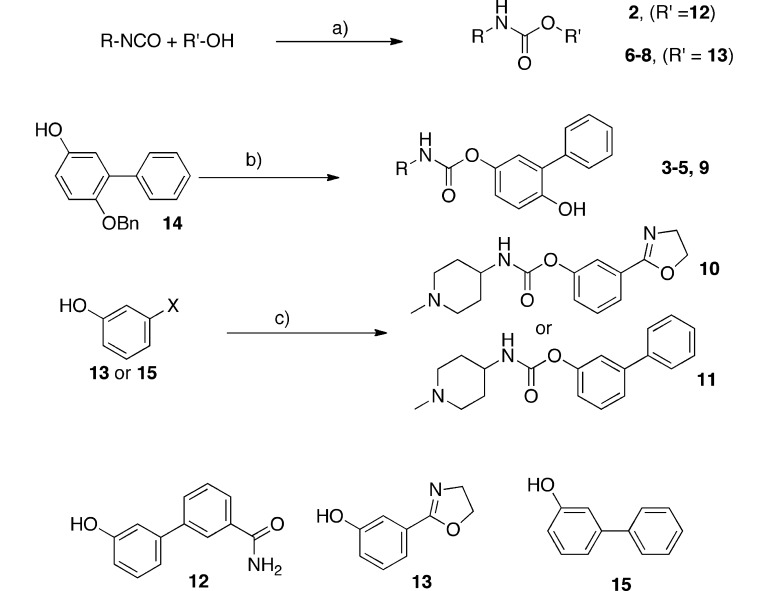
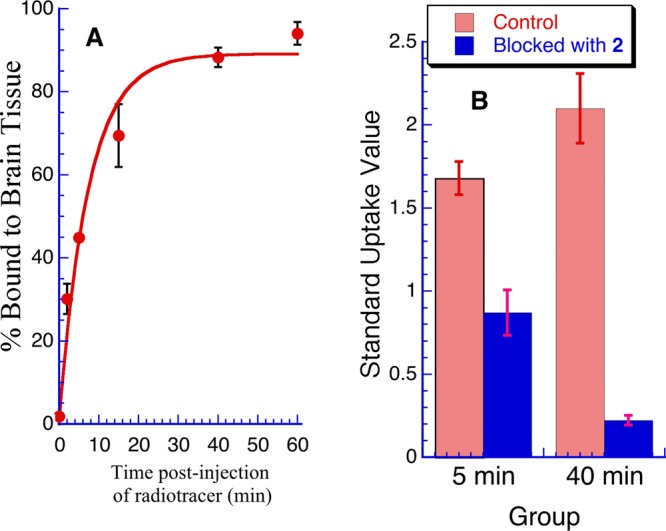
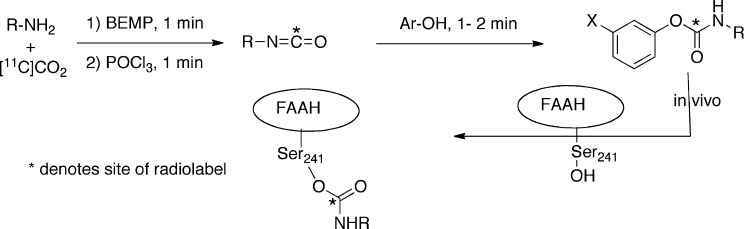
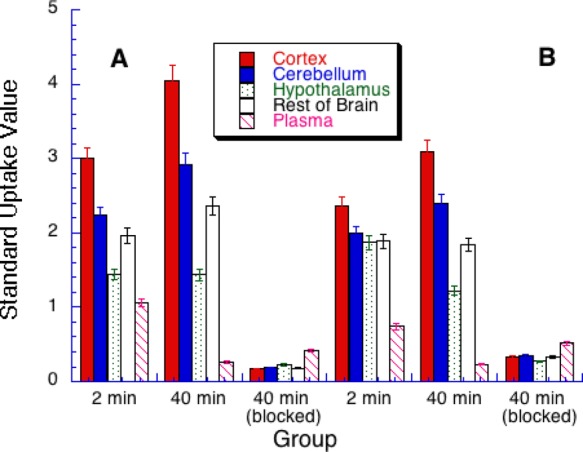
Fatty acid amide hydrolase (FAAH) plays a key role in regulating the tone of the endocannabinoid system. Radiotracers are required to image and quantify FAAH activity in vivo. We have synthesized a series of potent FAAH inhibitors encompassing two classes of N-alkyl-O-arylcarbamates and radiolabeled eight of them with carbon-11. The [¹¹C-carbonyl]-radiotracers were evaluated in vitro and ex vivo in rats as potential FAAH imaging agents for positron emission tomography (PET). Both sets of [¹¹C]O-arylcarbamates showed good to excellent brain penetration and an appropriate regional distribution. Pretreatments with a FAAH inhibitor demonstrated that 80-95% of brain uptake of radioactivity constituted binding of the radiotracers to FAAH. Brain extraction measurements showed that binding to FAAH was irreversible and kinetically different for the two classes of carbamates. These promising results are discussed in terms of the requirements of a suitable radiotracer for the in vivo imaging of FAAH using PET.
脂肪酸酰胺水解酶(FAAH)在调节内源性大麻素系统的紧张度方面发挥着关键作用。需要放射性示踪剂来对体内 FAAH 的活性进行成像和定量。我们已经合成了一系列强效的 FAAH 抑制剂,涵盖了两类 N-烷基-O-芳基氨基甲酸酯,并对其中的八种进行了碳-11 放射性标记。将这些 [¹¹C-羰基] 放射性示踪剂在体外和大鼠体内进行了评估,作为正电子发射断层扫描(PET)的潜在 FAAH 成像剂。两组 [¹¹C]O-芳基氨基甲酸酯都显示出了良好到优秀的脑穿透性和适当的区域分布。用 FAAH 抑制剂预处理表明,放射性示踪剂在大脑中的摄取有 80-95%是与 FAAH 结合的。脑提取测量表明,与 FAAH 的结合是不可逆的,并且两种氨基甲酸酯类的动力学不同。这些有前途的结果将根据使用 PET 对体内 FAAH 进行成像的合适放射性示踪剂的要求进行讨论。