Department of Human Development and Family Studies, Auburn University, Auburn, AL 36849, USA.
J Sleep Res. 2013 Jun;22(3):282-8. doi: 10.1111/jsr.12019. Epub 2012 Dec 6.
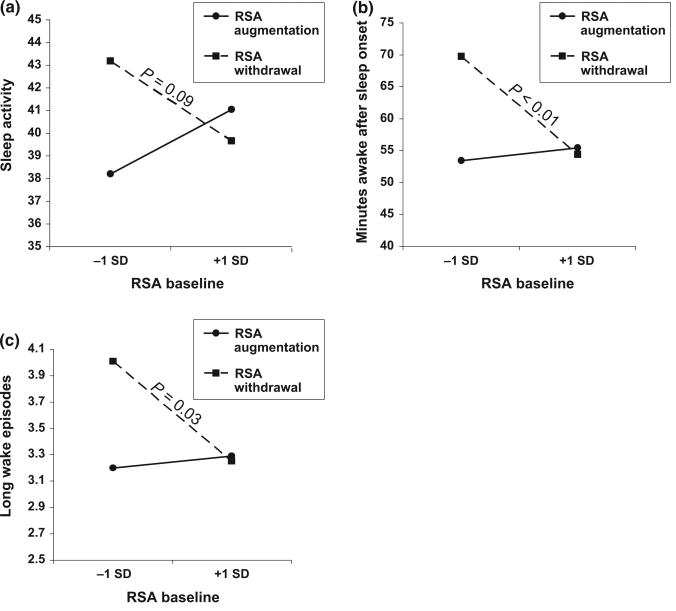
We examined indices of children's parasympathetic nervous system activity (PNS), including respiratory sinus arrhythmia during baseline (RSAB) and RSA reactivity (RSAR), to a laboratory challenge, and importantly the interaction between RSAB and RSAR as predictors of multiple parameters of children's sleep. Lower RSAR denotes increased vagal withdrawal (reductions in RSA between baseline and task) and higher RSAR represents decreased vagal withdrawal or augmentation (increases in RSA between baseline and task). A community sample of school-attending children (121 boys and 103 girls) participated [mean age = 10.41 years; standard deviation (SD) = 0.67]. Children's sleep parameters were examined through actigraphy for 7 consecutive nights. Findings demonstrate that RSAB and RSAR interact to predict multiple sleep quality parameters (activity, minutes awake after sleep onset and long wake episodes). The overall pattern of effects illustrates that children who exhibit more disrupted sleep (increased activity, more minutes awake after sleep onset and more frequent long wake episodes) are those with lower RSAB in conjunction with lower RSAR. This combination of low RSAB and low RSAR probably reflects increased autonomic nervous system arousal, which interferes with sleep. Results illustrate the importance of individual differences in physiological regulation indexed by interactions between PNS baseline activity and PNS reactivity for a better understanding of children's sleep quality.
我们检查了儿童副交感神经系统活动(PNS)的指标,包括基线时的呼吸窦性心律失常(RSAB)和 RSA 反应性(RSAR),以进行实验室挑战,重要的是,RSAB 和 RSAR 之间的相互作用可预测儿童睡眠的多个参数。RSAR 较低表示迷走神经撤回增加(基线和任务之间的 RSA 减少),而 RSAR 较高表示迷走神经撤回减少或增强(基线和任务之间的 RSA 增加)。一个有上学儿童的社区样本(121 名男孩和 103 名女孩)参与了研究[平均年龄= 10.41 岁;标准差(SD)= 0.67]。通过活动记录仪连续 7 晚检查儿童的睡眠参数。研究结果表明,RSAB 和 RSAR 相互作用可预测多个睡眠质量参数(活动、睡眠起始后清醒时间和长时间清醒事件)。总体效应模式表明,睡眠中断更多的儿童(活动增加、睡眠起始后清醒时间增加和长醒时间更频繁)的 RSAB 较低,同时 RSAR 也较低。这种低 RSAB 和低 RSAR 的组合可能反映了自主神经系统唤醒增加,从而干扰了睡眠。研究结果表明,PNS 基线活动与 PNS 反应性之间的相互作用所反映的个体差异在生理调节方面具有重要意义,对于更好地理解儿童的睡眠质量至关重要。