• 文献检索
  • 文档翻译
  • 深度研究
  • 学术资讯
  • Suppr Zotero 插件Zotero 插件
  • 邀请有礼
  • 套餐&价格
  • 历史记录
应用&插件
Suppr Zotero 插件Zotero 插件浏览器插件Mac 客户端Windows 客户端微信小程序
定价
高级版会员购买积分包购买API积分包
服务
文献检索文档翻译深度研究API 文档MCP 服务
关于我们
关于 Suppr公司介绍联系我们用户协议隐私条款
关注我们

Suppr 超能文献

核心技术专利:CN118964589B侵权必究
粤ICP备2023148730 号-1Suppr @ 2026

文献检索

告别复杂PubMed语法,用中文像聊天一样搜索,搜遍4000万医学文献。AI智能推荐,让科研检索更轻松。

立即免费搜索

文件翻译

保留排版,准确专业,支持PDF/Word/PPT等文件格式,支持 12+语言互译。

免费翻译文档

深度研究

AI帮你快速写综述,25分钟生成高质量综述,智能提取关键信息,辅助科研写作。

立即免费体验

反事实推理:从儿童到成年。

Counterfactual reasoning: from childhood to adulthood.

机构信息

Department of Psychology, University of Salzburg, 5020 Salzburg, Austria.

出版信息

J Exp Child Psychol. 2013 Mar;114(3):389-404. doi: 10.1016/j.jecp.2012.10.010. Epub 2012 Dec 5.

DOI:10.1016/j.jecp.2012.10.010
PMID:23219156
原文链接:https://pmc.ncbi.nlm.nih.gov/articles/PMC3582172/
Abstract

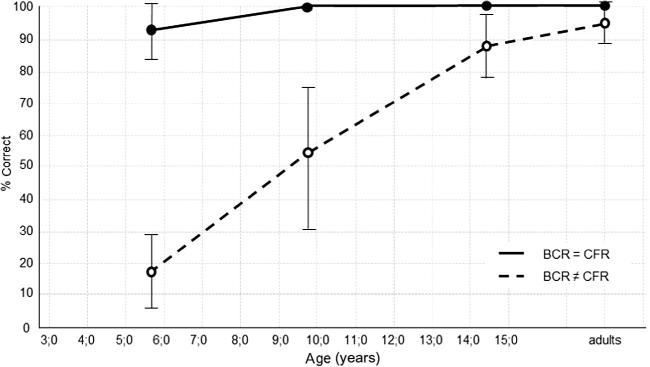
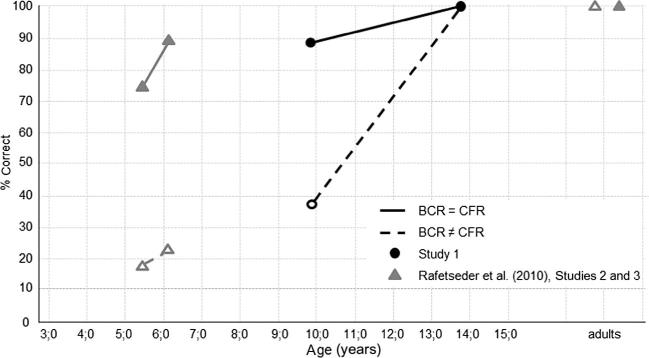
The objective of this study was to describe the developmental progression of counterfactual reasoning from childhood to adulthood. In contrast to the traditional view, it was recently reported by Rafetseder and colleagues that even a majority of 6-year-old children do not engage in counterfactual reasoning when asked counterfactual questions (Child Development, 2010, Vol. 81, pp. 376-389). By continuing to use the same method, the main result of the current Study 1 was that performance of the 9- to 11-year-olds was comparable to that of the 6-year-olds, whereas the 12- to 14-year-olds approximated adult performance. Study 2, using an intuitively simpler task based on Harris and colleagues (Cognition, 1996, Vol. 61, pp. 233-259), resulted in a similar conclusion, specifically that the ability to apply counterfactual reasoning is not fully developed in all children before 12 years of age. We conclude that children who failed our tasks seem to lack an understanding of what needs to be changed (events that are causally dependent on the counterfactual assumption) and what needs to be left unchanged and so needs to be kept as it actually happened. Alternative explanations, particularly executive functioning, are discussed in detail.

摘要

这项研究的目的是描述反事实推理从儿童期到成年期的发展过程。与传统观点相反,Rafetseder 及其同事最近报告说,即使是大多数 6 岁儿童在被问及反事实问题时也不会进行反事实推理(《儿童发展》,2010 年,第 81 卷,第 376-389 页)。通过继续使用相同的方法,当前研究 1 的主要结果是,9 至 11 岁儿童的表现与 6 岁儿童相当,而 12 至 14 岁儿童的表现接近成人水平。研究 2 使用了基于 Harris 及其同事的直观上更简单的任务(《认知》,1996 年,第 61 卷,第 233-259 页),得出了类似的结论,特别是在 12 岁之前,并非所有儿童都完全具备应用反事实推理的能力。我们的结论是,未能通过我们任务的儿童似乎缺乏对需要改变的内容(与反事实假设因果相关的事件)以及需要保持不变的内容的理解,因此需要保持实际发生的情况。详细讨论了替代解释,特别是执行功能。
https://cdn.ncbi.nlm.nih.gov/pmc/blobs/d24c/3582172/0bfc87d2b352/gr2.jpg
https://cdn.ncbi.nlm.nih.gov/pmc/blobs/d24c/3582172/1acf57bc209b/gr1.jpg
https://cdn.ncbi.nlm.nih.gov/pmc/blobs/d24c/3582172/0bfc87d2b352/gr2.jpg
https://cdn.ncbi.nlm.nih.gov/pmc/blobs/d24c/3582172/1acf57bc209b/gr1.jpg
https://cdn.ncbi.nlm.nih.gov/pmc/blobs/d24c/3582172/0bfc87d2b352/gr2.jpg

相似文献

1
Counterfactual reasoning: from childhood to adulthood.反事实推理:从儿童到成年。
J Exp Child Psychol. 2013 Mar;114(3):389-404. doi: 10.1016/j.jecp.2012.10.010. Epub 2012 Dec 5.
2
Children's spontaneous counterfactuals: The roles of valence, expectancy, and cognitive flexibility.儿童的自发反事实思维:效价、预期和认知灵活性的作用。
J Exp Child Psychol. 2016 Jun;146:79-94. doi: 10.1016/j.jecp.2016.01.009. Epub 2016 Feb 23.
3
What is and what never should have been: Children's causal and counterfactual judgments about the same events.是什么以及本不应是什么:儿童对相同事件的因果和反事实判断。
J Exp Child Psychol. 2020 Apr;192:104773. doi: 10.1016/j.jecp.2019.104773. Epub 2020 Jan 14.
4
How do symbols affect 3- to 4-year-olds' executive function? Evidence from a reverse-contingency task.符号如何影响3至4岁儿童的执行功能?来自反向偶发任务的证据。
Dev Sci. 2009 Nov;12(6):1070-82. doi: 10.1111/j.1467-7687.2009.00856.x.
5
Mature counterfactual reasoning in 4- and 5-year-olds.4 岁和 5 岁儿童的成熟反事实推理。
Cognition. 2019 Feb;183:57-66. doi: 10.1016/j.cognition.2018.10.027. Epub 2018 Nov 7.
6
Did she mean to do it? Acquiring a folk theory of intentionality.她是故意的吗?获得一种关于意图的民间理论。
J Exp Child Psychol. 2010 Nov;107(3):207-28. doi: 10.1016/j.jecp.2010.04.001. Epub 2010 May 31.
7
The effects of bilingualism on toddlers' executive functioning.双语对幼儿执行功能的影响。
J Exp Child Psychol. 2011 Mar;108(3):567-79. doi: 10.1016/j.jecp.2010.10.009. Epub 2010 Nov 30.
8
Counterfactual reasoning: developing a sense of "nearest possible world".反事实推理:培养“最接近的可能世界”意识。
Child Dev. 2010 Jan-Feb;81(1):376-89. doi: 10.1111/j.1467-8624.2009.01401.x.
9
The use of questions as problem-solving strategies during early childhood.在幼儿期使用问题作为解决问题的策略。
J Exp Child Psychol. 2013 Jan;114(1):63-76. doi: 10.1016/j.jecp.2012.07.002. Epub 2012 Oct 5.
10
Associations among false belief understanding, counterfactual reasoning, and executive function.错误信念理解、反事实推理和执行功能之间的关系。
Br J Dev Psychol. 2009 Sep;27(Pt 3):681-702. doi: 10.1348/026151008x357886.

引用本文的文献

1
Do Theory of Mind and Mental Time Travel abilities build on joint cognitive foundations?心理理论和心理时间旅行能力是否建立在共同的认知基础之上?
R Soc Open Sci. 2025 Jun 11;12(6):241960. doi: 10.1098/rsos.241960. eCollection 2025 Jun.
2
Time from structure: Children infer the temporal order of past events from visual arrays.来自结构的时间:儿童从视觉阵列中推断过去事件的时间顺序。
Psychon Bull Rev. 2025 Feb 14. doi: 10.3758/s13423-025-02659-9.
3
The Role of Controllability and Foreseeability in Children's Counterfactual Emotions.可控性和可预测性在儿童反事实情绪中的作用。

本文引用的文献

1
Is reasoning from counterfactual antecedents evidence for counterfactual reasoning?从反事实前提进行推理是反事实推理的证据吗?
Think Reason. 2010 May;16(2):131-155. doi: 10.1080/13546783.2010.488074.
2
Executive control and the experience of regret.执行控制与后悔体验。
J Exp Child Psychol. 2012 Mar;111(3):501-15. doi: 10.1016/j.jecp.2011.10.003. Epub 2011 Nov 23.
3
The development of children's regret and relief.儿童的后悔和宽慰感的发展。
Child Dev. 2025 May-Jun;96(3):1098-1111. doi: 10.1111/cdev.14224. Epub 2025 Feb 14.
4
Where innovations flourish: an ethnographic and archaeological overview of hunter-gatherer learning contexts.创新蓬勃发展之地:对狩猎采集者学习环境的民族志与考古学概述
Evol Hum Sci. 2020 Jun 17;2:e31. doi: 10.1017/ehs.2020.35. eCollection 2020.
5
A plausible role of imagination in pretend play, counterfactual reasoning, and executive functions.想象在假装游戏、反事实推理和执行功能中可能扮演的角色。
Br J Psychol. 2023 Aug;114(3):749-770. doi: 10.1111/bjop.12650. Epub 2023 Apr 3.
6
Anchored in the present: preschoolers more accurately infer their futures when confronted with their pasts.立足当下:面对过去,幼儿更能准确推断未来。
Philos Trans R Soc Lond B Biol Sci. 2022 Dec 19;377(1866):20210344. doi: 10.1098/rstb.2021.0344. Epub 2022 Oct 31.
7
Causal learning, counterfactual reasoning and pretend play: a cross-cultural comparison of Peruvian, mixed- and low-socioeconomic status U.S. children.因果学习、反事实推理和假装游戏:秘鲁、混合和低社会经济地位的美国儿童的跨文化比较。
Philos Trans R Soc Lond B Biol Sci. 2022 Dec 19;377(1866):20210345. doi: 10.1098/rstb.2021.0345. Epub 2022 Oct 31.
8
What would have happened? Counterfactuals, hypotheticals and causal judgements.将会发生什么?反事实、假设和因果判断。
Philos Trans R Soc Lond B Biol Sci. 2022 Dec 19;377(1866):20210339. doi: 10.1098/rstb.2021.0339. Epub 2022 Oct 31.
9
Causal Reasoning and Event Cognition as Evolutionary Determinants of Language Structure.因果推理与事件认知作为语言结构的进化决定因素
Entropy (Basel). 2021 Jun 30;23(7):843. doi: 10.3390/e23070843.
10
This is not what I expected: The impact of prior expectations on children's and adults' preferences and emotions.这并非我所预期的:先前的期望对儿童和成人的偏好和情绪的影响。
Dev Psychol. 2021 May;57(5):702-717. doi: 10.1037/dev0001177.
Cogn Emot. 2012;26(5):820-35. doi: 10.1080/02699931.2011.621933. Epub 2011 Nov 14.
4
When the alternative would have been better: counterfactual reasoning and the emergence of regret.当替代方案会更好时:反事实推理与遗憾的出现。
Cogn Emot. 2012;26(5):800-19. doi: 10.1080/02699931.2011.619744. Epub 2011 Oct 6.
5
The development of regret.遗憾的产生。
J Exp Child Psychol. 2012 Jan;111(1):120-7. doi: 10.1016/j.jecp.2011.07.002. Epub 2011 Aug 17.
6
Counterfactual thinking and false belief: the role of executive function.反事实思维和错误信念:执行功能的作用。
J Exp Child Psychol. 2011 Mar;108(3):532-48. doi: 10.1016/j.jecp.2010.09.007. Epub 2010 Nov 18.
7
Counterfactual reasoning: developing a sense of "nearest possible world".反事实推理:培养“最接近的可能世界”意识。
Child Dev. 2010 Jan-Feb;81(1):376-89. doi: 10.1111/j.1467-8624.2009.01401.x.
8
Children's thinking about their own and others' regret and relief.儿童对自己和他人的后悔和宽慰的思考。
J Exp Child Psychol. 2010 Jun-Jul;106(2-3):184-91. doi: 10.1016/j.jecp.2010.02.005. Epub 2010 Mar 21.
9
Is understanding regret dependent on developments in counterfactual thinking?理解后悔是否依赖于反事实思维的发展?
Br J Dev Psychol. 2009 Jun;27(Pt 2):505-10. doi: 10.1348/026151008x401697.
10
Associations among false belief understanding, counterfactual reasoning, and executive function.错误信念理解、反事实推理和执行功能之间的关系。
Br J Dev Psychol. 2009 Sep;27(Pt 3):681-702. doi: 10.1348/026151008x357886.