Genome Center and Department of Biochemistry and Molecular Medicine, University of California, Davis, CA 95616, USA.
Genome Res. 2013 Mar;23(3):530-8. doi: 10.1101/gr.143693.112. Epub 2012 Dec 5.
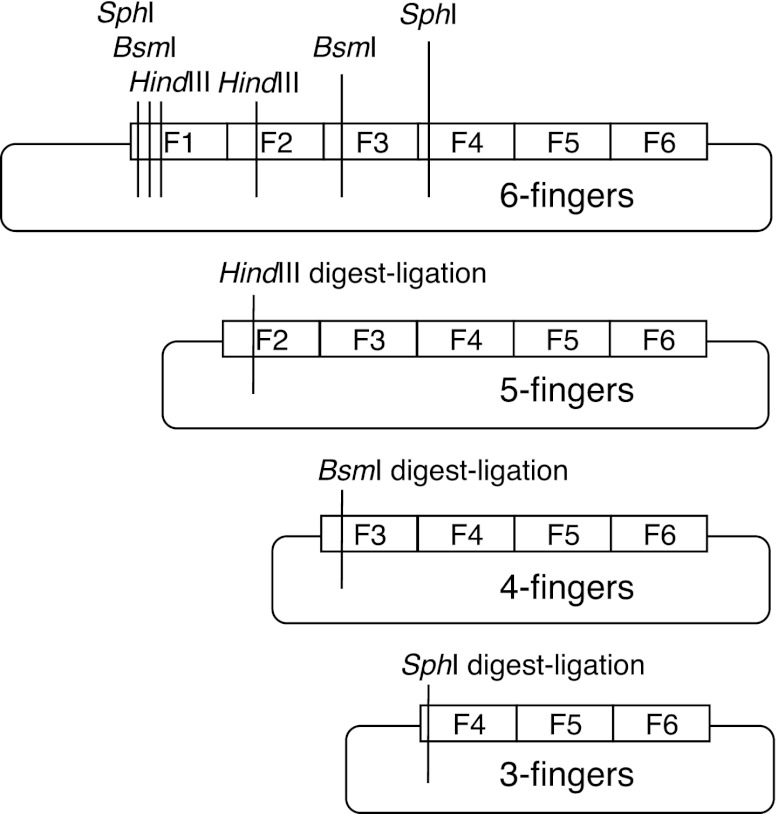
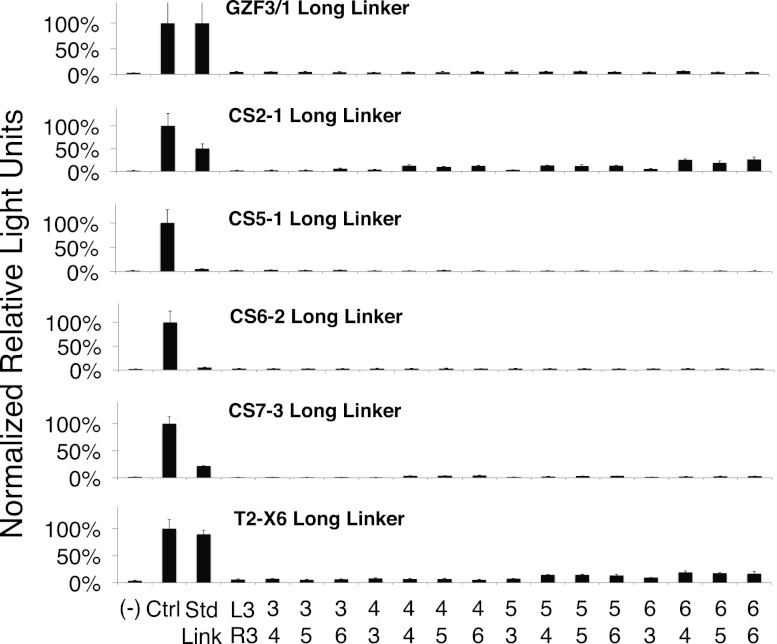
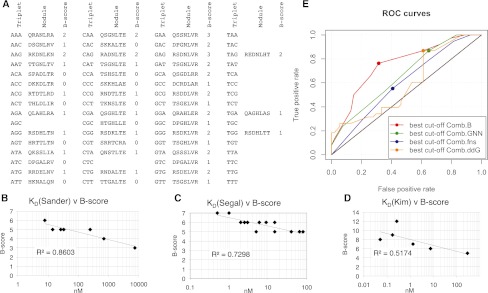
Zinc-finger nucleases (ZFNs) are important tools for genome engineering. Despite intense interest by many academic groups, the lack of robust noncommercial methods has hindered their widespread use. The modular assembly (MA) of ZFNs from publicly available one-finger archives provides a rapid method to create proteins that can recognize a very broad spectrum of DNA sequences. However, three- and four-finger arrays often fail to produce active nucleases. Efforts to improve the specificity of the one-finger archives have not increased the success rate above 25%, suggesting that the MA method might be inherently inefficient due to its insensitivity to context-dependent effects. Here we present the first systematic study on the effect of array length on ZFN activity. ZFNs composed of six-finger MA arrays produced mutations at 15 of 21 (71%) targeted loci in human and mouse cells. A novel drop-out linker scheme was used to rapidly assess three- to six-finger combinations, demonstrating that shorter arrays could improve activity in some cases. Analysis of 268 array variants revealed that half of MA ZFNs of any array composition that exceed an ab initio B-score cutoff of 15 were active. These results suggest that, when used appropriately, MA ZFNs are able to target more DNA sequences with higher success rates than other current methods.
锌指核酸酶 (ZFNs) 是基因组工程的重要工具。尽管许多学术团体对此非常感兴趣,但缺乏强大的非商业方法阻碍了它们的广泛应用。从公开的单指档案中进行 ZFN 的模块化组装 (MA) 提供了一种快速生成能够识别非常广泛的 DNA 序列的蛋白质的方法。然而,三指和四指阵列通常无法产生活性核酸酶。尽管提高单指档案特异性的努力并未将成功率提高到 25%以上,但这表明 MA 方法可能由于其对上下文相关效应的不敏感性而固有地效率低下。在这里,我们首次对阵列长度对 ZFN 活性的影响进行了系统研究。由六指 MA 阵列组成的 ZFN 在人类和小鼠细胞中的 21 个目标基因座中的 15 个(71%)产生了突变。使用一种新颖的缺失链接器方案来快速评估三指到六指组合,表明在某些情况下较短的阵列可以提高活性。对 268 个阵列变体的分析表明,超过 15 的初始 B 评分截止值的任何阵列组成的 MA ZFN 中,有一半是活性的。这些结果表明,当适当地使用时,MA ZFN 能够以比其他当前方法更高的成功率靶向更多的 DNA 序列。