Hu Jianwu, Chen Caiyun, Su Yuan, DU Jiao, Qian Xin, Jin Yang
Department of Pulmonary Medicine, Union Hospital, Tongji Medical College, Huazhong University of Science and Technology, Wuhan 430022, P.R. China.
Exp Ther Med. 2012 Dec;4(6):1045-1050. doi: 10.3892/etm.2012.702. Epub 2012 Sep 10.
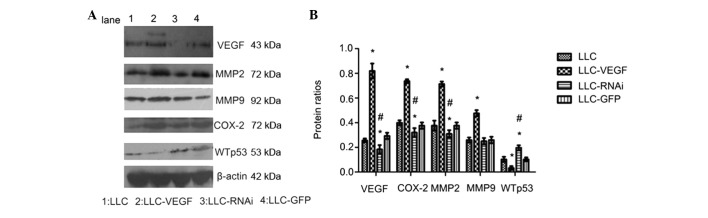
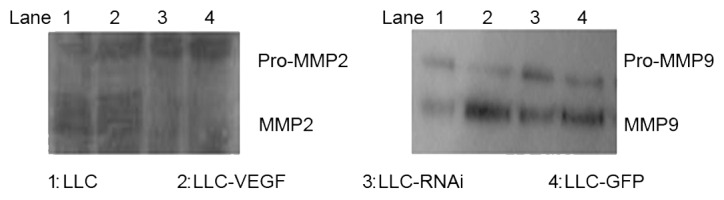
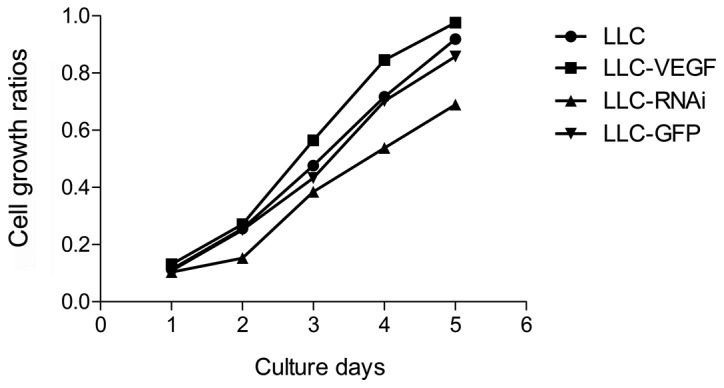
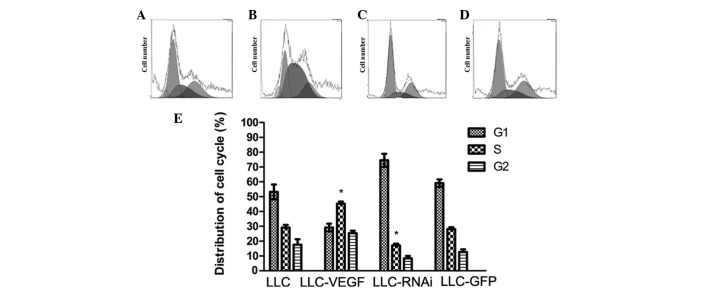
Vascular endothelial growth factor (VEGF) plays a critical role in tumor progression, angiogenesis and metastasis. Cyclooxygenase (COX)-2, matrix metalloproteinase (MMP)2, MMP9 and wild-type (WT) p53 has been found to regulate the production of VEGF. Whether VEGF regulates the production of COX-2, MMP2, MMP9 and WTp53, however, has yet to be determined. This study examined the influence of the overexpression or knockdown of VEGF on the protein levels of COX-2, MMP2, MMP9 and WTp53 as well as cell growth and cell cycle progression in Lewis lung carcinoma (LLC) cells. LLC cells were transfected with pIRES2-VEGF-GFP in the VEGF-overexpressing group (LLC-VEGF), pIRES2-GFP in the mock group (LLC-GFP) or pSUPER-VEGF-GFP in the VEGF knockdown group (LLC-RNAi). Protein levels were detected by western blot analysis. LLC cell growth exhibited no marked change in the LLC-VEGF group, but was significantly retarded in the LLC-RNAi group. Further examination revealed that more cells entered the S stage in the LLC-VEGF group than in the control (or mock) group (45.3 vs. 29.1%, P<0.05), and that cell growth was retarded in the LLC-RNAi group. Moreover, COX-2 and MMP2 and MMP9 proteins were significantly increased in the LLC-VEGF group (approximately 1.84-, 1.89- and 1.83-fold, respectively, vs. control, P<0.05), but significantly decreased in the LLC-RNAi group, whereas the expression of WTp53 exhibited the opposite pattern of change. VEGF expression was positively correlated with COX-2, MMP2 and MMP9 expression (r=0.984, r=0.978, r=0.969, respectively, P<0.01) and negatively correlated with WTp53 (r=-0.833, p<0.01). The activities of MMP2 and MMP9 were increased in the LLC-VEGF group. In conclusion, VEGF overexpression may promote the expression of COX-2 and MMPs, but inhibits WTp53 production in LLC cells; VEGF underexpression may have an inverse effect. These changes are closely correlated with the infiltration and metastasis of lung cancer.
血管内皮生长因子(VEGF)在肿瘤进展、血管生成和转移中起着关键作用。已发现环氧合酶(COX)-2、基质金属蛋白酶(MMP)2、MMP9和野生型(WT)p53可调节VEGF的产生。然而,VEGF是否调节COX-2、MMP2、MMP9和WTp53的产生尚未确定。本研究检测了VEGF过表达或敲低对Lewis肺癌(LLC)细胞中COX-2、MMP2、MMP9和WTp53蛋白水平以及细胞生长和细胞周期进程的影响。VEGF过表达组(LLC-VEGF)的LLC细胞用pIRES2-VEGF-GFP转染,mock组(LLC-GFP)用pIRES2-GFP转染,VEGF敲低组(LLC-RNAi)用pSUPER-VEGF-GFP转染。通过蛋白质印迹分析检测蛋白水平。LLC-VEGF组的LLC细胞生长无明显变化,但LLC-RNAi组的细胞生长明显受到抑制。进一步检测发现,LLC-VEGF组进入S期的细胞比对照组(或mock组)更多(45.3%对29.1%,P<0.05),且LLC-RNAi组的细胞生长受到抑制。此外,LLC-VEGF组中COX-2、MMP2和MMP9蛋白显著增加(分别约为对照组的1.84倍、1.89倍和1.83倍,P<0.05),但在LLC-RNAi组中显著降低,而WTp53的表达呈现相反的变化模式。VEGF表达与COX-2、MMP2和MMP9表达呈正相关(r分别为0.984、0.978、0.969,P<0.01),与WTp53呈负相关(r=-0.833,P<0.01)。LLC-VEGF组中MMP2和MMP9的活性增加。总之,VEGF过表达可能促进LLC细胞中COX-2和MMPs的表达,但抑制WTp53的产生;VEGF低表达可能产生相反的效果。这些变化与肺癌的浸润和转移密切相关。