Montreal Neurological Institute, McGill University Montreal, QC, Canada ; International Laboratory for Brain, Music, and Sound Research Montreal, QC, Canada.
Front Psychol. 2012 Dec 5;3:544. doi: 10.3389/fpsyg.2012.00544. eCollection 2012.
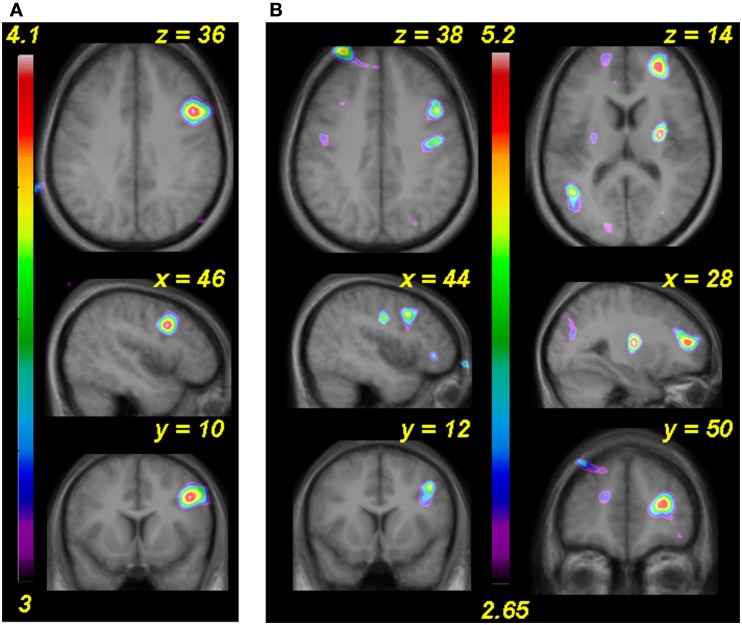
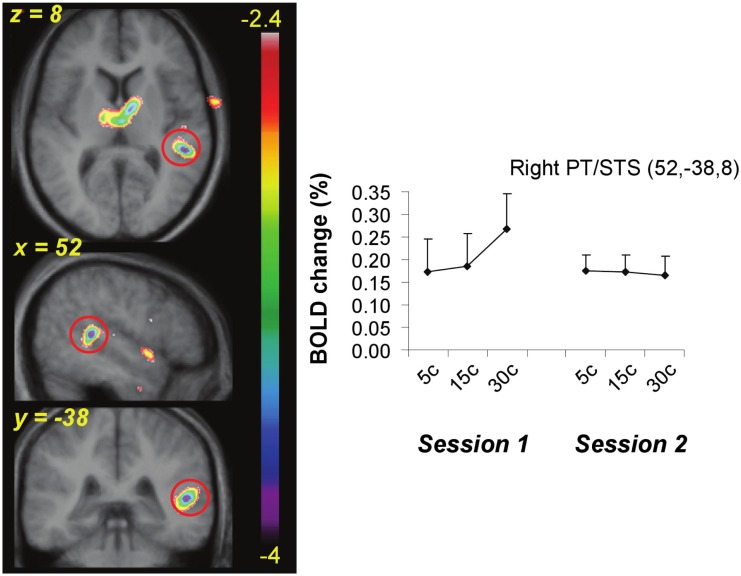
We tested changes in cortical functional response to auditory patterns in a configural learning paradigm. We trained 10 human listeners to discriminate micromelodies (consisting of smaller pitch intervals than normally used in Western music) and measured covariation in blood oxygenation signal to increasing pitch interval size in order to dissociate global changes in activity from those specifically associated with the stimulus feature that was trained. A psychophysical staircase procedure with feedback was used for training over a 2-week period. Behavioral tests of discrimination ability performed before and after training showed significant learning on the trained stimuli, and generalization to other frequencies and tasks; no learning occurred in an untrained control group. Before training the functional MRI data showed the expected systematic increase in activity in auditory cortices as a function of increasing micromelody pitch interval size. This function became shallower after training, with the maximal change observed in the right posterior auditory cortex. Global decreases in activity in auditory regions, along with global increases in frontal cortices also occurred after training. Individual variation in learning rate was related to the hemodynamic slope to pitch interval size, such that those who had a higher sensitivity to pitch interval variation prior to learning achieved the fastest learning. We conclude that configural auditory learning entails modulation in the response of auditory cortex to the trained stimulus feature. Reduction in blood oxygenation response to increasing pitch interval size suggests that fewer computational resources, and hence lower neural recruitment, is associated with learning, in accord with models of auditory cortex function, and with data from other modalities.
我们在一个形态学习范式中测试了听觉模式的皮质功能反应变化。我们训练了 10 位人类听众来区分微旋律(由比西方音乐中常用的更小的音高间隔组成),并测量了血氧信号的变化,以区分活动的全局变化和那些与受过训练的刺激特征特别相关的变化。使用具有反馈的心理物理阶梯程序进行了为期两周的训练。在训练前后进行的辨别能力的行为测试显示,在受过训练的刺激上有显著的学习,并且可以推广到其他频率和任务;在未受过训练的对照组中没有学习发生。在训练之前,功能磁共振成像数据显示出听觉皮层随微旋律音高间隔增大而出现的预期的系统活动增加。训练后,该功能变得更浅,右侧后听觉皮层观察到的最大变化。听觉区域的活动总体减少,同时额叶皮质的活动总体增加。学习率的个体差异与音高间隔大小的血流动力学斜率有关,因此那些在学习前对音高间隔变化更敏感的人能够更快地学习。我们得出结论,形态听觉学习需要对训练刺激特征的听觉皮层反应进行调制。随着音高间隔增大,血氧反应减少表明,与学习相关的计算资源减少,因此神经募集减少,这与听觉皮层功能的模型以及来自其他模态的数据一致。