Jung Woon Tae, Kim Hyun Jin, Min Hyun Ju, Ha Chang Yoon, Kim Hong Jun, Ko Gyung Hyuck, Na Byoung-Kuk, Sohn Woon-Mok
Department of Internal Medicine, Gyeongsang National University School of Medicine, Jinju 660-751, Korea.
Korean J Parasitol. 2012 Dec;50(4):333-7. doi: 10.3347/kjp.2012.50.4.333. Epub 2012 Nov 26.
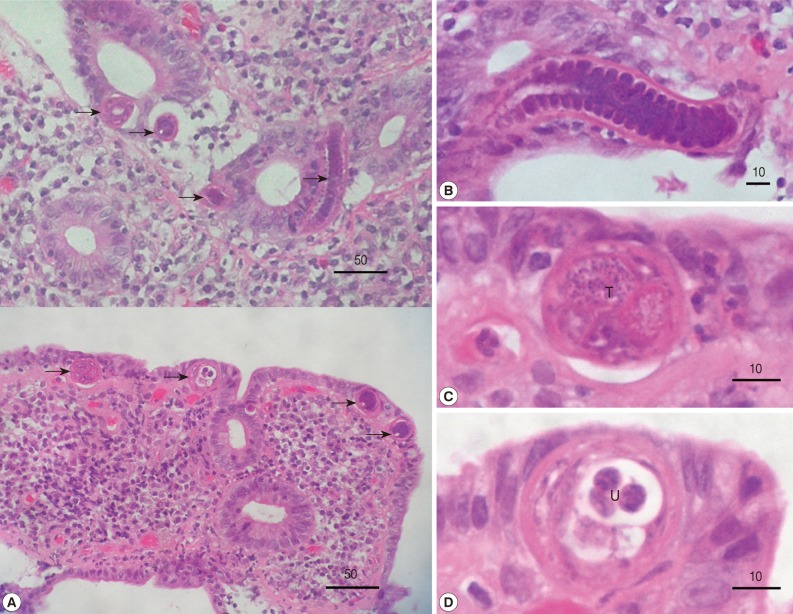
We encountered an indigenous case of intestinal capillariasis with protein-losing enteropathy in the Republic of Korea. A 37-year-old man, residing in Sacheon-si, Gyeongsangnam-do, admitted to the Gyeongsang National University Hospital (GNUH) due to long-lasting diarrhea, abdominal pain, anasarca, and weight loss. He recalled that he frequently ate raw fish, especially the common blackish goby (Acanthogobius flavimanus) and has never been abroad. Under the suspicion of protein-losing enteropathy, he received various kinds of medical examinations, and was diagnosed as intestinal capillariasis based on characteristic sectional findings of nematode worms in the biopsied small intestine. Adults, juvenile worms, and eggs were also detected in the diarrheic stools collected before and after medication. The clinical symptoms became much better after treatment with albendazole 400 mg daily for 3 days, and all findings were in normal range in laboratory examinations performed after 1 month. The present study is the 6th Korean case of intestinal capillariasis and the 3rd indigenous one in the Republic of Korea.
我们在大韩民国遇到了一例伴有蛋白丢失性肠病的本土肠毛细线虫病病例。一名37岁男子居住在庆尚南道泗川市,因长期腹泻、腹痛、全身性水肿和体重减轻入住庆尚国立大学医院(GNUH)。他回忆说自己经常吃生鱼,尤其是中华乌塘鳢,且从未出过国。在怀疑患有蛋白丢失性肠病的情况下,他接受了各种医学检查,并根据活检小肠中特征性的线虫断面发现被诊断为肠毛细线虫病。在用药前后收集的腹泻粪便中也检测到了成虫、幼虫和虫卵。每天服用400毫克阿苯达唑,持续3天进行治疗后,临床症状明显好转,1个月后进行的实验室检查中所有结果均在正常范围内。本研究是韩国第6例肠毛细线虫病病例,也是大韩民国第3例本土病例。