School of Biological Sciences, University of Essex, Wivenhoe Park, Colchester, UK.
J R Soc Interface. 2012 Dec 12;10(79):20120846. doi: 10.1098/rsif.2012.0846. Print 2013 Feb.
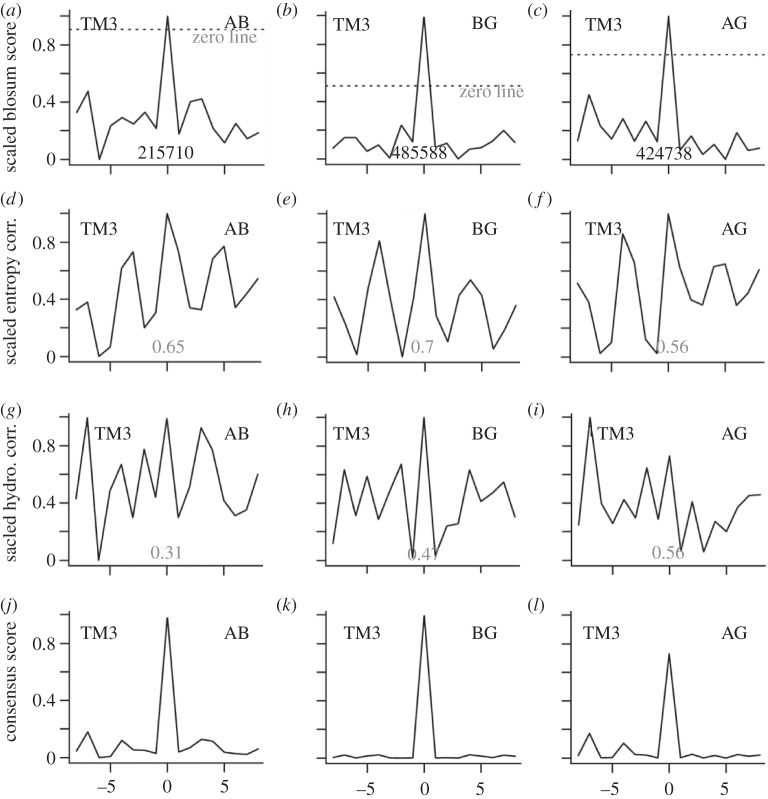
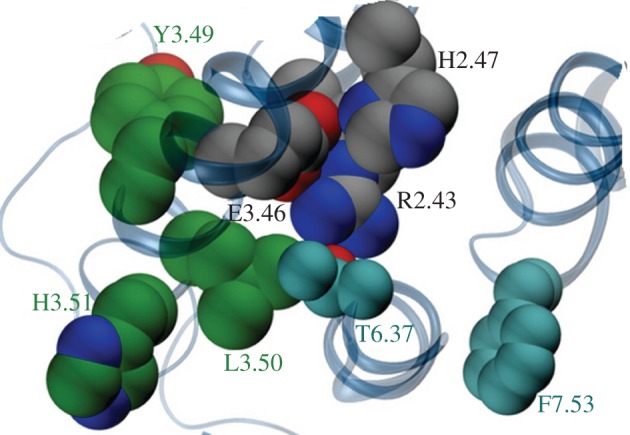
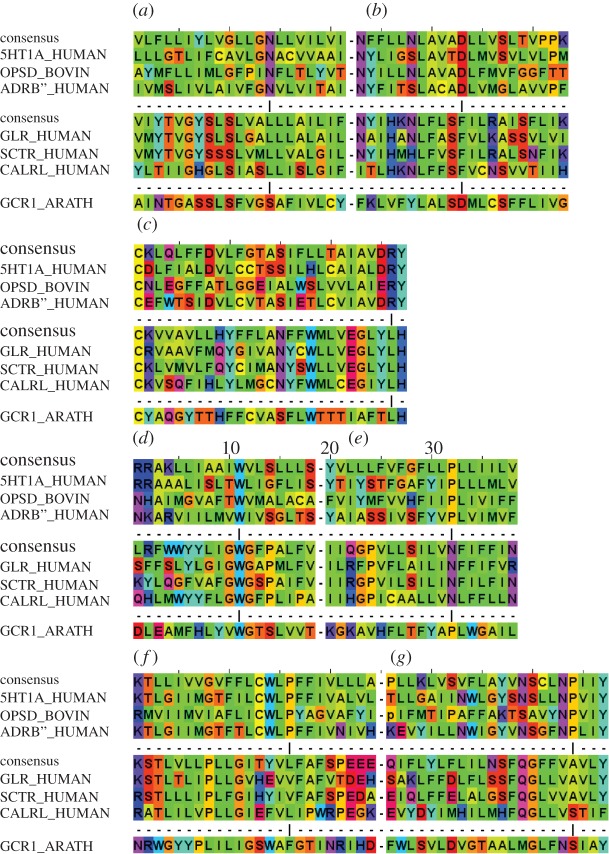
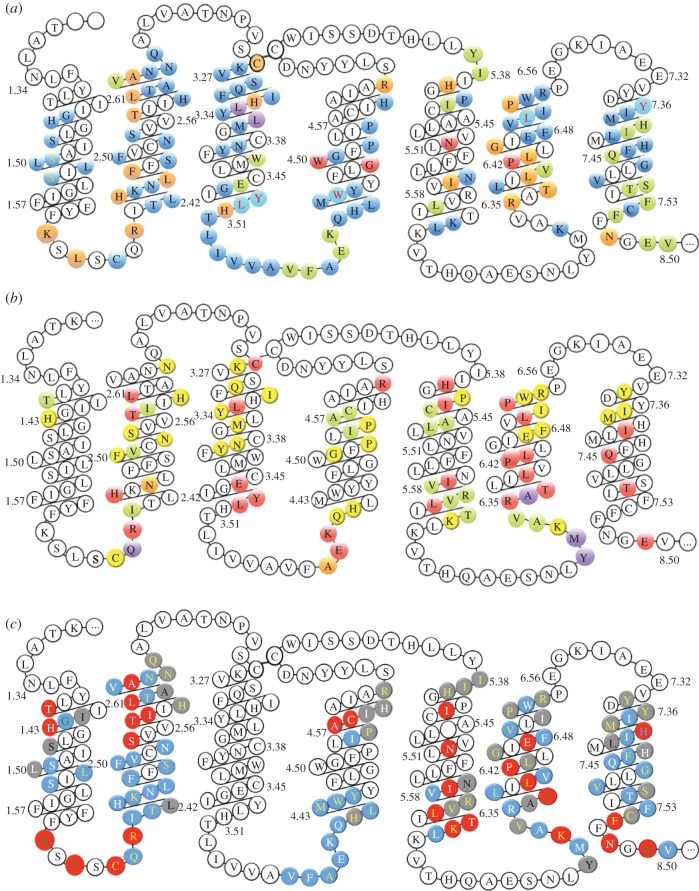
Modelling class B G-protein-coupled receptors (GPCRs) using class A GPCR structural templates is difficult due to lack of homology. The plant GPCR, GCR1, has homology to both class A and class B GPCRs. We have used this to generate a class A-class B alignment, and by incorporating maximum lagged correlation of entropy and hydrophobicity into a consensus score, we have been able to align receptor transmembrane regions. We have applied this analysis to generate active and inactive homology models of the class B calcitonin gene-related peptide (CGRP) receptor, and have supported it with site-directed mutagenesis data using 122 CGRP receptor residues and 144 published mutagenesis results on other class B GPCRs. The variation of sequence variability with structure, the analysis of polarity violations, the alignment of group-conserved residues and the mutagenesis results at 27 key positions were particularly informative in distinguishing between the proposed and plausible alternative alignments. Furthermore, we have been able to associate the key molecular features of the class B GPCR signalling machinery with their class A counterparts for the first time. These include the [K/R]KLH motif in intracellular loop 1, [I/L]xxxL and KxxK at the intracellular end of TM5 and TM6, the NPXXY/VAVLY motif on TM7 and small group-conserved residues in TM1, TM2, TM3 and TM7. The equivalent of the class A DRY motif is proposed to involve Arg(2.39), His(2.43) and Glu(3.46), which makes a polar lock with T(6.37). These alignments and models provide useful tools for understanding class B GPCR function.
使用 A 类 GPCR 结构模板对 B 类 G 蛋白偶联受体 (GPCR) 进行建模由于缺乏同源性而很困难。植物 GPCR GCR1 与 A 类和 B 类 GPCR 都具有同源性。我们利用这一点生成了 A 类-B 类的比对,并通过将最大滞后相关性的熵和疏水性纳入共识评分中,我们能够对受体跨膜区域进行比对。我们应用这种分析生成了 B 类降钙素基因相关肽 (CGRP) 受体的活性和非活性同源模型,并通过使用 122 个 CGRP 受体残基和 144 个发表的关于其他 B 类 GPCR 的诱变结果的定点突变数据对其进行了支持。序列变异性与结构的变化、极性违规的分析、组保守残基的比对以及 27 个关键位置的诱变结果,特别有助于区分提出的和合理的替代比对。此外,我们还首次能够将 B 类 GPCR 信号转导机制的关键分子特征与其 A 类对应物相关联。这些特征包括细胞内环 1 中的 [K/R]KLH 基序、TM5 和 TM6 细胞内末端的 [I/L]xxxL 和 KxxK、TM7 上的 NPXXY/VAVLY 基序以及 TM1、TM2、TM3 和 TM7 中的小组保守残基。拟议的 B 类 GPCR 中与 A 类 DRY 基序等效的基序涉及 Arg(2.39)、His(2.43)和 Glu(3.46),它们与 T(6.37)形成极性锁定。这些比对和模型为理解 B 类 GPCR 功能提供了有用的工具。