Department of Psychiatry and Behavioral Sciences, University of Washington at Harborview Medical Center, Seattle, WA, USA.
Addict Sci Clin Pract. 2012 Dec 14;7(1):27. doi: 10.1186/1940-0640-7-27.
A substantial body of research has established the effectiveness of brief interventions for problem alcohol use. Following these studies, national dissemination projects of screening, brief intervention (BI), and referral to treatment (SBIRT) for alcohol and drugs have been implemented on a widespread scale in multiple states despite little existing evidence for the impact of BI on drug use for non-treatment seekers. This article describes the design of a study testing the impact of SBIRT on individuals with drug problems, its contributions to the existing literature, and its potential to inform drug policy.
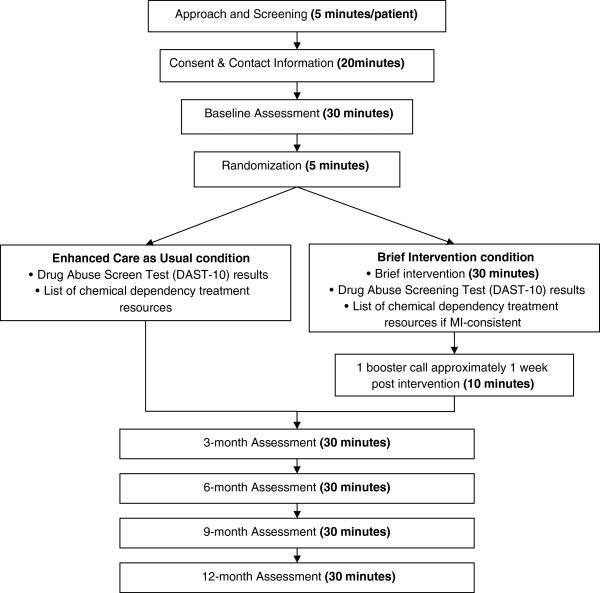
METHODS/DESIGN: The study is a randomized controlled trial of an SBIRT intervention carried out in a primary care setting within a safety net system of care. Approximately 1,000 individuals presenting for scheduled medical care at one of seven designated primary care clinics who endorse problematic drug use when screened are randomized in a 1:1 ratio to BI versus enhanced care as usual (ECAU). Individuals in both groups are reassessed at 3, 6, 9, and 12 months after baseline. Self-reported drug use and other psychosocial measures collected at each data point are supplemented by urine analysis and public health-related data from administrative databases.
This study will contribute to the existing literature by providing evidence for the impact of BI on problem drug use based on a broad range of measures including self-reported drug use, urine analysis, admission to drug abuse treatment, and changes in utilization and costs of health care services, arrests, and death with the intent of informing policy and program planning for problem drug use at the local, state, and national levels.
ClinicalTrials.gov NCT00877331.
大量研究已经证实了简短干预措施对解决酗酒问题的有效性。在这些研究之后,尽管针对非治疗寻求者的 BI 对药物使用的影响几乎没有现有证据,但仍在多个州广泛实施了针对酒精和药物的筛查、简短干预(BI)和转介治疗(SBIRT)的国家传播项目。本文描述了一项测试 SBIRT 对有药物问题的个体的影响的研究的设计,以及它对现有文献的贡献及其对药物政策的潜在影响。
方法/设计:该研究是一项在医疗保障系统内的初级保健环境中进行的 SBIRT 干预的随机对照试验。大约 1000 名在七个指定的初级保健诊所之一因计划的医疗护理就诊的个体,在接受筛查时自我报告存在药物使用问题,将其以 1:1 的比例随机分配到 BI 与增强的常规护理(ECAU)组。两组个体在基线后 3、6、9 和 12 个月时进行重新评估。在每个数据点收集的自我报告的药物使用和其他心理社会措施,辅以尿液分析和来自行政数据库的公共卫生相关数据。
该研究将通过提供基于广泛的措施(包括自我报告的药物使用、尿液分析、药物滥用治疗入院、以及医疗保健服务的使用和成本的变化、逮捕和意图为地方、州和国家各级的药物滥用问题提供政策和计划规划信息,为现有文献做出贡献。
ClinicalTrials.gov NCT00877331。