Nagarajan Niranjan, Bertrand Denis, Hillmer Axel M, Zang Zhi Jiang, Yao Fei, Jacques Pierre-Étienne, Teo Audrey S M, Cutcutache Ioana, Zhang Zhenshui, Lee Wah Heng, Sia Yee Yen, Gao Song, Ariyaratne Pramila N, Ho Andrea, Woo Xing Yi, Veeravali Lavanya, Ong Choon Kiat, Deng Niantao, Desai Kartiki V, Khor Chiea Chuen, Hibberd Martin L, Shahab Atif, Rao Jaideepraj, Wu Mengchu, Teh Ming, Zhu Feng, Chin Sze Yung, Pang Brendan, So Jimmy B Y, Bourque Guillaume, Soong Richie, Sung Wing-Kin, Tean Teh Bin, Rozen Steven, Ruan Xiaoan, Yeoh Khay Guan, Tan Patrick B O, Ruan Yijun
Genome Biol. 2012 Dec 13;13(12):R115. doi: 10.1186/gb-2012-13-12-r115.
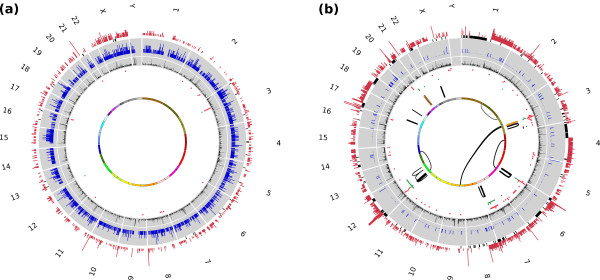
Gastric cancer is the second highest cause of global cancer mortality. To explore the complete repertoire of somatic alterations in gastric cancer, we combined massively parallel short read and DNA paired-end tag sequencing to present the first whole-genome analysis of two gastric adenocarcinomas, one with chromosomal instability and the other with microsatellite instability.
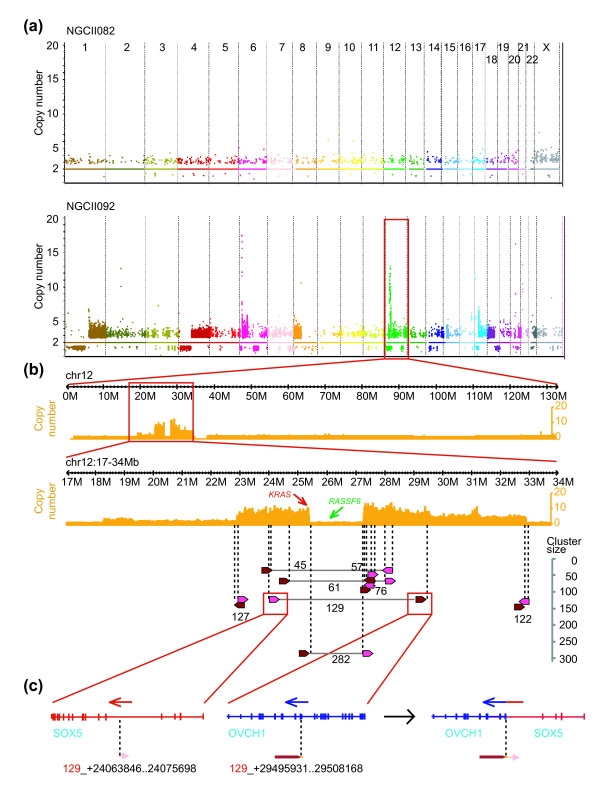
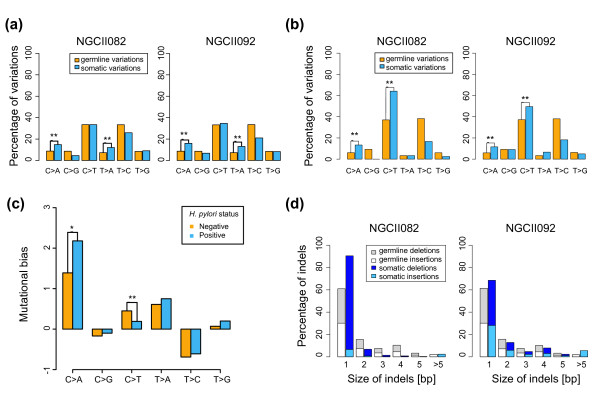
Integrative analysis and de novo assemblies revealed the architecture of a wild-type KRAS amplification, a common driver event in gastric cancer. We discovered three distinct mutational signatures in gastric cancer--against a genome-wide backdrop of oxidative and microsatellite instability-related mutational signatures, we identified the first exome-specific mutational signature. Further characterization of the impact of these signatures by combining sequencing data from 40 complete gastric cancer exomes and targeted screening of an additional 94 independent gastric tumors uncovered ACVR2A, RPL22 and LMAN1 as recurrently mutated genes in microsatellite instability-positive gastric cancer and PAPPA as a recurrently mutated gene in TP53 wild-type gastric cancer.
These results highlight how whole-genome cancer sequencing can uncover information relevant to tissue-specific carcinogenesis that would otherwise be missed from exome-sequencing data.
胃癌是全球癌症死亡的第二大原因。为了探索胃癌体细胞改变的完整图谱,我们结合了大规模平行短读长测序和DNA双末端标签测序,对两例胃腺癌进行了首次全基因组分析,其中一例具有染色体不稳定性,另一例具有微卫星不稳定性。
综合分析和从头组装揭示了野生型KRAS扩增的结构,这是胃癌中常见的驱动事件。我们在胃癌中发现了三种不同的突变特征——在全基因组氧化和微卫星不稳定性相关突变特征的背景下,我们鉴定出了首个外显子特异性突变特征。通过结合40例完整胃癌外显子组的测序数据,并对另外94例独立胃肿瘤进行靶向筛查,进一步表征这些特征的影响,发现ACVR2A、RPL22和LMAN1是微卫星不稳定性阳性胃癌中反复突变的基因,而PAPPA是TP53野生型胃癌中反复突变的基因。
这些结果突出了全基因组癌症测序如何能够揭示与组织特异性致癌作用相关的信息,而这些信息在全外显子组测序数据中可能会被遗漏。