Gastroenterology Department, Rabin Medical Center, Petach Tikva, Israel.
Clin Transl Gastroenterol. 2011 Nov 17;2(11):e5. doi: 10.1038/ctg.2011.4.
Cowden syndrome (CS), associated with germline PTEN mutations, is an autosomal-dominant disorder with increased frequencies of thyroid and breast cancers. Recent reports document the occurrence of gastrointestinal (GI) polyps and increased risk of colon cancer in PTEN mutation carriers. Studies to date, however, have not been based on mutation carriers undergoing active, systematic, routine-interval GI surveillance. Our objective is to document the upper and lower GI findings in CS patients undergoing such an active GI surveillance program.
In a 5-year period, 3,000 consecutive patients were referred to our high-risk GI cancer clinic for various reasons. Of these 3,000, 10 met full-blown clinical criteria for the diagnosis of CS. Individuals with identified PTEN mutations underwent annual upper and lower endoscopy surveillance programs using dual white light and narrow-band imaging. All biopsies including archived materials were reviewed by a single dedicated GI pathologist.
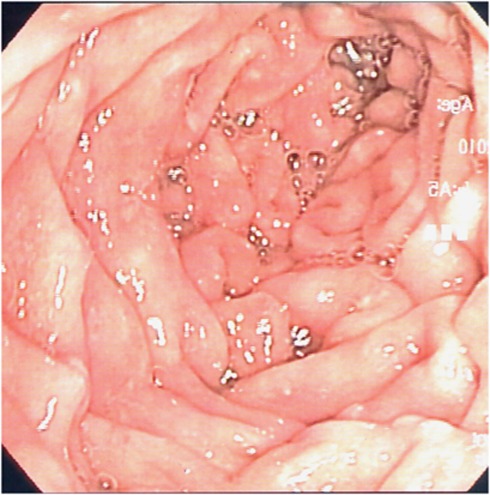
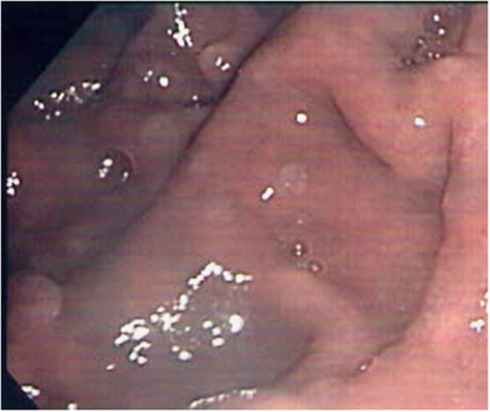
Ten PTEN mutation carriers from different ethnic backgrounds were invited and all participated in the active GI surveillance program. Eight patients had colonic polyps, mostly hyperplastic (eight patients) and hamartomatous (five patients), but also adenomatous (three patients), ganglioneuromatous (three patients), and juvenile polyps (two patients). One patient (10%) had an early-onset rectal cancer (aged 44 years), which was null for PTEN expression on immunohistochemistry. All patients had gastric polyps and nine (90%) had duodenal polyps, mostly hyperplastic and hamartomatous. Additional three patients (30%) had adenomatous duodenal polyps.
PTEN mutation-positive CS patients have a higher frequency of upper GI polyps than previously believed. They appear prone to develop adenomatous upper and lower tract dysplastic polyps and cancer. Thus, the polyps encountered during upper or lower endoscopy in these patients should not be automatically considered innocent hamartomas without malignant potential. Active surveillance programs in specialized centers should be considered in these patients.
Cowden 综合征(CS)与种系 PTEN 突变相关,是一种常染色体显性遗传病,甲状腺癌和乳腺癌的发病率增加。最近的报告记录了 PTEN 突变携带者胃肠道(GI)息肉的发生和结肠癌风险增加。然而,迄今为止的研究并非基于接受主动、系统、常规间隔 GI 监测的突变携带者。我们的目的是记录接受这种主动 GI 监测计划的 CS 患者的上消化道和下消化道发现。
在 5 年期间,3000 名连续患者因各种原因被转介到我们的高危 GI 癌症诊所。在这 3000 名患者中,有 10 名符合 CS 的全面临床诊断标准。确定存在 PTEN 突变的个体接受了使用双白光和窄带成像的年度上消化道和下消化道内镜监测计划。所有活检包括存档材料均由一位专门的 GI 病理学家进行审查。
从不同种族背景中邀请了 10 名 PTEN 突变携带者,并邀请他们全部参加主动 GI 监测计划。8 名患者有结肠息肉,主要为增生性(8 名患者)和错构瘤性(5 名患者),但也有腺瘤性(3 名患者)、神经节细胞瘤性(3 名患者)和青少年息肉(2 名患者)。1 名患者(10%)患有早发性直肠癌(44 岁),免疫组织化学检查显示 PTEN 表达为阴性。所有患者均有胃息肉,9 名(90%)有十二指肠息肉,主要为增生性和错构瘤性。另外 3 名患者(30%)有腺瘤性十二指肠息肉。
PTEN 突变阳性 CS 患者上消化道息肉的频率高于之前认为的。他们似乎容易发生腺瘤性上消化道和下消化道发育不良息肉和癌症。因此,在这些患者的上消化道或下消化道内镜检查中遇到的息肉不应自动被认为是没有恶性潜能的良性错构瘤。应考虑在这些患者中在专门中心进行主动监测计划。