Institute of Psychiatric Research, Department of Psychiatry, Indiana University School of Medicine, Indianapolis, IN 46202-4887, USA.
Addict Biol. 2013 Mar;18(2):297-306. doi: 10.1111/adb.12018. Epub 2012 Dec 14.
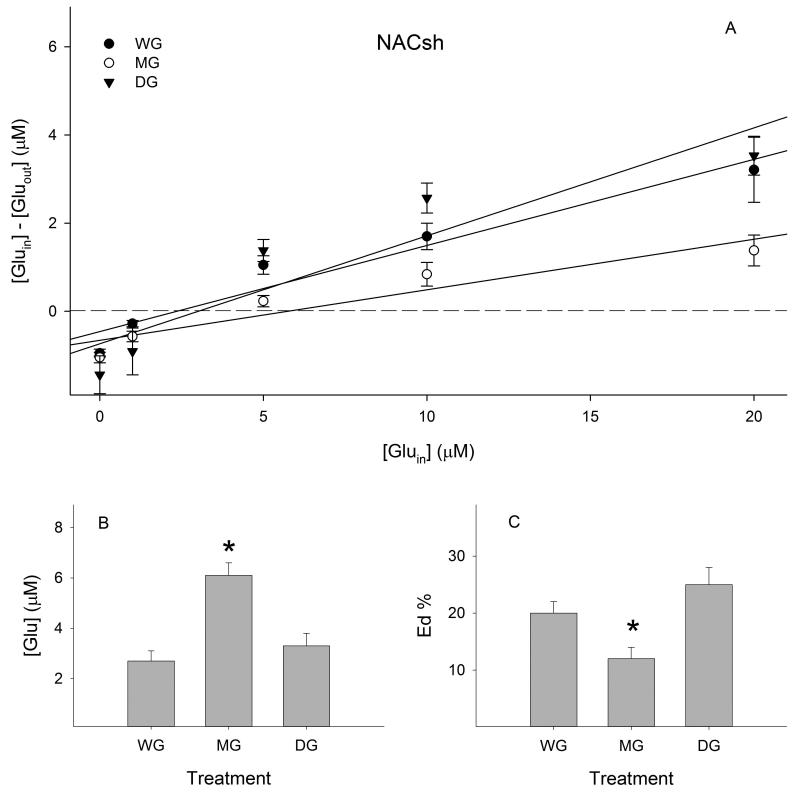
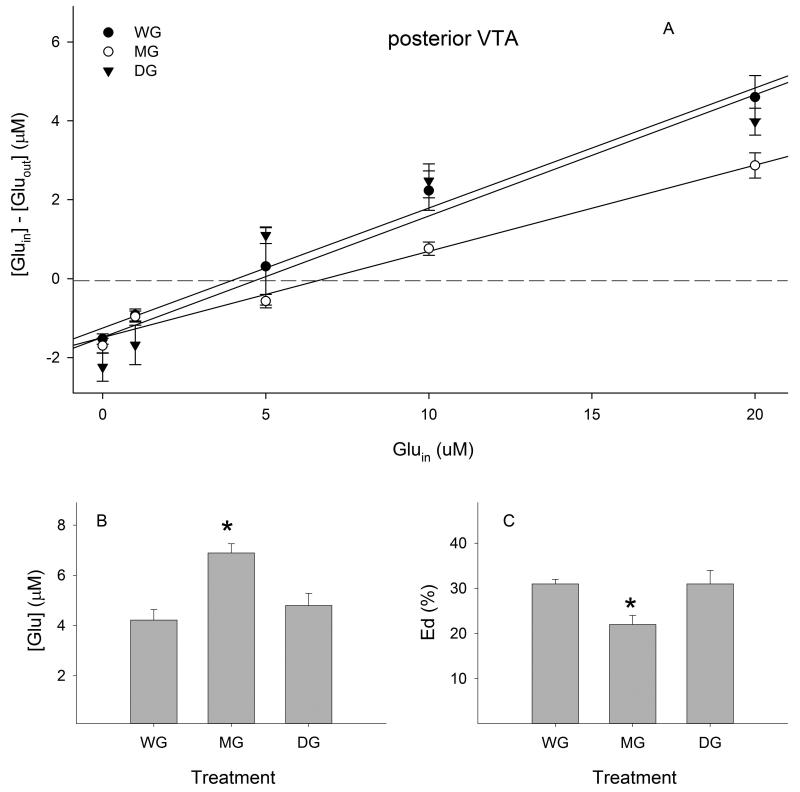
The present study determined the effects of voluntary ethanol drinking and deprivation on basal extracellular glutamate concentrations and clearance in the mesolimbic system and tested the hypothesis that chronic ethanol drinking would persistently increase basal glutamate neurotransmission. Three groups of alcohol-preferring (P) rats were used: 'water group (WG),' 'ethanol maintenance group (MG; 24-hour free choice water versus 15% ethanol)' and 'ethanol deprivation group (DG; 2 weeks of deprivation).' Quantitative microdialysis and Western blots were conducted to measure basal extracellular glutamate concentrations, clearance and proteins associated with glutamate clearance. Chronic alcohol drinking produced a 70-100% increase of basal extracellular glutamate concentrations in the posterior ventral tegmental area (4.0 versus 7.0 μM) and nucleus accumbens shell (3.0 versus 6.0 μM). Glutamate clearances were reduced by 30-40% in both regions of MG rats compared with WG rats. In addition, Western blots revealed a 40-45% decrease of excitatory amino transporter 1 (EAAT1) protein, but no significant changes in the levels of EAAT2 or cystine-glutamate antiporter in these regions of MG versus WG rats. The enhanced glutamate concentrations returned to control levels, accompanied by a recovery of glutamate clearance following deprivation. These results indicated that chronic alcohol drinking enhanced extracellular glutamate concentrations in the mesolimbic system, as a result, in part, of reduced clearance, suggesting that enhanced glutamate neurotransmission may contribute to the maintenance of alcohol drinking. However, because the increased glutamate levels returned to normal after deprivation, elevated glutamate neurotransmission may not contribute to the initiation of relapse drinking.
本研究旨在确定自愿饮酒和断酒对中脑边缘系统基础细胞外谷氨酸浓度和清除率的影响,并检验慢性乙醇摄入是否会持续增加基础谷氨酸神经传递的假说。研究使用了三组酒精偏好(P)大鼠:“水组(WG)”、“乙醇维持组(MG;24 小时自由选择水与 15%乙醇)”和“乙醇剥夺组(DG;2 周剥夺)”。通过定量微透析和 Western blot 来测量基础细胞外谷氨酸浓度、清除率以及与谷氨酸清除相关的蛋白。慢性饮酒导致腹侧被盖区(4.0 比 7.0 μM)和伏隔核壳(3.0 比 6.0 μM)的基础细胞外谷氨酸浓度增加 70-100%。MG 大鼠的谷氨酸清除率比 WG 大鼠降低 30-40%。此外,Western blot 显示 MG 大鼠与 WG 大鼠相比,兴奋性氨基酸转运体 1(EAAT1)蛋白水平降低 40-45%,但 EAAT2 或胱氨酸-谷氨酸反向转运蛋白的水平没有显著变化。在剥夺后,谷氨酸浓度恢复到对照水平,同时谷氨酸清除率恢复。这些结果表明,慢性饮酒增加了中脑边缘系统的细胞外谷氨酸浓度,部分原因是清除率降低,表明增强的谷氨酸神经传递可能有助于维持饮酒。然而,由于剥夺后谷氨酸水平恢复正常,升高的谷氨酸神经传递可能不会导致复发饮酒的开始。