Blizard Institute, Queen Mary University of London, London, UK.
Diabetes Care. 2013 Apr;36(4):908-13. doi: 10.2337/dc12-0931. Epub 2012 Dec 17.
Specific autoantibodies characterize type 1 diabetes in childhood but are also found in adult-onset diabetes, even when initially non-insulin requiring, e.g., with latent autoimmune diabetes (LADA). We aimed to characterize adult-onset autoimmune diabetes.
We consecutively studied 6,156 European diabetic patients attending clinics within 5 years of diagnosis (age range, 30-70 years) examined cross-sectionally clinically and for GAD antibodies (GADA) and antibodies to insulinoma-associated antigen-2 (IA-2A) and zinc-transporter 8 (ZnT8A).
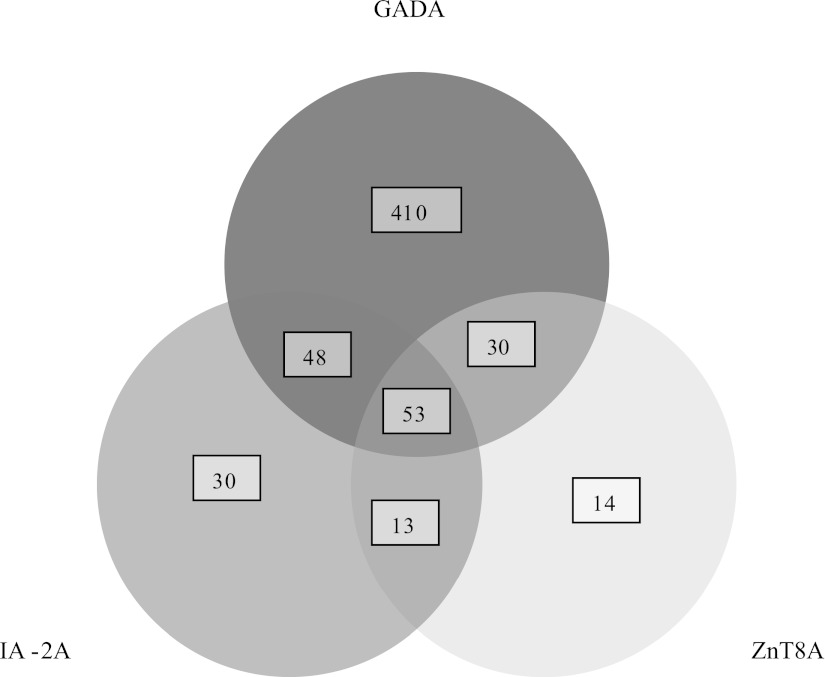
Of 6,156 patients, 541 (8.8%) had GADA and only 57 (0.9%) IA-2A or ZnT8A alone. More autoantibody-positive than autoantibody-negative patients were younger, leaner, on insulin (49.5 vs. 13.2%), and female (P < 0.0001 for each), though LADA patients (9.7% of total) did not show categorically distinct clinical features from autoantibody-negative type 2 diabetes. Similarly, more GADA patients with high (>200 World Health Organization IU) (n = 403) compared with low (n = 138) titer were female, lean, and insulin treated (54.6 vs. 39.7%) (P < 0.02 for each). Autoantibody-positive patients usually had GADA (541 of 598; 90.5%) and had LADA more often than type 1 autoimmune diabetes (odds ratio 3.3).
Adult-onset autoimmune diabetes emerges as a prevalent form of autoimmune diabetes. Our results indicate that adult-onset autoimmune diabetes in Europe encompasses type 1 diabetes and LADA in the same broad clinical and autoantibody-positive spectrum. At diagnosis, patients with adult-onset autoimmune diabetes are usually non-insulin requiring and clinically indistinguishable from patients with type 2 diabetes, though they tend to be younger and leaner. Only with screening for autoantibodies, especially GADA, can they be identified with certainty.
特定的自身抗体可用于鉴定儿童时期的 1 型糖尿病,但在成年发病的糖尿病中也有发现,即使在最初是非胰岛素依赖型糖尿病时,例如潜伏性自身免疫性糖尿病(LADA)。我们旨在对成年发病的自身免疫性糖尿病进行特征分析。
我们连续研究了 6156 名欧洲糖尿病患者,这些患者在确诊后 5 年内(年龄范围 30-70 岁)接受了临床检查,并进行了谷氨酸脱羧酶抗体(GADA)、胰岛细胞抗原 2 抗体(IA-2A)和锌转运体 8 抗体(ZnT8A)检测。
在 6156 名患者中,有 541 名(8.8%)存在 GADA,仅有 57 名(0.9%)单独存在 IA-2A 或 ZnT8A。与自身抗体阴性患者相比,自身抗体阳性患者更年轻、更消瘦、使用胰岛素(49.5%比 13.2%)和女性(每个因素 P < 0.0001),但 LADA 患者(占总人数的 9.7%)在临床特征方面与自身抗体阴性的 2 型糖尿病患者并没有明显的区别。同样,在高滴度(>200 国际单位/毫升)(n = 403)GADA 患者中,女性、消瘦和胰岛素治疗的比例(54.6%比 39.7%)高于低滴度(n = 138)GADA 患者(每个因素 P < 0.02)。自身抗体阳性患者通常同时存在 GADA(541 名患者中的 598 名;90.5%),并且比 1 型自身免疫性糖尿病更常见 LADA(比值比 3.3)。
成年发病的自身免疫性糖尿病是一种普遍存在的自身免疫性糖尿病形式。我们的结果表明,欧洲的成年发病自身免疫性糖尿病涵盖了 1 型糖尿病和 LADA,具有相同的广泛临床和自身抗体阳性特征。在诊断时,成年发病的自身免疫性糖尿病患者通常不需要胰岛素治疗,在临床方面与 2 型糖尿病患者无法区分,尽管他们往往更年轻、更消瘦。只有通过自身抗体筛查,特别是 GADA,才能明确诊断。