Department of Clinical Sciences, Division of Experimental Vascular Research, Lund University, Lund, Sweden.
J Neuroinflammation. 2012 Dec 21;9:274. doi: 10.1186/1742-2094-9-274.
Subarachnoid hemorrhage (SAH) is associated with high morbidity and mortality. It is suggested that the associated inflammation is mediated through activation of the mitogen-activated protein kinase (MAPK) pathway which plays a crucial role in the pathogenesis of delayed cerebral ischemia after SAH. The aim of this study was first to investigate the timecourse of altered expression of proinflammatory cytokines and matrix metalloproteinase in the cerebral arteries walls following SAH. Secondly, we investigated whether administration of a specific mitogen-activated protein kinase kinase (MEK)1/2 inhibitor, U0126, given at 6 h after SAH prevents activation of the MEK/extracellular signal-regulated kinase 1/2 pathway and the upregulation of cerebrovascular inflammatory mediators and improves neurological function.
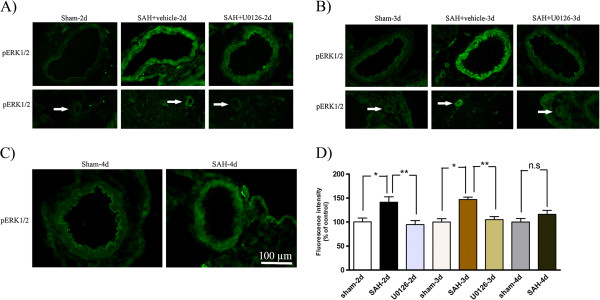
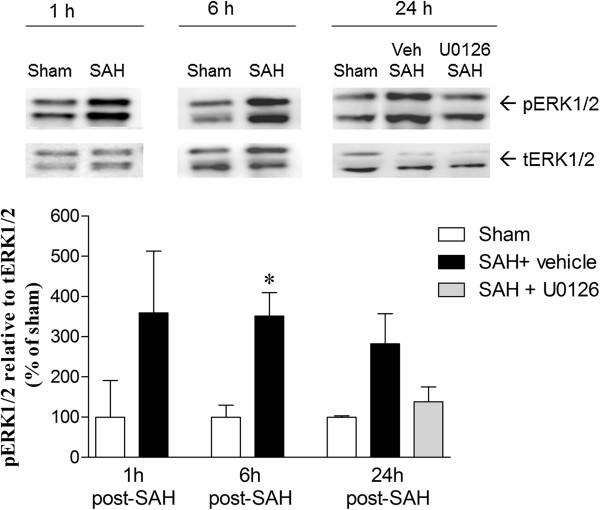
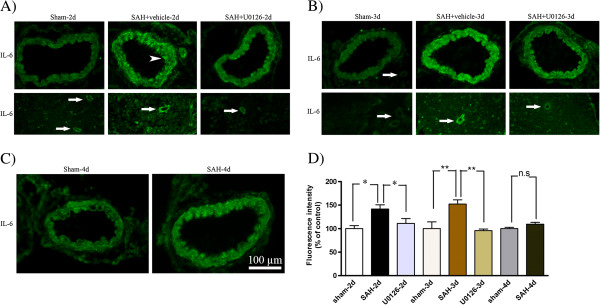
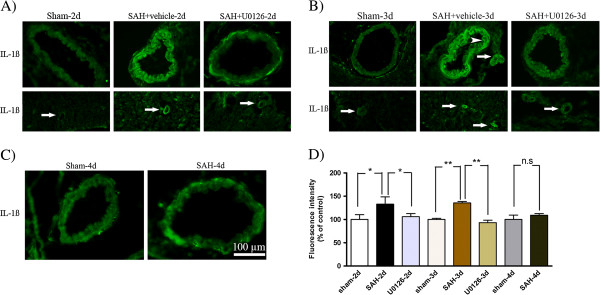
SAH was induced in rats by injection of 250 μl of autologous blood into basal cisterns. U0126 was given intracisternally using two treatment regimens: (A) treatments at 6, 12, 24 and 36 h after SAH and experiments terminated at 48 h after SAH, or (B) treatments at 6, 12, and 24 h after SAH and terminated at 72 h after SAH. Cerebral arteries were harvested and interleukin (IL)-6, IL-1β, tumor necrosis factor α (TNF)α, matrix metalloproteinase (MMP)-9 and phosphorylated ERK1/2 (pERK1/2) levels investigated by immunohistochemistry. Early activation of pERK1/2 was measured by western blot. Functional neurological outcome after SAH was also analyzed.
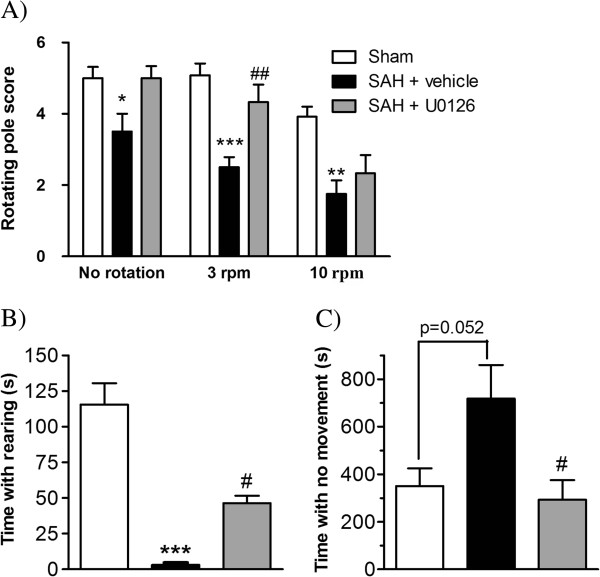
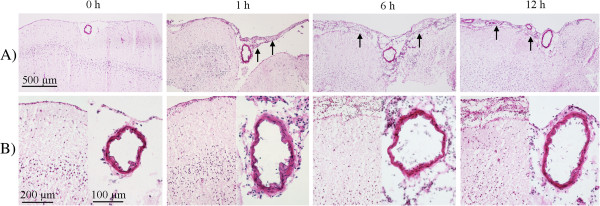
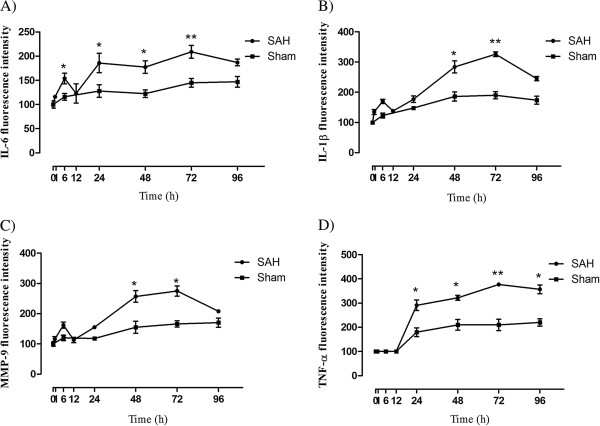
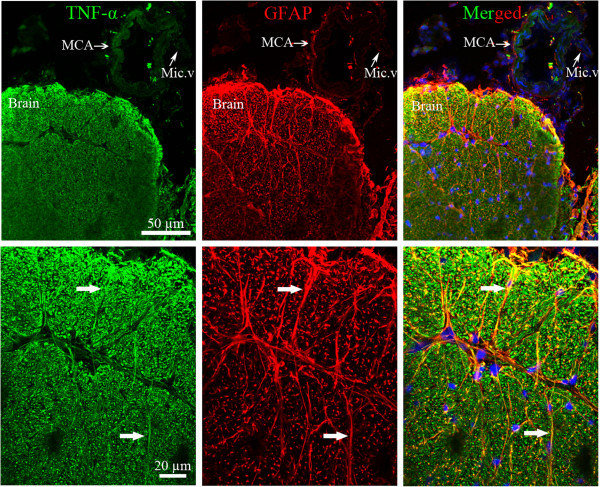
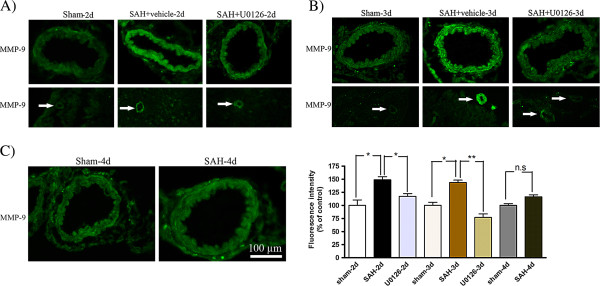
Expression levels of IL-1β, IL-6, MMP-9 and pERK1/2 proteins were elevated over time with an early increase at around 6 h and a late peak at 48 to 72 h post-SAH in cerebral arteries. Enhanced expression of TNFα in cerebral arteries started at 24 h and increased until 96 h. In addition, SAH induced sensorimotor and spontaneous behavior deficits in the animals. Treatment with U0126 starting at 6 h after SAH prevented activation of MEK-ERK1/2 signaling. Further, U0126 significantly decreased the upregulation of inflammation proteins at 48 and 72 h following SAH and improved neurological function. We found no differences between treatment regimens A and B.
These results show that SAH induces early activation of the MEK-ERK1/2 pathway in cerebral artery walls, which is associated with upregulation of proinflammatory cytokines and MMP-9. Inhibition of the MEK-ERK1/2 pathway by U0126 starting at 6 h post-SAH prevented upregulation of cytokines and MMP-9 in cerebral vessels, and improved neurological outcome.
蛛网膜下腔出血(SAH)与高发病率和死亡率相关。据认为,相关炎症是通过丝裂原活化蛋白激酶(MAPK)途径的激活介导的,MAPK 途径在蛛网膜下腔出血后迟发性脑缺血的发病机制中起关键作用。本研究的目的首先是研究蛛网膜下腔出血后动脉壁中促炎细胞因子和基质金属蛋白酶表达的时间变化。其次,我们研究了在蛛网膜下腔出血后 6 小时给予特定的丝裂原活化蛋白激酶激酶(MEK)1/2 抑制剂 U0126 是否可以防止 MEK/细胞外信号调节激酶 1/2 途径的激活以及脑血管炎症介质的上调,并改善神经功能。
通过将 250μl 自体血液注入基底池来诱导大鼠蛛网膜下腔出血。通过两种治疗方案进行 U0126 鞘内给药:(A)蛛网膜下腔出血后 6、12、24 和 36 小时给予治疗,实验在蛛网膜下腔出血后 48 小时终止,或(B)蛛网膜下腔出血后 6、12 和 24 小时给予治疗,在蛛网膜下腔出血后 72 小时终止。通过免疫组织化学法研究白细胞介素(IL)-6、IL-1β、肿瘤坏死因子α(TNF)α、基质金属蛋白酶(MMP)-9 和磷酸化 ERK1/2(pERK1/2)水平。通过 Western blot 测定 pERK1/2 的早期激活。还分析了蛛网膜下腔出血后的早期神经功能。
IL-1β、IL-6、MMP-9 和 pERK1/2 蛋白的表达水平随时间推移而升高,在蛛网膜下腔出血后约 6 小时出现早期增加,在 48 至 72 小时出现晚期高峰。在大脑动脉中,TNFα的增强表达在 24 小时开始并增加直至 96 小时。此外,蛛网膜下腔出血诱导动物出现感觉运动和自发性行为缺陷。在蛛网膜下腔出血后 6 小时开始用 U0126 治疗可防止 MEK-ERK1/2 信号的激活。进一步,U0126 显著降低了蛛网膜下腔出血后 48 小时和 72 小时炎症蛋白的上调,并改善了神经功能。我们在治疗方案 A 和 B 之间未发现差异。
这些结果表明,蛛网膜下腔出血诱导大脑动脉壁中 MEK-ERK1/2 途径的早期激活,这与促炎细胞因子和 MMP-9 的上调有关。在蛛网膜下腔出血后 6 小时开始用 U0126 抑制 MEK-ERK1/2 途径可防止血管中细胞因子和 MMP-9 的上调,并改善神经功能。