Research Center for Infectious Diseases, Julius-Maximilians-Universität Würzburg Würzburg, Germany.
Front Microbiol. 2012 Dec 3;3:414. doi: 10.3389/fmicb.2012.00414. eCollection 2012.
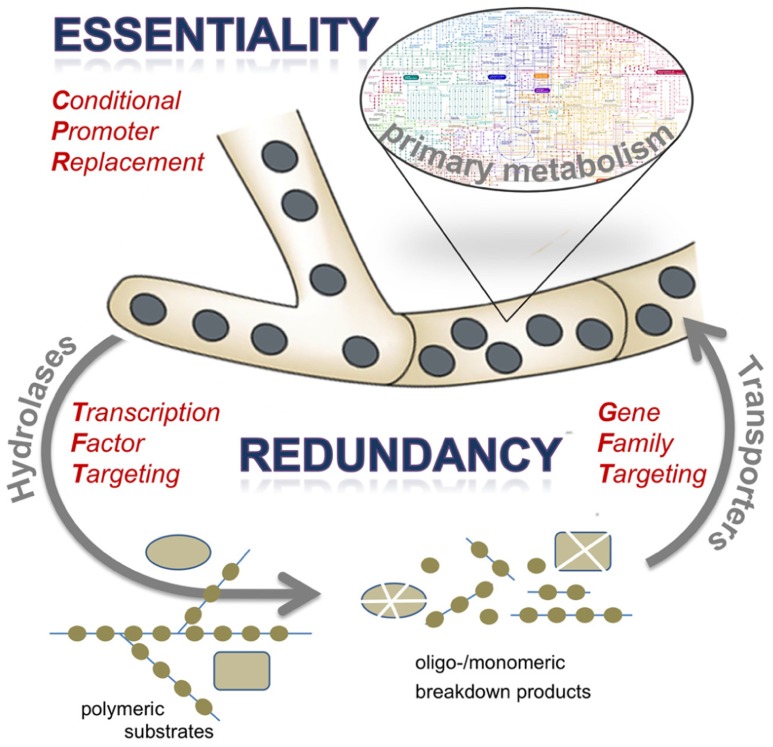
Incidence rates of infections caused by environmental opportunistic fungi have risen over recent decades. Aspergillus species have emerged as serious threat for the immunecompromised, and detailed knowledge about virulence-determining traits is crucial for drug target identification. As a prime saprobe, A. fumigatus has evolved to efficiently adapt to various stresses and to sustain nutritional supply by osmotrophy, which is characterized by extracellular substrate digestion followed by efficient uptake of breakdown products that are then fed into the fungal primary metabolism. These intrinsic metabolic features are believed to be related with its virulence ability. The plethora of genes that encode underlying effectors has hampered their in-depth analysis with respect to pathogenesis. Recent developments in Aspergillus molecular biology allow conditional gene expression or comprehensive targeting of gene families to cope with redundancy. Furthermore, identification of essential genes that are intrinsically connected to virulence opens accurate perspectives for novel targets in antifungal therapy.
近年来,环境机会性真菌引起的感染发病率有所上升。曲霉菌属已成为免疫功能低下者的严重威胁,而对毒力决定因素特征的详细了解对于药物靶点的识别至关重要。作为一种主要的腐生物,烟曲霉已经进化到能够有效地适应各种压力,并通过渗透营养来维持营养供应,其特征是细胞外基质的消化,然后有效地吸收分解产物,这些产物随后被输入真菌的初级代谢。这些内在的代谢特征被认为与它的毒力能力有关。大量编码潜在效应物的基因阻碍了对其发病机制的深入分析。曲霉分子生物学的最新进展使得条件基因表达或基因家族的全面靶向成为可能,以应对冗余问题。此外,鉴定与毒力内在相关的必需基因为抗真菌治疗的新靶点提供了准确的前景。