Galldiks Norbert, Filss Christian P, Goldbrunner Roland, Langen Karl-Josef
Institute of Neuroscience and Medicine, Forschungszentrum Juelich, Juelich ; Departments of Neurology, University Hospital Cologne, Cologne, Germany.
Case Rep Oncol. 2012 Sep;5(3):490-4. doi: 10.1159/000342480. Epub 2012 Sep 8.
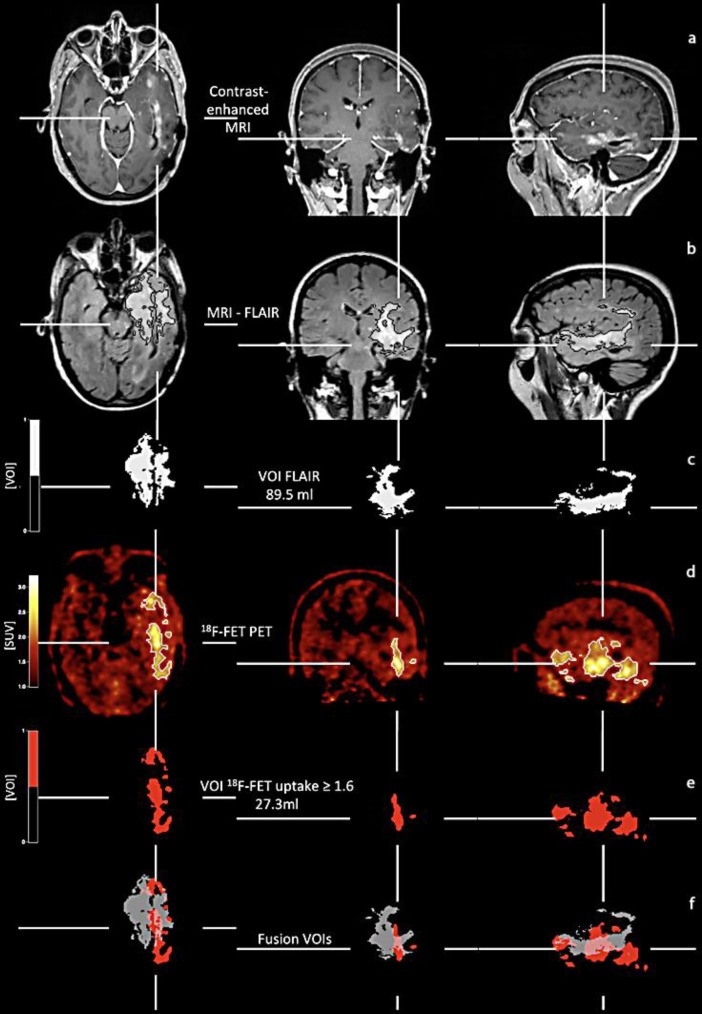
Antiangiogenic treatment using bevacizumab may cause difficulties in distinguishing between antivascular and true antitumor effects when using MRI response criteria based on changes of contrast enhancement (i.e., Macdonald criteria). Furthermore, more precise tumor response assessment criteria (i.e., RANO criteria), which incorporate nonenhancing T2/FLAIR sequences into Macdonald criteria, may be influenced by other causes of T2/FLAIR hyperintensity (e.g., radiation-induced gliosis). The authors present discrepant MR and [(18)F]fluoroethyl-L-tyrosine PET imaging findings in a patient with bevacizumab treatment failure.
使用贝伐单抗进行抗血管生成治疗时,若依据基于对比增强变化的MRI反应标准(即麦克唐纳标准),可能难以区分抗血管作用和真正的抗肿瘤作用。此外,更精确的肿瘤反应评估标准(即RANO标准)将非增强T2/FLAIR序列纳入了麦克唐纳标准,但其可能会受到T2/FLAIR高信号其他成因(如放射性脑胶质增生)的影响。作者展示了一名贝伐单抗治疗失败患者中不一致的磁共振成像(MR)和[¹⁸F]氟乙基-L-酪氨酸正电子发射断层显像(PET)成像结果。