Nedergaard Mette K, Kristoffersen Karina, Michaelsen Signe R, Madsen Jacob, Poulsen Hans S, Stockhausen Marie-Thérése, Lassen Ulrik, Kjaer Andreas
Department of Clinical Physiology, Nuclear Medicine & PET and Cluster for Molecular Imaging, Rigshospitalet and University of Copenhagen, Copenhagen, Denmark.
Department of Radiation Biology, The Finsen Center, Rigshospitalet, Copenhagen, Denmark.
PLoS One. 2014 Jun 11;9(2):e100009. doi: 10.1371/journal.pone.0100009. eCollection 2014.
Brain tumor imaging is challenging. Although 18F-FET PET is widely used in the clinic, the value of 18F-FET MicroPET to evaluate brain tumors in xenograft has not been assessed to date. The aim of this study therefore was to evaluate the performance of in vivo 18F-FET MicroPET in detecting a treatment response in xenografts. In addition, the correlations between the 18F-FET tumor accumulation and the gene expression of Ki67 and the amino acid transporters LAT1 and LAT2 were investigated. Furthermore, Ki67, LAT1 and LAT2 gene expression in xenograft and archival patient tumors was compared.
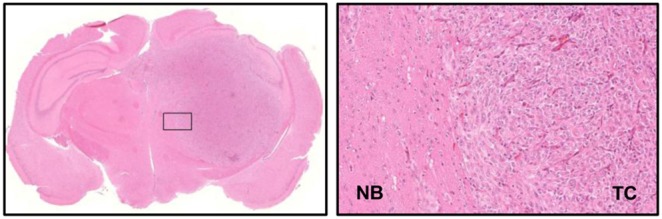
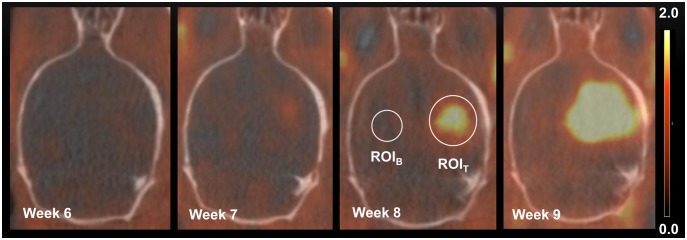
Human GBM cells were injected orthotopically in nude mice and 18F-FET uptake was followed by weekly MicroPET/CT. When tumor take was observed, mice were treated with CPT-11 or saline weekly. After two weeks of treatment the brain tumors were isolated and quantitative polymerase chain reaction were performed on the xenograft tumors and in parallel on archival patient tumor specimens.
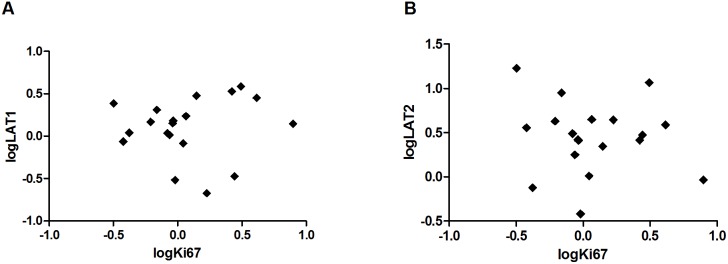
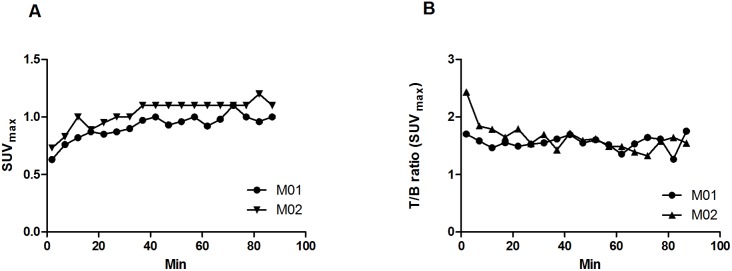
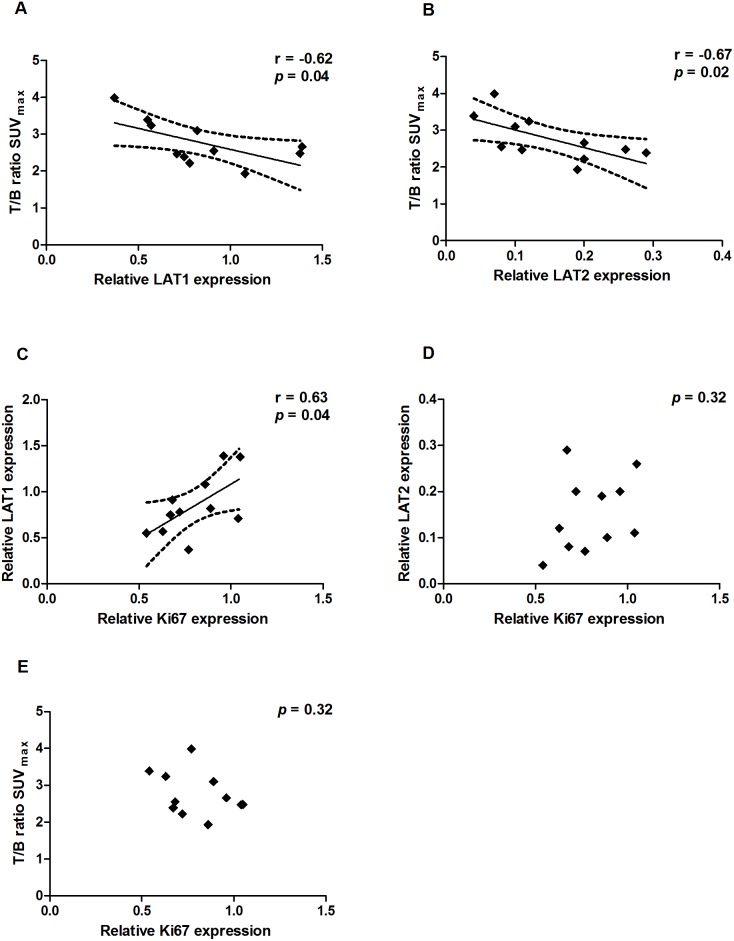
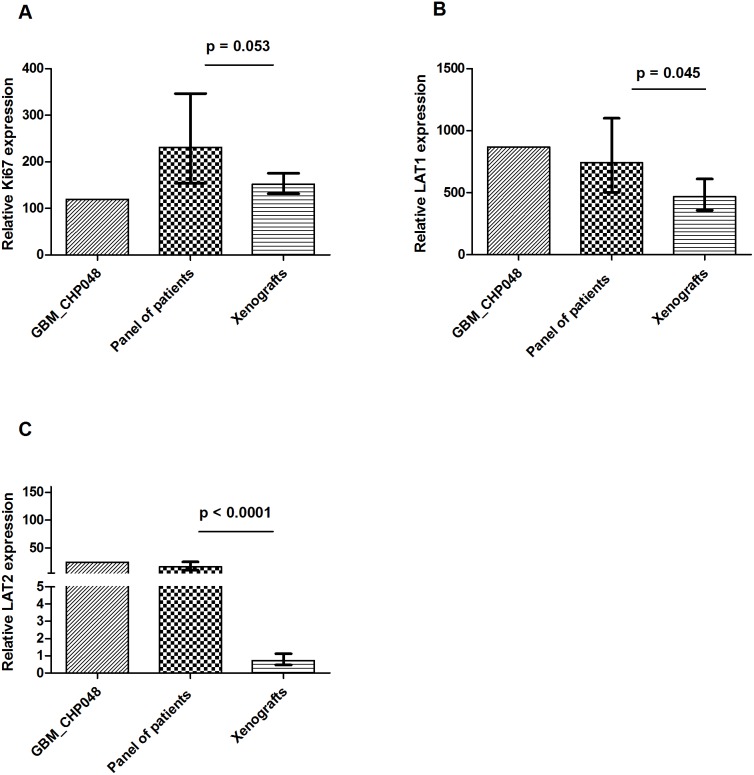
The relative tumor-to-brain (T/B) ratio of SUV max was significantly lower after one week (123 ± 6%, n = 7 vs. 147 ± 6%, n = 7; p = 0.018) and after two weeks (142 ± 8%, n = 5 vs. 204 ± 27%, n = 4; p = 0.047) in the CPT-11 group compared with the control group. Strong negative correlations between SUV max T/B ratio and LAT1 (r = -0.62, p = 0.04) and LAT2 (r = -0.67, p = 0.02) were observed. In addition, a strong positive correlation between LAT1 and Ki67 was detected in xenografts. Furthermore, a 1.6 fold higher expression of LAT1 and a 23 fold higher expression of LAT2 were observed in patient specimens compared to xenografts.
18F-FET MicroPET can be used to detect a treatment response to CPT-11 in GBM xenografts. The strong negative correlation between SUV max T/B ratio and LAT1/LAT2 indicates an export transport function. We suggest that 18F-FET PET may be used for detection of early treatment response in patients.
脑肿瘤成像具有挑战性。尽管18F-FET PET在临床上广泛应用,但18F-FET MicroPET评估异种移植脑肿瘤的价值迄今尚未得到评估。因此,本研究的目的是评估体内18F-FET MicroPET检测异种移植瘤治疗反应的性能。此外,还研究了18F-FET肿瘤摄取与Ki67以及氨基酸转运体LAT1和LAT2基因表达之间的相关性。此外,还比较了异种移植瘤和存档患者肿瘤中Ki67、LAT1和LAT2的基因表达。
将人胶质母细胞瘤细胞原位注射到裸鼠体内,每周进行MicroPET/CT监测18F-FET摄取情况。观察到肿瘤形成后,小鼠每周接受CPT-11或生理盐水治疗。治疗两周后,分离脑肿瘤,并对异种移植瘤和存档患者肿瘤标本同时进行定量聚合酶链反应。
与对照组相比,CPT-11组在1周后(123±6%,n = 7 vs. 147±6%,n = 7;p = 0.018)和2周后(142±8%,n = 5 vs. 204±27%,n = 4;p = 0.047)SUV max的相对肿瘤与脑(T/B)比值显著降低。观察到SUV max T/B比值与LAT1(r = -0.62,p = 0.04)和LAT2(r = -0.67,p = 0.02)之间存在强负相关。此外,在异种移植瘤中检测到LAT1与Ki67之间存在强正相关。此外,与异种移植瘤相比,在患者标本中观察到LAT1表达高1.6倍,LAT2表达高23倍。
18F-FET MicroPET可用于检测胶质母细胞瘤异种移植瘤对CPT-11的治疗反应。SUV max T/B比值与LAT1/LAT2之间的强负相关表明存在输出转运功能。我们建议18F-FET PET可用于检测患者的早期治疗反应。